
Automated Gates: The Complete UK Buyer's Guide
Everything you need to know before buying automated gates in the UK — types, costs, safety standards, access control, and how to choose the right installer.
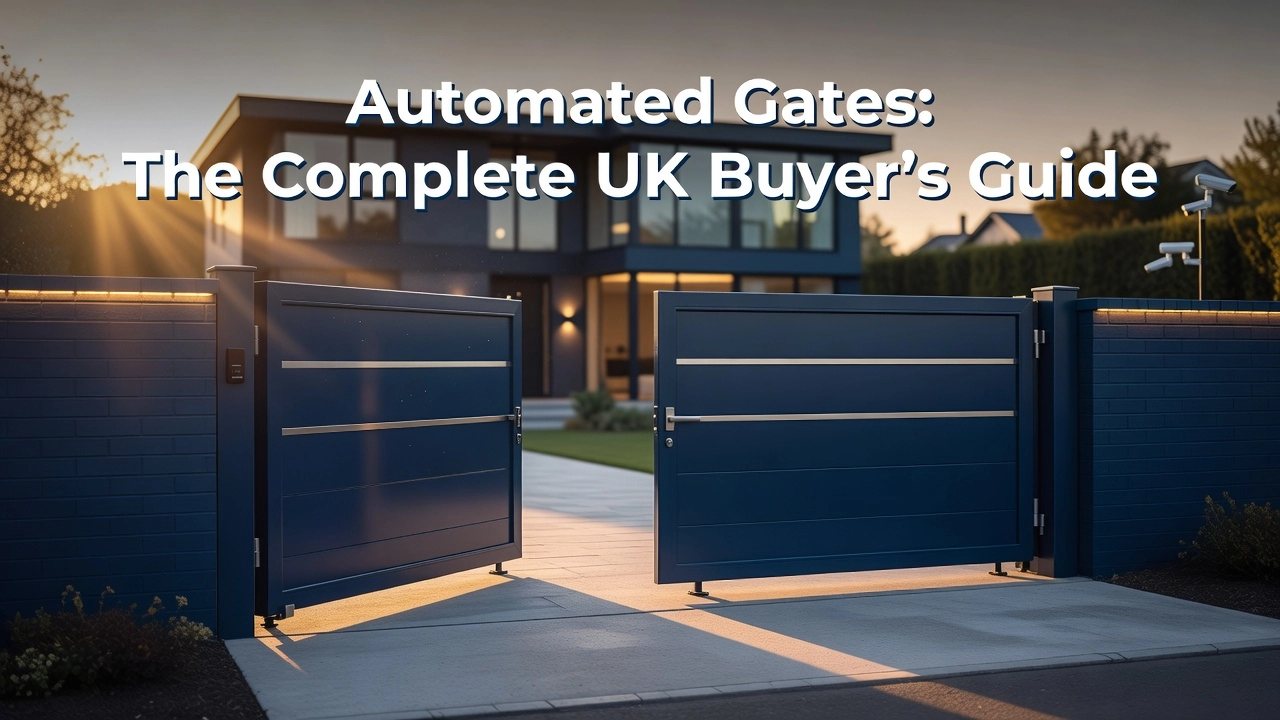
Your property's entrance makes a statement before anyone even reaches your front door. For homeowners and businesses across the UK, automated gates have become the go-to solution for combining security, convenience, and kerb appeal in one investment. But with so many options, regulations, and technical considerations to navigate, choosing the right system can feel overwhelming.
Whether you're weighing up swing gates versus sliding gates, trying to understand safety standards, or simply wondering what a realistic budget looks like, this guide has you covered. We've put together a comprehensive resource that walks you through everything you need to know before making your purchase.
From selecting the right gate type for your property layout to understanding UK-specific legal requirements and maintenance expectations, each section is designed to give you practical, actionable information. No jargon, no unnecessary complexity, just clear guidance that helps you make a confident, informed decision. By the time you've finished reading, you'll know exactly what to look for, what questions to ask installers, and how to get the best possible value from your investment in automated gates.
Why Automated Gates Are Worth the Investment
Automated gates have moved firmly into the mainstream. The UK automatic gate and door opening system market was valued at $720 million in 2024 and is projected to reach $1,410 million by 2035, growing at a compound annual rate of 6.3%. That trajectory is driven by rising security concerns, urban expansion, and the rapid integration of smart home technology into everyday property management. These are not niche luxury products for a handful of high-net-worth buyers; they are increasingly standard infrastructure for residential, commercial, and agricultural properties across the UK.
The residential segment leads this demand convincingly. Homeowners account for approximately 56% of the global automatic gate opening system market in 2026, confirming that the primary motivation behind most gate automation projects is household security. That figure matters because it signals alignment with broad consumer behaviour rather than a specialist trend. If the majority of gate buyers are homeowners prioritising security, the investment reflects a widely held judgment about value, not an outlier decision.
The practical return on that investment is straightforward to quantify. Automated gates create an immediate physical deterrent to opportunistic intrusion, removing the ease of access that an unguarded driveway provides. Beyond security, the daily convenience is substantial; there is no longer any need to leave the vehicle in heavy rain or on a dark winter evening to open and close ironwork by hand. Modern systems integrate with video entry intercoms, smartphone apps, and wider smart home platforms, giving property owners complete visibility and control over who enters their site.
For properties in East Sussex, West Sussex, and Kent, gated entrances carry a recognised premium in the local market. Estate agents consistently identify security features and kerb appeal as factors that influence both valuation and time-to-sale, particularly for detached homes, rural plots, and commercial premises. A well-designed automated entrance communicates quality and seriousness to prospective buyers or tenants before they even reach the front door.
Finally, manual gate fatigue is a genuine and frequently underestimated driver. Owners of larger driveway gates often discover only after installation that the daily effort of operating heavy ironwork is a significant quality-of-life issue; automation resolves it entirely.
Types of Automated Gates: Swing, Sliding, and Everything in Between
Choosing the right type of automated gate is one of the most consequential decisions in any installation project, and the options extend well beyond a simple swing or slide choice. Gate type, material, and automation system are deeply interconnected, and selecting one without considering the others is a reliable route to expensive compromises down the line.
1. Sliding Gates: The Dominant Choice for Practical Sites
Sliding gates currently account for 51% of the global automated gate product segment in 2026, and the reason is straightforwardly practical. A sliding gate travels parallel to the fence or boundary line, requiring no clearance arc either in front of or behind the gate leaf. This makes them the natural solution for sloped driveways, tight urban entrances, and high-traffic commercial sites where a swinging gate would either fail to open fully or create a collision hazard. For gated communities, country clubs, and commercial properties processing significant vehicle volumes, sliding automated gates are specifically identified as best suited for wide, high-traffic entrances. The 2026 guide to swing, sliding, and automatic gate types reinforces that sliding gates demand only lateral run-back space, which is almost always easier to accommodate than a full swing arc.
2. Swing Gates: The Residential Standard Where Conditions Permit
Swing gates, whether single-leaf or bi-parting, remain the most widely specified option for residential driveways across the UK, particularly where the ground is level and the driveway provides adequate clearance. They suit traditional, heritage, and period property styles extremely well, and for standard-width openings they are typically the more cost-effective choice at the point of installation. The critical caveat is site suitability; swing gates require flat ground and a clear arc. Attempting to install a double-swing gate on a sloped driveway without proper assessment is precisely the kind of error that results in a costly retrofit to an entirely different gate type.
3. Cantilever Sliding Gates: Premium Engineering for Difficult Surfaces
Cantilever sliding gates remove the ground track entirely. The gate is supported by counterbalanced rollers fixed to structural posts, meaning no floor channel is required. This is particularly valuable for gravel driveways, uneven ground, or any surface where a floor-mounted track would become blocked or damaged. The long-term maintenance saving on track cleaning and repair is a genuine operational benefit, not just an aesthetic one. Cantilever systems do carry a higher upfront fabrication and installation cost due to the structural demands of the counterbalance design, but for properties where ground conditions make a standard tracked sliding gate impractical, they are the correct solution rather than a luxury upgrade.
4. Materials, Bespoke Fabrication, and the Automation Interdependency
Material selection shapes every downstream decision. Mild steel with powder coating, hot-dip galvanised steel, aluminium, and wrought iron each carry different weight, maintenance, and longevity profiles. A significant 2026 design trend in the residential sector is the mixed-material gate: metal frames, typically steel or aluminium, infilled with timber boards or composite cladding to deliver a warmer, more contemporary aesthetic than solid metal. These designs require careful engineering because timber infill adds weight, and gate weight directly determines which automation system can be specified.
This interdependency between fabrication and automation is precisely why sourcing both from a single supplier produces consistently better outcomes. A supplier designing the gate and specifying the operator together will engineer the leaf width, weight distribution, and hinge or roller configuration to match the motor's rated capacity from the outset. Catalogue gates, available in standard sizes at lower upfront cost, frequently require compromise on dimensions, material finish, or design detail. For non-standard openings, listed buildings, or buyers with defined design requirements, a bespoke CNC plasma-cut gate fabricated to exact dimensions is not merely a premium option; it is often the only option that actually fits and functions correctly.
How Gate Automation Works: Drive Technology Explained
Understanding what happens inside a gate automation system helps you make smarter decisions about which technology suits your property, budget, and usage patterns. Every automated gate relies on a drive mechanism to convert electrical energy into controlled mechanical movement, and the choice of drive type has significant implications for installation, aesthetics, maintenance, and long-term reliability.
Electromechanical systems are the dominant technology in 2026, accounting for the majority of new residential and commercial installations. These systems pair an electric motor with a mechanical linkage to move the gate leaf, combining proven engineering with modern electronics. Their appeal lies in low maintenance requirements, long operational lifespans, and seamless compatibility with the access control and smart home systems that buyers increasingly expect as standard. The four principal drive configurations within this category are underground actuators, above-ground ram actuators, rack and pinion systems, and worm-drive operators, each suited to specific gate types and application contexts.
Underground Actuators
For premium swing gate installations, underground actuators represent the gold standard. The entire motor housing is buried beneath the gate post or threshold slab, concealing all mechanical components from view. This approach delivers a clean, uninterrupted aesthetic that architects and discerning homeowners favour, while simultaneously protecting the mechanism from weather exposure, accidental impact, and tampering. The civil groundwork required adds to installation cost and complexity, but for properties where visual finish matters, the result is a gate that appears to move entirely under its own volition.
Above-Ground Ram Actuators
Above-ground linear actuators mount visibly on the gate post and leaf, making them considerably more straightforward to install and service. Because the mechanism is accessible without excavation, maintenance and repair work is faster and less costly. This makes ram actuators a practical, reliable choice for agricultural gates, rural access points, and commercial sites where operational uptime matters more than visual subtlety. According to the automatic driveway gates buyer's guide for 2026, this category encompasses some of the most widely deployed operators in working farm and light commercial environments.
Rack and Pinion for Sliding Gates
Rack and pinion drive is the established standard for sliding gate automation. A toothed steel rack is welded along the gate's bottom rail; a motor-mounted pinion gear engages this rack to drive the gate laterally along its track. The system delivers consistent, high-torque movement capable of handling substantial gate weights across high-cycle commercial environments. Modern rack and pinion operators increasingly incorporate encoder-based position feedback, replacing traditional mechanical limit switches to improve precision and reduce servicing intervals.
Hydraulic, Solar, and Smart Systems
Hydraulic operators occupy a specialist niche, deploying a pressurised fluid circuit to drive a piston and move very large or very heavy gate structures that exceed standard electromechanical capacity. They are less common outside large commercial and industrial settings due to higher equipment costs and the added complexity of fluid-system maintenance.
Solar-powered automation is a growing priority in 2026, particularly for rural properties and agricultural sites across Sussex and Kent where running mains cable to a remote gate position is impractical or cost-prohibitive. A 12V or 24V DC motor paired with a solar panel and rechargeable battery pack can deliver fully autonomous operation with zero ongoing energy cost, making it an increasingly attractive specification for off-grid entrances.
Smart connectivity has shifted from a premium add-on to a baseline expectation. Most current electromechanical operators are available with integrated GSM modules, Wi-Fi, or Bluetooth, enabling control through smartphone apps, voice assistant commands, and integration with home automation platforms including Control4 and KNX. This connectivity layer transforms the gate from a standalone mechanism into an active component of a broader property security and access control ecosystem, a capability that aligns directly with how modern buyers expect their homes and commercial premises to function.
Access Control Integration: Intercoms, Keypads, and Video Entry
Access control systems are now the largest single component segment of the entire automatic gate and door opening market, accounting for 34.6% of market share in 2025. That figure tells you something important: buyers are not shopping for a gate motor in isolation. They are investing in a complete access management solution, and the intercom, keypad, or camera they specify is often just as important as the gate itself.
The Access Control Technology Spectrum
The range of options available for automated gates in 2026 is broader than many buyers realise. At the simpler end, audio intercoms and PIN keypads provide cost-effective entry management for lower-traffic residential driveways. Moving up in capability, wired and wireless video intercoms, proximity key fobs, GSM telephone entry systems, ANPR (automatic number plate recognition), and biometric readers each address different use cases. GSM systems, for example, allow a visitor to call a landline or mobile directly from the gate column, making them a practical, low-infrastructure choice for rural or agricultural properties where broadband connectivity may be limited. Selecting the right combination depends on three variables: the property type, the expected volume of daily visitors, and the specific security requirements of the site.
Video Intercoms and Smartphone Integration
For new residential installations, video intercom with smartphone connectivity has become a baseline expectation rather than a premium add-on. The workflow is straightforward: a visitor presses the call button at the gate column, the homeowner receives a push notification on their smartphone, views a live video feed of the visitor, and releases the gate remotely. This can happen from the kitchen, from the office, or from another country entirely. The commercial video door entry intercom market is projected to grow at a CAGR of 14.7% from 2026 to 2033, the highest growth rate of any single access technology category, which reflects how rapidly this format has become the consumer standard across both residential and commercial sectors.
Scalable Credentials for Commercial Sites
For commercial premises, multi-occupancy developments, and business parks, proximity fob and card reader systems deliver a scalable and auditable solution that audio intercoms simply cannot match. Each user receives an individual credential that can be activated or deactivated remotely through a cloud management platform, without any physical rekeying of the site. When a member of staff leaves, their access is removed in seconds. When a contractor needs temporary access, a time-limited credential is issued and automatically expires. This level of granular control, combined with a full timestamped log of every entry and exit, is exactly what facilities managers and security-conscious business owners require.
ANPR: Frictionless Entry at Higher-Security Sites
Automatic number plate recognition is increasingly specified for sites where convenience and security must coexist. Registered vehicles trigger the gate automatically as they approach, with no driver action required, no fob to carry, and no PIN to enter. Beyond convenience, every vehicle movement generates a timestamped record, providing an audit trail that satisfies both internal security policies and, in some regulated environments, compliance obligations. AI-enabled video analytics have made ANPR more accessible and accurate, with modern systems capable of vehicle classification and tailgating detection alongside basic plate recognition.
Specify Access Control and Automation Together
The most common mistake in gate access control projects is treating the two disciplines as separate procurement decisions. Column positions, underground cable routes, intercom post foundations, conduit sizing, and power supply capacity all need to be planned from the outset. A video intercom column requires a different foundation specification to a simple keypad post. A wired video system requires a multicore cable run that must be installed before groundworks are completed. Retrofitting access control to an existing automated gate is possible but almost always results in compromise, whether in cable routing, aesthetics, or system reliability. Working with a single installer who designs and delivers the full scope, from fabrication and automation through to access control, eliminates those compromises entirely.
Upgrading Existing Manual Gates to Automated: What Is Involved
Upgrading a manual gate to an automated system is one of the most practical and cost-effective improvements a property owner can make, and it is a segment growing rapidly across the UK. Crucially, many homeowners do not realise they can retain their existing ironwork entirely. Provided the gate structure is sound, a retrofit automation kit can be fitted without replacing the gates themselves, preserving the original character of the entrance while adding the convenience and security of full electric operation. Smart home adoption has accelerated this trend considerably, with app-based gate control and remote access now standard consumer expectations rather than luxury additions.
Suitability Assessment: The Essential Starting Point
Before any motor is specified or purchased, a professional suitability assessment is non-negotiable. The existing gate must be structurally sound, correctly hung, and supported by adequate post foundations. Automation systems have defined weight and width tolerances; swing gate retrofit kits are available for leaves ranging from lightweight residential ironwork up to 750 kg per leaf at 6 metres, meaning most standard UK driveway gates fall within automatable parameters once properly assessed. A site survey by a qualified installer is the only reliable way to confirm compatibility, because mismatched motors and gate weights are a leading cause of retrofit failures, producing jamming, uneven movement, and accelerated wear.
Gate Condition and Remedial Fabrication
Gate geometry matters as much as gate weight. Hinges, posts, and frame welds must all be inspected carefully, as gates that have dropped, twisted, or corroded are not suitable candidates for direct automation. Attempting to fit a motor to a poorly hung gate transfers stress unevenly through the drive mechanism, shortening motor life significantly and producing unreliable, potentially unsafe operation. Remedial fabrication work, including hinge reinforcement or replacement and weld repairs, must be completed before any automation component is installed. This is a step that an experienced provider combining fabrication and automation expertise can handle within a single managed workflow, avoiding the coordination burden of using separate contractors.
Power Supply and Cabling Planning
A reliable 240V AC mains supply must be routed to the gate position, which typically requires a qualified electrician to run armoured cable from the consumer unit to the gate column. This is a project cost buyers should budget for explicitly, as it is separate from the gate motor and control system supply and installation. Solar-powered alternatives are a growing option for properties where cable routing is disruptive or impractical. Regardless of power source, this is also the stage at which intercom and access control cabling should be installed. Running all ground channels simultaneously avoids the significant disruption and added cost of excavating the same route twice, a point that is easy to overlook when scoping a project for the first time. Reviewing how to retrofit existing gates with automation can help property owners understand the full scope before engaging an installer.
Portara manages the complete upgrade process for existing manual gates across East Sussex, West Sussex, and Kent. From the initial structural assessment and any required fabrication remediation through to automation installation and access control integration, every stage is handled as a single coordinated project, giving property owners a clear scope, a single point of accountability, and a finished entrance that performs reliably from day one.
UK Safety Standards for Automated Gates: What BS EN 12453 Means for Buyers
Safety is not an afterthought when it comes to automated gates; it is the foundation every compliant installation must be built upon. BS EN 12453 is the UK and European standard that specifies maximum permissible force limits for power-operated pedestrian and vehicle gates. Its purpose is straightforward: to prevent entrapment injuries, which remain one of the most serious risks associated with incorrectly installed or poorly maintained automated gate systems. The current operative version is BS EN 12453:2017+A1:2021, which consolidated what were previously four separate standards into a single, comprehensive framework, and was described by the HSE as a major step forward in defining state-of-the-art safety requirements.
Force Limitation and How Compliance Is Achieved
Under BS EN 12453, gate operators must limit the force applied during movement to levels that will not cause injury upon contact with a person or obstruction. Compliance is not achieved by a single device in isolation; it requires a combination of correctly configured motor torque settings, safety edge sensors on the leading edge of the gate leaf, infrared photocells positioned across the gate opening, and in certain installations, loop detectors embedded in the ground. Each element plays a defined role, and the standard requires that force levels are kept below the specified maximum, not simply at the limit.
What a Compliant Installation Must Include
A properly compliant installation will incorporate several specific safety devices as standard. Obstruction detection photocells create an infrared beam across the gate opening that halts and reverses the gate immediately if broken during movement. Safety edges fitted to the leading edge of the gate leaf detect physical contact and trigger the same halt-and-reverse response. Warning lamps must activate during gate movement to alert anyone nearby. A manual release mechanism must also be fitted, allowing the gate to be operated by hand in the event of a power failure. These are not optional extras; they are requirements under BS EN 12453, and a compliant installer will include all of them without negotiation.
Legal Obligations and Liability
The Machinery Directive 2006/42/EC, retained in UK law post-Brexit, requires automated gate systems to carry UKCA marking and be accompanied by a Declaration of Conformity handed to the customer at installation. Buyers should request this document as a matter of course. Choosing a non-compliant installer or opting for a DIY kit installation carries serious consequences: if a person is injured by a gate that does not meet BS EN 12453, the property owner may bear direct legal and financial liability. Compliance is a legal requirement, not a commercial preference.
Questions to Ask Any Installer
When evaluating gate automation specialists, ask directly whether they will provide a Declaration of Conformity, conduct a full risk assessment to BS EN 12445, and install every required safety device as described above. A reputable, qualified installer will confirm all of this immediately. If an installer hesitates, cannot confirm these points, or offers a significantly lower price by omitting safety components, that is a clear warning sign worth taking seriously.
Agricultural and Rural Gate Automation: Special Considerations
Agricultural and rural gate automation is one of the most practically compelling applications in the entire sector, yet it remains almost entirely ignored by national suppliers and mainstream content alike. Across East Sussex, West Sussex, and Kent, working farms, equestrian yards, smallholdings, and large rural estates all share a common operational reality: gates are opened and closed many times each day, by a rotating cast of contractors, feed merchants, vets, farriers, and delivery drivers. That volume of daily access demand makes automation not a convenience but a genuine operational requirement, and it is a requirement that catalogue suppliers are frequently ill-equipped to meet.
Engineering for Agricultural Conditions
Farm and field gates present a fundamentally different set of engineering challenges compared to a standard residential driveway installation. Openings of 4 to 6 metres are common, and wider spans are not unusual on estate or arable properties. Five-bar and heavy tubular steel gate construction adds significant weight compared to domestic aluminium or mild steel designs, and the ground conditions at a field entrance are often unpaved, rutted, or prone to seasonal movement. These factors combine to push product selection firmly toward heavy-duty operators with high cycle-count ratings, deeper post foundations, and robust mounting arrangements. A residential-grade operator installed on a farm gate will not last; the specification must match the environment from the outset.
Solar Power for Remote Field Gates
Mains power is rarely available at a field gate, and the cost of trenching a cable from the nearest supply is often prohibitive. Solar-powered 24V DC automation systems with battery backup have become the default solution for remote agricultural installations, and modern systems are now sufficiently reliable for year-round UK operation, including low-light winter months. Battery reserves ensure that the system continues to operate during extended overcast periods, a practical necessity given the UK climate. No groundworks are required for power supply, which also reduces installation cost and disruption considerably.
Access Control: Simplicity Over Sophistication
On agricultural sites, the priority for access control is robustness and ease of use rather than technological complexity. A GSM telephone entry unit is the most widely used solution: when a visitor presses the call button, the system dials the owner's mobile directly, and a single authorised key press opens the gate. No broadband connection, no server, and no app dependency are required at the gate itself. Temporary access codes can be issued to vets, milk tankers, or contractors without any reprogramming of the gate system, making day-to-day management straightforward.
Livestock Safety and Obstruction Detection
The presence of animals near an automated gate introduces safety considerations that simply do not arise in residential contexts. Obstruction detection sensitivity must be calibrated carefully; a system set to residential parameters may respond inappropriately to a large animal moving near the gate line. Auto-close timers, which return the gate to the closed position after a set interval, are a particularly valuable feature on farm installations, directly addressing the common concern of a gate being left open and livestock straying. These parameters should be assessed and configured as part of the installation design process, not adjusted retrospectively.
Portara has direct experience designing, fabricating, and automating gates for farm, estate, and equestrian properties across East Sussex, West Sussex, and Kent. Unlike catalogue suppliers, Portara can manufacture bespoke five-bar and heavy tubular steel gates to fit non-standard field openings and automate them with operators correctly specified for agricultural duty cycles, delivering a complete solution from fabrication through to access control commissioning.
What Automated Gates Cost: Investment Ranges and Return on Value
Pricing is one of the most searched topics in gate automation, and also one of the most misleading. Any source quoting a single fixed price for an automated gate installation without accounting for gate type, size, material, drive system, access control specification, groundworks complexity, and proximity to mains power should be treated with considerable scepticism. These variables interact significantly, and the difference between a basic automation project and a fully specified bespoke installation can be substantial.
Residential Swing Gate Investment Tiers
For UK residential properties in 2026, broad investment tiers provide a more honest framework than single figures. At the entry level, automating an existing pair of steel swing gates with a standard above-ground actuator system and basic fob control typically starts from the low thousands in pounds. This assumes the gates are structurally sound, the posts are adequate, groundworks are minimal, and a power supply is already accessible nearby. At the upper end of the residential spectrum, a full project encompassing bespoke fabricated gates, underground linear actuators, video intercom, UKCA-compliant safety edges and photocells, and a GSM or app-based access system represents a considerably larger investment. That figure varies with specification, site conditions, and the complexity of the metalwork involved. UKCA compliance requirements and the engineering standards demanded by BS EN 12453 add specification cost that budget online guides routinely omit.
Sliding Gates and the True Cost Comparison
Sliding gate projects generally carry a higher base cost than equivalent swing gate installations. The gate leaf must incorporate a ground-level rack, the motor assembly must be rated for greater weight, and the structural specification of the gate itself is more demanding. However, on sloped or restricted driveways where swing gates would require significant groundworks to create level arc clearance, a sliding solution can offset part of that premium by eliminating costly foundation work. Buyers should evaluate total installed cost across both configurations before assuming swing gates are the cheaper option for their specific site.
Plan Access Control Costs Upfront
Access control additions are incremental costs that are far more economical when planned from the outset. Installing cable ducting for a video intercom, ANPR camera, or keypad entry system during the initial groundworks phase adds relatively little to project cost. Retrofitting the same infrastructure after completion, which requires reopening ground channels and reinstating surfacing, is substantially more expensive. Specifying access control requirements in full at the design stage is always the better financial decision.
Return on Value and Ongoing Ownership Costs
In the East Sussex, West Sussex, and Kent property market, gated entrances carry real buyer appeal, particularly for detached homes, period properties, and rural settings where privacy and security carry weight at point of sale. Automated gates are a visible, functional feature that contributes positively to kerb appeal and buyer perception in a way that less tangible upgrades do not.
On the ownership side, realistic total cost of ownership over a 10 to 15 year system lifespan should include annual maintenance visits, which are recommended by installers and motor manufacturers to preserve warranty coverage and maintain safety compliance. Modern DC gate operators consume very low electricity in normal use, keeping running costs minimal. Periodic safety device testing adds a small but necessary ongoing cost. Factoring these elements into the initial investment decision gives a far more accurate picture of long-term value than purchase price alone.
Local Specialist vs. National Supplier: Why It Matters for Automated Gates
The motor brand printed on a gate operator tells you very little about whether your installation will perform reliably, comply with UK safety law, or hold up under daily use for the next decade. Global manufacturers such as FAAC, CAME, BFT, and Nice produce high-quality hardware that reputable installers specify with confidence. But the motor is one component within a system that also includes control electronics, safety photocells, limit switches, manual release mechanisms, and an access control interface. Every one of those elements must be correctly specified for the gate's weight, dimensions, usage frequency, and site conditions. The fabrication quality, installation accuracy, and safety compliance are determined entirely by the installer, not the motor brand.
What Online Kit Suppliers Cannot Provide
National suppliers and online kit retailers can ship a box of components. They cannot conduct a site survey, assess ground conditions, fabricate a gate to the correct specification, or commission a safety system that meets BS EN 12453. As covered earlier in this guide, that standard places legal responsibility on the installer and the owner. Buyers who purchase automation kits without professional involvement are not simply taking a technical risk; they are accepting personal liability for a non-compliant installation on a powered, moving structure. The hardware being branded does not change that exposure.
The Integrated Model and Accountability
When fabrication, automation, and installation are split across separate contractors, accountability fragments. If the gate binds, the fabricator points to the motor; if the motor faults, the motor supplier points to the fabrication. A local specialist who designs, fabricates, and installs in-house eliminates that coordination problem entirely. The gate is built to the automation system's specifications from the outset, and a single team is accountable for every element of the outcome. This matters practically when something needs adjusting, and it matters contractually when something goes wrong.
Regional Knowledge That Cannot Be Replicated Remotely
A regional installer understands the local planning context that national teams cannot anticipate without a visit. In East Sussex and Kent, that includes permitted development thresholds near listed buildings and conservation areas, highway visibility splay rules for gates opening onto public roads, and the effect of local ground conditions, including clay shrinkage and chalk drainage profiles, on post foundations and sliding gate track stability. These are not generic considerations. They are site-specific variables that a local specialist encounters on every project across the area.
Aftercare Is Not a Secondary Concern
Automated gates are security-critical infrastructure. When a safety sensor triggers unexpectedly or a motor develops a fault, the response time matters. A local specialist can typically attend the same day or within 24 hours. National providers frequently operate on multi-day call-out schedules or route initial queries through a remote service centre before dispatching an engineer, who may have no familiarity with the specific installation.
Portara's fully integrated model addresses each of these variables directly. CNC plasma fabrication, gate automation, and access control installation are handled by a single team, working from an initial site survey through to post-installation support across East Sussex, West Sussex, and Kent. The gate is designed as a complete system from day one, with no handoff risk between contractors and no gap in accountability after installation.
Automated Gate Design Trends Worth Knowing in 2026
Gate design is evolving rapidly, and 2026 brings a distinct set of aesthetic and specification priorities that any buyer, architect, or developer should understand before committing to a new installation.
1. Minimalist Aesthetics Are Defining New Installations
Clean horizontal or vertical bar designs with tight, even spacing have become the dominant choice for new residential automated gates in 2026. Ornate scroll ironwork, once the default for high-end properties, now reads as dated against contemporary architectural exteriors. Flush post columns, uncluttered infill patterns, and the complete absence of ornamental detailing are what specifiers are requesting. This shift reflects broader trends in exterior architecture, where restraint and geometric precision carry more visual authority than decorative complexity. For properties across East Sussex and Kent, where new builds and barn conversions increasingly favour crisp, understated elevations, a minimalist gate design reinforces rather than contradicts the overall aesthetic.
2. Mixed-Material Designs Combine Structural and Sensory Appeal
Steel-framed gates with timber or composite infill panels are emerging as a compelling middle ground for buyers who want automation compatibility without sacrificing warmth. The steel frame provides the structural rigidity and mounting precision that gate automation requires, while the timber or composite panels introduce natural texture and visual softness that pure metal designs cannot replicate. This combination is particularly well-suited to rural and semi-rural properties in East Sussex and Kent, where a wholly industrial aesthetic can feel incongruous against mature hedgerows and traditional brickwork.
3. Integrated Lighting Is Becoming a Standard Specification
LED strip lighting recessed into gate posts, ground uplighting along approach paths, and illuminated intercom columns are increasingly specified as part of a complete entrance design rather than added as afterthoughts. Beyond aesthetics, integrated lighting materially improves the performance of entrance security cameras by maintaining consistent illumination levels at night, reducing shadow zones, and improving image clarity for video intercom systems.
4. Colour Trends Have Moved Beyond Black
Anthracite grey (RAL 7016), deep forest green, and dark charcoal tones have largely displaced traditional gloss black as the powder coat of choice for new gate installations. These finishes complement contemporary cladding materials, natural stone, and landscaped surroundings more convincingly than black does. Bespoke fabricated gates can be powder coated in any RAL colour, which is a significant practical advantage; catalogue products typically ship in a handful of standard finishes, limiting design flexibility at precisely the point where colour harmony matters most.
5. Architectural Alignment Elevates the Entire Entrance
The most considered gate installations in 2026 treat the entrance as an architectural element rather than a functional add-on. Buyers and specifiers are selecting gate designs that deliberately echo details found elsewhere on the property: window frame profiles, balustrade geometries, boundary fencing rhythms, and even roof lantern proportions. This level of coordination produces an entrance that reads as intentional and coherent. It is only achievable with a gate designed and fabricated specifically for the property; no catalogue product can replicate the precision alignment that bespoke fabrication makes possible.
Making the Right Choice for Your Property
The right approach to specifying an automated gate follows a clear sequence: gate type and material first, automation system second, access control third. Each layer depends entirely on the one before it. Gate type determines motor requirements; motor specification then defines which access control platforms will integrate cleanly. Getting this order wrong creates costly retrofitting problems that a methodical approach avoids entirely.
Compliance is non-negotiable. Any installer you appoint must issue a Declaration of Conformity confirming the completed installation meets BS EN 12453 and UK Machinery Directive requirements. Property owners who commission non-compliant installations carry personal legal liability for the outcome. This single document separates a responsible installer from one who should be avoided.
Choosing a single integrated supplier who handles fabrication, automation, and access control removes the accountability gaps that fragmented supply chains create. Fewer handoffs mean better outcomes and clearer responsibility if anything requires attention.
The most practical next step is booking a free site survey. Portara's surveys cost nothing, establish the true project scope, and remove the guesswork from budgeting before any commitment is made.
Portara designs, manufactures, and installs automated gate systems across East Sussex, West Sussex, and Kent, covering residential, commercial, and agricultural projects from initial design through to ongoing support.
Conclusion
Investing in an automated gate is one of the most impactful upgrades you can make to your property. To recap the essentials: choosing between swing and sliding gates depends on your available space and layout; UK safety standards are non-negotiable and must be met by any reputable installer; your budget should account for installation, maintenance, and long-term running costs; and the right system will genuinely enhance both security and kerb appeal for years to come.
Now that you have the knowledge, the next step is yours to take. Get at least three quotes from certified UK installers, ask the right questions, and don't settle until you find a solution that fits your property perfectly.
Your entrance sets the tone for everything beyond it. Make it count.