
Beyond Gates: Railings, Balustrades and Screens to Drawings
Bespoke railings, balustrades, bin stores and privacy screens fabricated to your drawings across East Sussex, West Sussex and Kent. Request a quote.
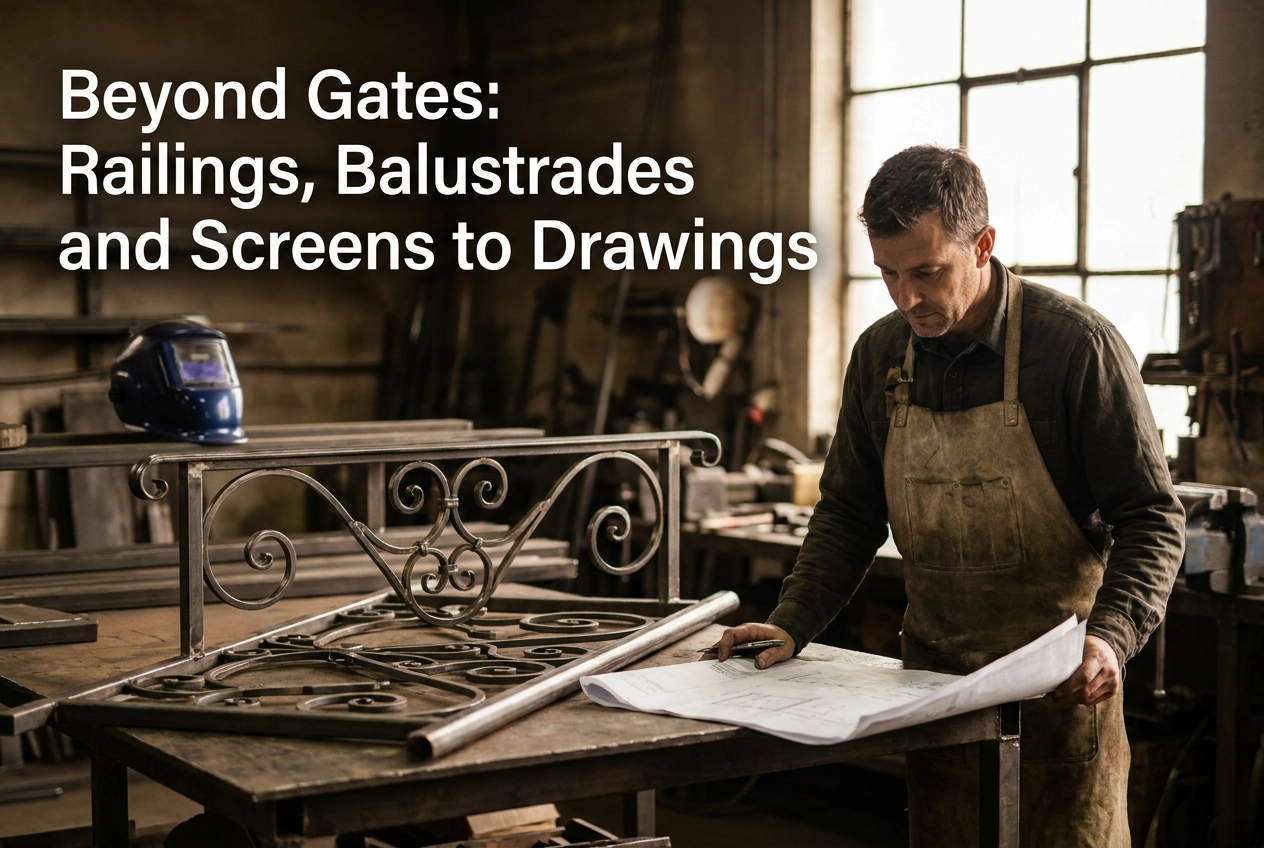
Your bespoke gate already proves the point: accurate cutting, square welded frames, and a finish that survives British weather are the hard part of external metalwork. The same workshop skills often extend into railings, balustrades, bin stores and privacy screens. That is where architectural metal fabrication becomes a practical next step, not a leap into structural steel contracting.
This tutorial walks through what a gate fabricator can genuinely deliver. You will learn how drawings become CNC-cut components and welded assemblies; how galvanising and powder coating protect external metal; and where the limits sit when structural steel is outside scope. We also cover Approved Document K, the information to send with a fabrication enquiry, and the route from quotation to survey, fabrication and fitting. Along the way, we look at bespoke metal fabrication across East Sussex, West Sussex and Kent, answer common questions, and explain how to request a quote from your drawings.
Architectural Metal Fabrication Beyond Gates
Our bespoke fabrication capability, accurate cutting, square welded frames and a finish chosen for exterior exposure, extends directly into railings, balustrades, bin stores and privacy screens. This is edge-level architectural metalwork. It guards, screens, encloses and divides, and it is fabricated to a drawing rather than sized by a structural calculation. The common gap is between an approved drawing and a fitted element: a developer, architect or contractor has a specification and a programme, but no workshop lined up to cut, weld, finish and fix the metalwork. Commissioning from one fabricator removes the handover problem, because the frame, the infill spacing, the brackets and the finish are all made and checked against the same drawing. Typical enquiries include privacy screens between neighbouring gardens, balustrade runs for steps and terraces, bin store enclosures for flats and commercial units, and replacement railings matched to an existing profile. Our bespoke fabrication service is the starting point for this work.
From Drawing to Fitted Metalwork: CNC Cutting, Welded Frames and Fabrication
Every job starts with the same paperwork: a dimensioned drawing or a measured sketch setting out overall dimensions, fixing centres, panel or baluster spacing, and any existing profile to be matched. That document, not the steel, decides whether the finished run lines up.
Components are cut by CNC plasma, which produces consistent, repeatable profiles across a run. Thermal cut quality can be classified under ISO 9013 where the drawing calls for it, so it is specified rather than assumed.
Frames are then welded and checked for square. On runs of identical bays they are dry-assembled, so bay four lines up like bay one.
Fabrication follows the fitting sequence. Base plates, brackets and fixing centres are set out during manufacture so the element arrives ready to align on site rather than needing adjustment in mid-air.
Where no drawing exists, we can measure the run and set out the layout for your approval before any steel is cut. That keeps a bespoke metal fabrication project moving without you needing a CAD package, the same logic that makes custom-made gates outperform off-the-shelf alternatives where the opening is anything but standard.
Finishes for External Metalwork: Galvanising and Powder Coating
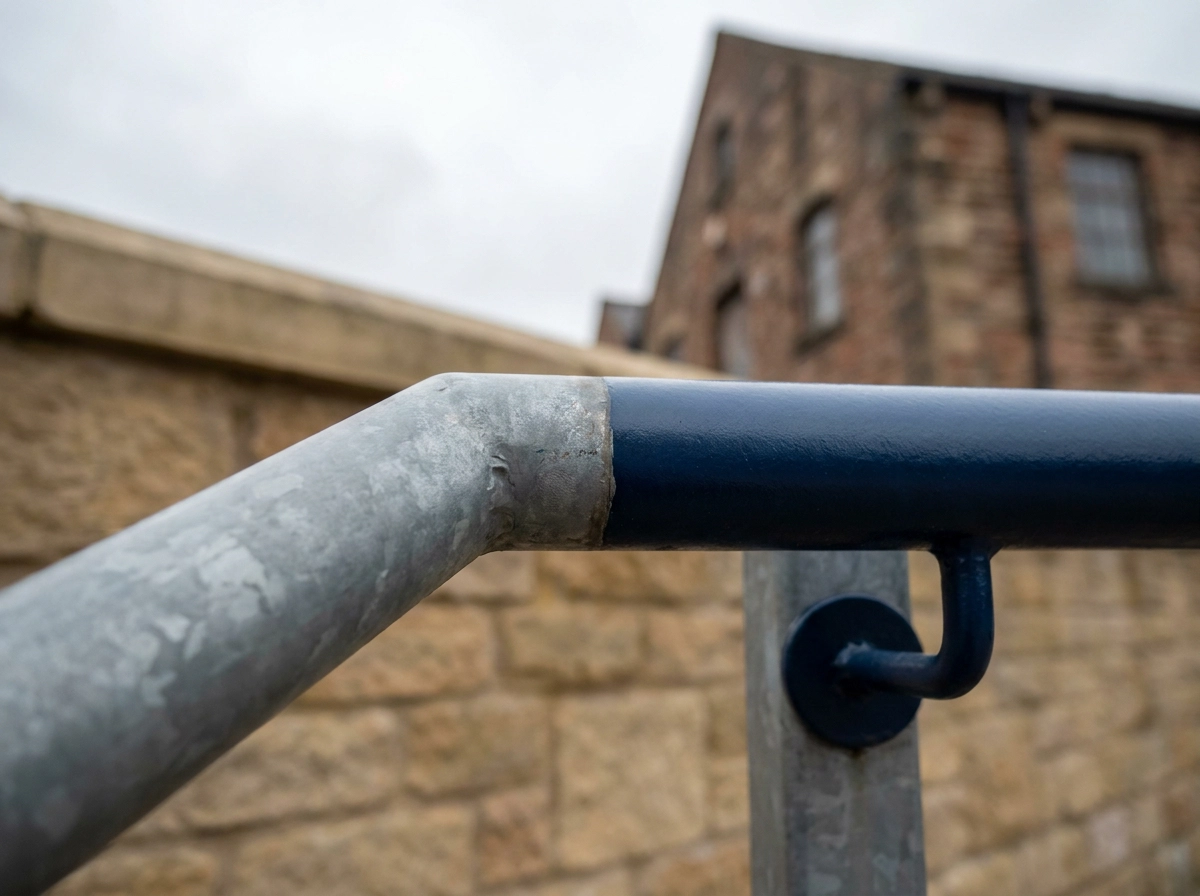
Once the drawing is set out, the next decision is how the steel will be protected. Choose the finish for exposure, not appearance alone. A sheltered porch screen under a deep overhang and a seafront railing in Sussex face very different conditions, and a coastal run needs more from its coating system than an inland one.
Hot-dip galvanising works by immersion: prepared steel is dipped in molten zinc. According to steelconstruction.info, zinc coatings protect steel by weathering at a slow rate, giving a long and predictable life, while small areas of exposed steel gain sacrificial protection. That is why galvanising is well suited to elements in continuous exterior exposure.
Powder coating supplies colour and a consistent surface. Where railings or screens must sit against a specified shade or match an existing gate, that consistency matters as much as durability.
The finish decision belongs before fabrication starts. Coating requirements, drainage and venting affect how components are drilled and assembled, and welding slag, spatter or grease left on a frame will not be removed by pre-treatment, so clean welding is part of the finish.
What a Gate Fabricator Can and Cannot Take On
A gate fabricator working to drawings can cut, weld and finish railing runs, balustrades, bin stores, privacy screens, gate frames and infill panels, all made in the workshop and delivered ready to fix. That is architectural metal fabrication at edge level: guarding, screening and enclosing elements sized by a drawing rather than by calculation.
It cannot take on structural steel design. Beam and column sizing, load calculations and anything requiring an engineer's certification sit outside a fabrication workshop's scope, however capable its welders are.
Some jobs sit in the middle. A long balustrade run or a screen carrying load may need structural engineer or building control input, and this article sets no fixed threshold for when that applies. Flagging that boundary early protects the customer: a workshop presenting itself as a structural steel contractor takes on design liability it cannot carry.
In practice, Portara fabricates to an engineer's or architect's drawing and fits to it, keeping design responsibility with the professional who owns it.
Where Approved Document K Fits In
With design responsibility settled, the regulatory backdrop matters, because it shapes what a fabricated balustrade or screen must achieve.
Approved Document K covers protection from falling, collision and impact in England, including K2 (protection from falling) and K3 (vehicle barriers and loading bays). It is guidance, not a guarantee: following it creates a presumption of compliance, but there is no obligation to adopt any particular solution, so any departure should be discussed with the building control body.
The Planning Portal notes that an edition was introduced with no new technical requirements, and work under earlier editions continues under those rules. The Building Safety Act 2022 received Royal Assent on 28 April 2022 and is relevant context where higher-risk building requirements may apply.
Barrier heights, design loads and infill spacing must come from the full Approved Document K PDF and be cited by clause, so no figures appear here. Your engineer or building control body confirms the applicable values. Related obligations continue once metalwork and gates are in service.
What to Send With Your Fabrication Enquiry
Once compliance is settled, the next practical step is a complete architectural metal fabrication enquiry. A dimensioned drawing, a DWG or DXF file, or a clear measured sketch all start the same way: a workshop needs enough geometry to cut and weld from. For a simple railing run or privacy screen, an annotated PDF is fine.
Include fixing positions, the required height or span, the floor or wall build-up the metalwork meets, and any existing profile to be matched. Photographs of the site or existing metalwork help the workshop judge access, ground conditions and how panels will be secured.
State the finish you want or the environment the metalwork faces. If a screen sits near the coast, salt exposure affects coating choice, so describe the setting rather than just the colour. Give the date the element is needed on site. Finally, tell us the quantity. One bespoke panel and fifteen identical bays are different fabrication jobs, and the quote should reflect the difference.
Clear inputs keep a bespoke metal fabrication enquiry moving, align with the pre-installation documentation you should expect, and set up the quotation and survey stage.
How to Commission: From Quotation to Survey, Fabrication and Fitting
For any bespoke metal fabrication job, once the drawing, photographs and fixing details are with the workshop, the process follows five stages.
Quotation and drawing review. Portara reviews the drawing, confirms what the workshop can fabricate, and flags anything that needs structural engineer or building control input before cutting starts.
Site survey. A survey confirms dimensions, levels, fixing points and access. A site survey is where drawing-versus-reality differences are typically identified and resolved, before any steel is cut.
Fabrication. CNC plasma cutting, welding, trial assembly and finishing follow. Each element is checked against the original drawing before it leaves the workshop.
Installation. The finished metalwork is set to the surveyed positions. The team can work alongside contractors who are fitting the elements themselves.
One point of responsibility. Buying fabrication and fitting as one job keeps a single point of responsibility for how railings, screens or balustrades line up. That joined-up approach pays off on larger runs and on smaller gate projects alike.
Bespoke Metal Fabrication Across East Sussex, West Sussex and Kent
That single point of responsibility matters most when the workshop is within reach. Portara fabricates for projects across East Sussex, West Sussex and Kent, which is what most people are looking for when they search for metal fabrication near me.
Proximity shortens the loop between survey, trial fit and adjustment. On a multi-bay railing run, or where new panels must match existing metalwork, a short return journey beats a courier and a conversation by email.
The same workshop serves homeowners, businesses, developers and contractors across the three counties, from a single privacy screen to a full balustrade package. Volume changes the quotation, not the process.
Delivery and fitting logistics depend on distance, so mention the site location, access and any parking or loading restrictions early. The quotation can then account for them honestly, rather than discovering them on the day.
Frequently Asked Questions About Bespoke Metal Fabrication
Wherever your site sits across the three counties, the same questions tend to come up before a quotation.
Do you work from drawings? Yes. Dimensioned drawings, CAD files and measured sketches all feed the same process, and the workshop fabricates to the dimensions supplied.
Can you match existing railings? Matching depends on profile, spacing and finish. Send photographs plus a measurement or a sample section, and the workshop will confirm what is achievable.
Are you a structural steel contractor? No. Portara fabricates edge-level architectural metalwork to drawings. Structural design and certification stay with an engineer.
Can you make bin stores and privacy screens? Yes. They are built like gate frames and railing panels: a welded frame, an infill and an exterior finish.
How long does a bespoke fabrication job take? Programme depends on drawing readiness, finish and fitting access, so the quotation stage is when a realistic date is agreed.
Project-specific details are confirmed at quotation.
Send Your Drawings for a Bespoke Fabrication Quote
With those questions answered, the next step is simply the paperwork.
Include your finish preference and exposure context, as covered earlier. If your balustrade run or screen may carry a load, settle whether a structural engineer or building control needs to be involved before fabrication starts. That keeps design responsibility with the professional who owns it. Ask for fabrication and fitting to be quoted together if you want one point of responsibility on site.
Send your drawings to Portara for a bespoke metal fabrication quotation across East Sussex, West Sussex and Kent.
Conclusion
Bespoke metalwork beyond gates succeeds when the drawing pack is complete. The next step is simple: send your drawings to Portara for a bespoke metal fabrication quotation across East Sussex, West Sussex and Kent. Turn your measured idea into a fitted element with confidence, and start the conversation today.