
Bifold Driveway Gates: The Complete Guide for UK Homeowners
Everything UK homeowners need to know about bifold driveway gates: how they work, costs, planning rules, automation options, and materials. Expert guidance from Portara Automation.
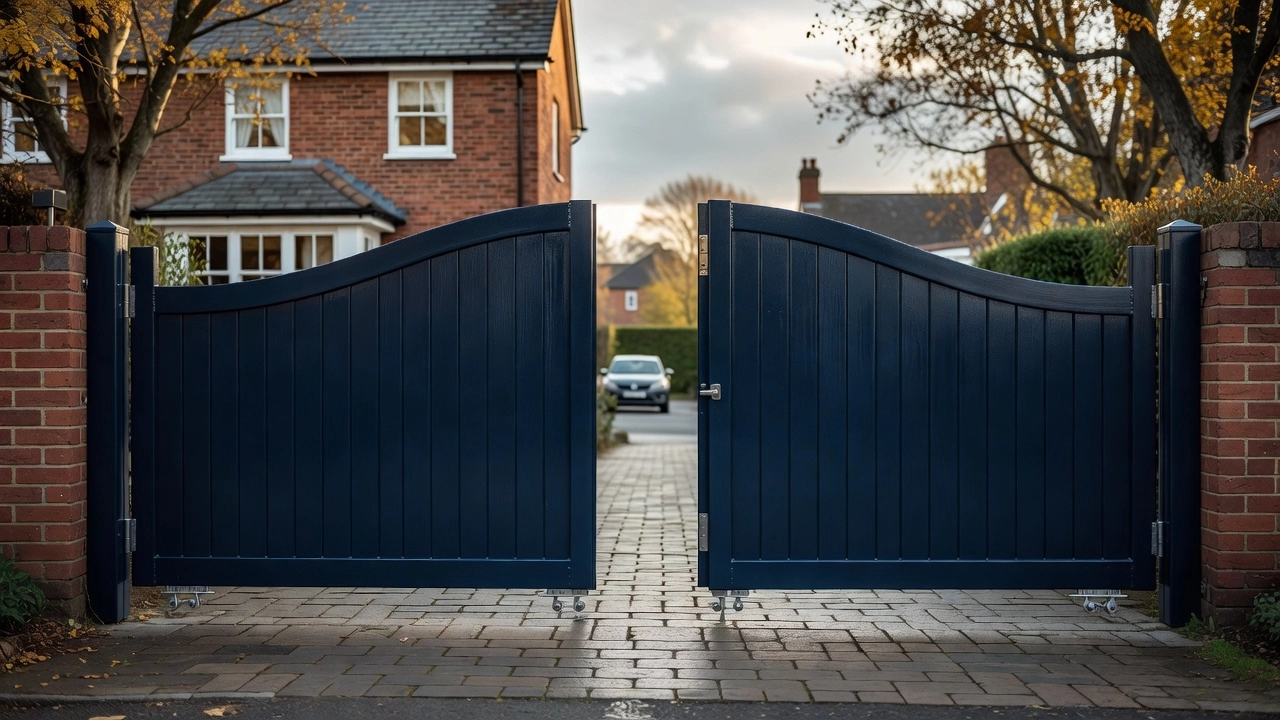
Space on a British driveway has always been at a premium. Whether you're working with a narrow urban plot or simply want to make the most of every inch of your property, the gate you choose can make or break the entire setup. This is where bifold driveway gates have quietly become one of the smartest solutions available to UK homeowners.
Unlike traditional swing or sliding gates, bifold designs fold back on themselves, dramatically reducing the clearance space required to operate them. But with a growing number of styles, materials, and automation options now on the market, choosing the right system is no straightforward task.
In this guide, we'll walk you through everything you need to make a confident, informed decision. You'll learn how bifold gates compare to other gate types, what materials perform best in the UK climate, which automation systems are worth the investment, and what to expect from installation and ongoing maintenance. Whether you're replacing an existing gate or starting from scratch, this guide covers the full picture.
How Bifold Driveway Gates Work
A bifold driveway gate operates on a deceptively simple principle: each gate panel is divided into two equal segments connected at a central hinge point. Rather than swinging outward in a full arc or sliding laterally along a track, the gate folds back on itself when opening, with the outer leaf pivoting inward to meet the inner leaf. This folding motion is supported by a system of hinges, rollers, guides, and drop bolts working in combination to ensure smooth, controlled movement. Geared hinges are commonly used on heavier installations to maintain consistent operation under load, and the overall hardware assembly can be fitted without welding, reducing installation time considerably.
The spatial advantage this creates is significant. A traditional double swing gate serving a 4-metre opening requires roughly 2 metres of clearance depth behind each leaf to operate freely. A bifold configuration serving the same opening folds each leaf back into approximately 1 metre of side space, making the gate viable where a conventional swing gate simply cannot function. This reduced clearance arc also makes bifold gates a practical solution for sloping driveways, where a standard swing leaf would otherwise drag or bottom out on an incline. According to Harling Security's bifold gate guidance, this design is specifically well-suited to properties with limited driveway space or sloping entrances.
Manual bifold gates use handles for operation, with drop bolts securing the gate in both open and closed positions. Automated systems replace this manual effort with electromechanical linear actuators or specialist bifold gate operators that drive the folding motion directly. Because the geometry of a bifold gate concentrates the mechanical force requirement, these systems can often require fewer operators per opening compared to a traditional double swing installation, making automation both more straightforward and more cost-effective.
Two primary configurations exist. A single bifold leaf uses one folding panel across the full opening and is typically suited to openings up to around 4 metres. A double bifold arrangement uses mirrored folding panels from each post, with each leaf folding back to its respective side; this is the standard solution for wider residential and commercial entrances. The CLD bi-folding gate buying guide further contextualises how these configurations serve a range of security-rated applications from residential driveways through to high-security perimeter installations.
This versatility is reflected in strong and accelerating market demand. The global bi-folding speed gates market is currently valued at approximately USD 600 million and is forecast to grow at a CAGR of 10.3% from 2026 to 2033, a growth rate that substantially outpaces the broader metal driveway gates market. That momentum points to a gate type moving firmly from niche to mainstream across both residential and commercial applications.
Bifold vs Swing vs Sliding Gates: Which Is Right for Your Property?
Choosing the right gate style is primarily an engineering decision before it becomes an aesthetic one. Site geometry determines what is physically possible; preference determines what looks best within those constraints. The table below sets out the core differences across all three gate types to help you assess which suits your property.
Factor
Swing Gates
Sliding Gates
Bifold Gates
Space to operate
Full arc clearance equal to leaf length
Clear run-back along fence line equal to gate width
Operational footprint contained within post width
Typical opening width
Up to 16 ft per leaf
Well-suited to 16 ft or wider spans
Wide openings on constrained sites
Automation complexity
Straightforward; linear arm or underground operators
More involved; track, rollers, and precise groundwork required
Most complex; articulated hinges and specialist bifold operators
Aesthetic flexibility
Timeless, estate-style; suits traditional and grand entrances
Clean, modern, horizontal movement suits contemporary homes
Contemporary finish; suits urban and modern rural settings
Approximate cost
Lowest entry cost for smaller spans
Mid to high range; groundwork increases total cost
Highest cost tier; specialist mechanism and installation
Maintenance
Hinges, operators, latch hardware; grade conflicts on slopes
Track and rollers need regular clearing; debris and ice are risks
Most moving parts; regular lubrication of fold joints is essential
Swing Gates
Swing gates dominate the residential market with a 44.7% share of the metal driveway gates segment, and it is easy to see why. They use simpler hardware than either alternative, carry a lower upfront cost for smaller spans, and deliver the symmetrical, architectural framing that suits traditional and estate-style properties. Automation is straightforward, with linear arm or underground actuators requiring fewer moving parts than sliding or folding assemblies. The fundamental constraint is arc clearance: every swing gate leaf must travel through a full unobstructed arc, which demands sufficient driveway depth behind the gate line. On short drives, sloped sites, or plots where parked vehicles sit close to the gate, that clearance simply does not exist. Out-swinging across a public pavement or road is also typically prohibited, which means inward swing is standard and driveway depth becomes the deciding factor.
Sliding Gates
Sliding gates currently hold 51% of the automatic gate opening product market, largely because they perform well on wide openings and sloped driveways where a swing arc would be impractical. Rather than swinging through the driveway, the leaf travels laterally along the boundary, which removes the depth problem entirely. However, this creates a different spatial requirement: a clear run-back along the fence line equal to the full gate width must be available and unobstructed. On many standard residential plots, boundary walls, corner returns, or adjacent outbuildings make that run-back impossible. Groundwork must also be precise; cross-slope along the track causes alignment problems, and ground-track systems are vulnerable to debris and ice accumulation. For long boundary runs on level or gently sloped ground with adequate side room, sliding gates are highly effective. For the average residential plot with tight side boundaries, they are often impractical regardless of their market dominance.
Bifold Gates
Bifold driveway gates solve the specific problem that neither swing nor sliding gates can address: a wide entrance opening on a plot where driveway depth is limited and fence-line run-back is unavailable. Because the panels fold back parallel to the posts, the entire operational footprint stays within the post width. No arc clearance is consumed on the driveway side, and no side room is required along the boundary. This makes bifold gates the technically correct choice for constrained urban driveways, converted properties with tight approaches, and any site where maximising the usable opening width is the priority. The trade-off is cost and complexity; articulated hinges, multi-point latching, and dedicated bifold operators require specialist installation and more attentive maintenance than either alternative.
The Practical Decision
If your plot has adequate driveway depth and a level or gently sloped approach, swing gates offer the simplest, most cost-effective automated entrance. If your opening is wide, your boundary is long, and you have clear run-back along the fence line, a sliding gate is worth considering. If your driveway is shallow, your side boundaries are constrained, and you still need a full-width automated opening, bifold driveway gates are not simply a preference; they are the only mechanically sound solution for the site.
Space-Saving Benefits for UK Driveways
Much of South East England's residential housing stock presents a structural challenge that conventional gate designs simply cannot solve. Terraced and semi-detached properties across East Sussex, West Sussex, and Kent, many built in the late Victorian and Edwardian periods, frequently offer driveway depths of only 3 to 5 metres between the road boundary and the house frontage. In these settings, the available clearance behind the gate line is the single most important factor in determining which gate design is even physically possible.
The Swing Arc Problem
A standard swing gate covering a 3-metre opening requires each leaf to travel through an arc of roughly 1.5 metres as it opens. For a wider opening of 4 metres, that arc extends to 2 metres per leaf. On a shallow driveway, this creates an immediate conflict: the gate either sweeps into a parked vehicle on the drive, or, if specified to open outward, directs heavy metalwork across the public footway, which carries both safety and legal implications under highway regulations. A bifold gate eliminates this problem precisely because its folding mechanism reduces the effective sweep to approximately 50% of an equivalent swing gate, keeping the opening clearance requirement well within the available depth.
Sloped and Irregular Approaches
Sliding gates appear to offer an alternative on constrained sites, but they introduce their own complications on sloped driveways. Achieving a level run-back for a sliding gate often requires significant groundwork, including excavation, base levelling, and track installation. A bifold gate, by contrast, can be engineered to operate on a gradient through appropriate post specification, heavy-duty hinge selection, and correctly configured automation, avoiding the groundwork cost entirely.
Corner Plots and Narrow Frontages
Corner plots present additional constraints: visibility splays required by local planning and highway conditions frequently prevent gate posts from being positioned where a swing or sliding gate would need them. On narrow frontages, the side clearance required for a sliding gate's run-back simply does not exist. In both cases, bifold gates are the recommended solution where restricted depth and limited side space apply, making them the default practical choice rather than a premium alternative.
This demand pattern aligns with broader market data: residential applications account for 52.3% of global metal driveway gate revenue, confirming that homeowners, not commercial developers, are the primary force driving gate specification decisions. The space constraints common to UK residential streets are a direct contributor to that residential demand, and bifold gates are increasingly the format that meets it.
Material Options for Bifold Driveway Gates
Steel (Mild Steel, Powder-Coated)
Mild steel is the default specification for bifold driveway gates across the UK, and for good reason. It commands 38.2% of the global metal driveway gates market in 2025, a dominance underpinned by its exceptional strength-to-weight ratio. In a bifold configuration, this ratio matters more than in a conventional swing gate because each panel leaf is hinged at both the post and at the central fold knuckle, distributing load across multiple pivot points simultaneously. Steel's rigidity ensures the panel maintains its geometry under repeated cycling without flex-induced wear at the knuckle joint, while its manageable weight keeps operator torque requirements within standard electromechanical drive specifications. The material is also highly receptive to fabrication processes including welding, cutting, and forming, making it straightforward to build into clean modern lines or detailed decorative patterns depending on the property's requirements.
Wrought Iron
Wrought iron occupies a distinct position in the material hierarchy: it is heavier than mild steel, more expensive to fabricate, and demands more from the gate operator, yet it remains the preferred choice for period properties across East Sussex and Kent where conservation area guidelines and planning sensitivities favour traditional aesthetics. The material's characteristic surface texture and ability to hold ornate scrollwork and hand-forged detailing make it visually irreplaceable for Georgian, Victorian, and Edwardian entrances. Because wrought iron adds significant mass to each bifold leaf, hinge sizing and operator selection must be calculated specifically for the combined leaf weight rather than treated as a standard installation. Longevity is excellent when the gate is properly finished; without adequate protective coating, however, the material is susceptible to rust, particularly in the salt-laden air common along the East Sussex coast.
Aluminium
Aluminium offers a compelling engineering case for wider bifold openings. Lighter than both mild steel and wrought iron, it reduces the mechanical load on hinges and operators proportionally, which translates directly into lower motor specifications and longer component service life. The material is naturally corrosion-resistant, making it well-suited to rural and coastal environments where moisture exposure is persistent. That said, powder coating is still strongly recommended for aluminium gates; the coating adds UV stability and surface hardness that the bare material alone does not provide. As noted in a detailed comparison of driveway gate materials, aluminium can be fabricated into strong gate frames despite its lower density, and the combination of light weight with a durable powder-coated finish makes it particularly effective for modern or decorative gate designs.
CNC Plasma-Cut Bespoke Designs
For property owners who require something beyond a standard catalogue gate, CNC plasma cutting transforms what is achievable. The technology directs an accelerated jet of ionised gas through electrically conductive materials, including steel, aluminium, and stainless steel, cutting with high precision and minimal material distortion. In practical terms, this means any infill pattern can be programmed and cut directly into the gate panel: wildlife motifs, geometric repeats, family monograms, or wholly original decorative compositions. The CNC-controlled process also ensures dimensional repeatability across both leaves of a bifold pair, which is critical for the precise alignment required at the fold knuckle. Standard catalogue gates simply cannot replicate this level of personalisation. Plasma-cut gate design has grown into a substantial global sector, with over 46,000 products active across specialist suppliers as of 2026, reflecting strong and sustained demand for bespoke metalwork.
Powder-Coated Finishes
Regardless of material, the quality of the applied finish determines long-term performance in UK conditions. High-quality polyester powder coating creates a chemically bonded barrier that outperforms conventional wet-paint systems in both UV resistance and adhesion, resisting the corrosive combination of coastal salt air, agricultural moisture, and temperature cycling characteristic of East Sussex, West Sussex, and Kent. The coating is applied electrostatically and cured under heat, producing a uniform, hard-wearing surface that does not peel or bubble as paint films can. Colour options span the full RAL range, enabling precise matching to property materials, joinery, and any conditions attached to planning permissions. Portara Automation offers bespoke fabrication with finish options tailored to individual property style and planning requirements, ensuring that the final gate not only performs reliably but integrates seamlessly with its surroundings.
Automating Your Bifold Driveway Gates
Bifold driveway gates cannot be automated using the same operators fitted to standard swing gates. The folding leaf geometry, where each panel articulates at a central knuckle joint, is mechanically incompatible with conventional rotary arm actuators designed for single rigid leaves. Attempting to drive a bifold gate with the wrong operator risks frame distortion, rapid mechanical failure, and serious safety hazards. The correct solution is either a dedicated bifold operator engineered specifically for the articulated movement, or a linear push-rod actuator positioned to drive the folding action at the pivot or knuckle point. This distinction matters at the specification stage, long before installation begins, and is precisely why bifold automation should always be handled by a specialist rather than treated as a straightforward DIY upgrade.
Drive Technology and Smart Integration
Electromechanical drive technology leads the gate automation market and is the correct choice for bifold operators. Its dominance is well-founded: electromechanical systems offer high reliability, low maintenance requirements compared to hydraulic alternatives, and seamless compatibility with modern digital control systems. This makes them the standard specification across residential, commercial, and agricultural applications, and the technology underpinning most dedicated folding gate operators available today.
Smart home integration has become a core expectation rather than an optional extra. Modern automated bifold gates can be connected via Wi-Fi enabled operators for full smartphone app control, or via GSM-based systems that operate over cellular networks, a practical advantage where Wi-Fi signal at the driveway entrance is limited. Voice assistant compatibility is now widely supported, with leading operators integrating natively with Amazon Alexa and Google Home, enabling hands-free open and close commands. Dedicated gate automation apps provide scheduled access, remote monitoring, and event logs, giving property owners comprehensive control regardless of location.
Building a Complete Entrance System
Automation alone addresses access convenience, but a properly specified entrance system layers access control around the gate operator. Portara Automation designs and installs the full suite of additions that work alongside automated bifold gates: video intercom systems for visual verification before entry is granted; digital keypads for code-based access without physical keys; proximity fob readers for fast, contactless entry; and inductive vehicle detection loops buried in the driveway surface to trigger automatic opening for authorised vehicles. Each element integrates with the gate control panel to create a single, managed entrance solution.
The Retrofit and Upgrade Case
The upgrade market for gate automation is growing rapidly and offers a compelling option for owners of existing manual bifold structures. The global automatic gate systems market is valued at USD 3.68 billion in 2026 and forecast to reach USD 5.99 billion by 2036, a CAGR of 5%, with consumer demand for converting manual gates to automated systems explicitly cited as a key growth driver across that period. For bifold gates specifically, the structural case for retrofitting is strong: existing post foundations, frame steelwork, and leaf panels can typically be retained in full. Only the operator mechanism, control panel, and associated wiring need to be added or replaced, making automation a cost-effective upgrade rather than a complete gate replacement. Portara Automation assesses existing manual bifold structures as part of the consultation process, confirming suitability for retrofit and specifying the correct operator for the gate's weight, leaf dimensions, and usage frequency.
Do Bifold Driveway Gates Need Planning Permission in the UK?
In England, bifold driveway gates fall under the same permitted development framework as all residential boundary gates. Under Class A of Part 2 of the Town and Country Planning (General Permitted Development) Order 2015, gates do not require planning permission provided they remain within specific height thresholds: a maximum of 1 metre in height where the gate is adjacent to a highway used by vehicular traffic, or 2 metres in height elsewhere on the boundary. Bifold gates are not treated differently to swing or sliding designs under this framework; the operating mechanism does not affect how the rules apply. What matters is the height of the gate leaf structure and its relationship to the highway boundary. One point worth noting for bifold installations specifically: because the panels fold back along the driveway rather than swinging outward, the gate leaf and post positions at various points during operation may sit differently relative to the highway, which can influence which height threshold applies to different elements of the installation.
When Planning Permission Is Always Required
Permitted development rights do not apply universally, and several property designations remove them entirely regardless of gate height. Listed buildings and their curtilage require both planning permission and potentially listed building consent even where an identical gate on an unlisted property would be permitted development. Conservation Areas impose additional restrictions, particularly where existing boundary structures contribute to the character of the area; these areas are common across historic towns, villages, and market streets throughout East Sussex and Kent, covering a significant proportion of properties in Portara Automation's primary service region. Article 4 Direction areas represent a third category, where local authorities have formally withdrawn permitted development rights for specific streets or localities. Buyers must check whether their postcode falls within such a direction via their local council's planning portal before making any purchase decisions.
Ancillary Structures and Automation Equipment
Automated bifold gates introduce an additional layer of planning consideration that is frequently overlooked. Intercom posts, camera columns, and keypad pillars are independent structures subject to the same permitted development height limits as the gate itself. If any ancillary element adjacent to the highway exceeds 1 metre, or exceeds 2 metres elsewhere on the boundary, a separate planning application may be required even when the gate leaf is fully compliant. Buyers should assess the full installation footprint, not just the gate panels, when determining whether their project falls within permitted development.
Before ordering, confirm with your local authority whether your street frontage is formally classified as a highway used by vehicular traffic. This classification is not always obvious; in some cases a pavement, verge, or shared access road between the kerb and the boundary may complicate the determination. Where genuine uncertainty exists, a Lawful Development Certificate provides formal confirmation of lawfulness without the cost and delay of a full planning application, and many councils also offer pre-application advice services as a lower-stakes route to clarity.
Portara Automation addresses planning considerations as a standard part of the initial consultation and site survey process. Rather than leaving buyers to navigate these rules independently after placing an order, the team identifies any relevant designations, boundary classifications, and ancillary structure implications upfront, ensuring customers avoid the costly mistake of ordering gates that cannot be lawfully installed.
How Much Do Bifold Driveway Gates Cost in the UK?
Several variables combine to determine what a bifold driveway gate project will cost, and understanding each one helps you evaluate quotations with confidence. The width of the gate opening is the primary driver: wider openings require longer, heavier panels and more powerful operators. Panel height adds structural mass and affects the automation specification required. Material choice creates a clear cost hierarchy, with aluminium sitting at the lower tier, mild steel occupying the mid-range, and wrought iron or bespoke CNC plasma-cut fabrication commanding a significant premium. Layered on top of these structural factors are the automation system specified and any access control additions, including keypads, fob readers, intercom systems, and video entry integration.
Indicative Price Ranges
For a standard 3 to 4 metre opening, a manually operated mild steel bifold gate pair supplied without automation typically starts from around £2,500 to £4,000. Once you introduce a quality operator system, basic intercom, and professional installation, that figure rises to a range of £5,000 to £10,000 for a fully operational automated pair. Bespoke wrought iron designs or gates featuring detailed CNC plasma-cut panels sit above this range, with final cost dependent on the complexity of the fabrication work involved. You can browse bi-folding gates available online to understand catalogue supply pricing as a baseline, but bespoke manufacture and full installation represent a different scope of work entirely.
What Increases the Cost
Certain site conditions consistently push project costs upward. Sloped or uneven ground requires civil groundworks preparation before installation can begin, adding both time and material cost. Openings wider than 5 metres demand heavier-duty operator systems rated for greater torque and panel weight. Access control integration, whether a GSM module, video entry panel, or coded keypad, adds both hardware and commissioning time. High-frequency usage, typical of commercial, agricultural, or multi-household properties, requires commercial-grade automation rather than standard residential operators.
Long-Term Value
The strongest argument for investing in a bespoke fabricated steel or wrought iron gate with a quality automation system is the total cost of ownership across a 20 to 30 year lifespan. A specialist-installed system at £8,000 that performs reliably for 25 years represents a significantly lower annual cost than a catalogue-sourced product requiring replacement or substantial repair within a decade. The per-year value calculation consistently favours quality specification and professional installation.
Accurate pricing is not possible without a site survey. Like-for-like comparisons across suppliers mean very little without a physical assessment of your opening width, ground conditions, boundary constraints, and intended usage frequency. Portara Automation provides detailed, itemised quotations following an initial consultation carried out at no charge, giving you a clear and comparable figure based on your specific site rather than a generic estimate.
Security Standards and Credentials to Look For
Security credentials are becoming an increasingly important part of the gate-buying conversation, and bifold driveway gates are no exception. With residential security accounting for approximately 56% of the automatic gate systems market share in 2026, homeowners are treating automated gates as active security assets rather than purely aesthetic features. Understanding the standards that underpin gate security performance allows buyers to ask sharper questions and make more informed comparisons between suppliers.
Secured by Design
Secured by Design is the UK police-preferred specification programme, developed and backed by the Association of Chief Police Officers (ACPO). Products and installations that meet Secured by Design criteria have been independently assessed to a recognised physical security specification, and the designation carries weight beyond the installation itself. Gate systems designed and installed to Secured by Design principles can support home insurance applications, demonstrate security intent during planning consultations, and provide documented evidence of responsible specification on residential and commercial developments. For buyers comparing gate suppliers, asking whether a fabricator works to Secured by Design principles, or whether their hardware suppliers hold SBD-approved product status, is a straightforward way to separate credential-backed propositions from marketing language.
LPS 1175 and What It Means for Buyers
Loss Prevention Standard 1175 (LPS 1175), published by the LPCB (Loss Prevention Certification Board), is the UK benchmark for testing and certifying intruder-resistant physical security products. The current version is Issue 8.2, published in September 2024, which introduced a two-element alphanumeric classification system combining a threat level (letters A through H, reflecting attacker toolkits) with a delay rating in minutes. The older SR1 to SR8 terminology from previous issues remains widely used in supplier marketing, so buyers should be aware that both naming conventions refer to the same framework. Certified LPS 1175 bi-folding gates do exist, but these are primarily specified for commercial, educational, and high-security estate contexts. Most residential bifold driveway gates are not formally tested to this standard; however, understanding its principles helps buyers critically evaluate material grades, lock specifications, and hinge quality when comparing proposals from different fabricators.
Hardware, Fabrication, and Physical Security Specification
The overall security performance of a bifold gate installation depends on the sum of its components, not just the gate leaf. Multi-point locking systems engage at multiple points along the gate frame, significantly increasing resistance to forced entry compared with single-point mechanisms. Ground bolts provide a secondary locking point at the base of the gate, preventing lifting or deflection under load. Anti-lift hinges prevent the gate from being lifted off its pivot points, a common vulnerability in poorly specified installations.
Material thickness, hinge gauge, and post embedment depth are equally critical and are frequently where under-specified or budget installations fall short. A reputable fabricator will size these elements correctly for the intended security level, the gate weight, and the soil or substrate conditions at the specific site. Superficially similar gates can differ substantially in forced-entry resistance based on these fabrication decisions, which is why a detailed technical specification, not just a visual impression, should form the basis of any comparative assessment between suppliers.
The Bifold Gate Installation Process: What to Expect
Step 1: Consultation and Site Survey
Every successful bifold gate installation begins with a thorough professional site survey. A qualified installer will measure the exact width of the opening to confirm the correct gate leaf dimensions and folding mechanism specification, since even small errors at this stage can create operational problems once the gate is hung. Ground conditions and gradient are assessed carefully, as bifold gates are particularly well-suited to sloping entrances where swing gates would foul the driveway surface. The surveyor will also identify the most practical route for power supply cabling and automation ducting, noting the location of existing electrical supplies and any obstacles that could complicate installation. Design preferences covering material choice, infill style, and surface finish are discussed at this stage, alongside any planning considerations relevant to the property's location or boundary treatment.
Step 2: Design and Fabrication
Following a confirmed survey, the design phase produces technical drawings that the customer reviews and signs off before any fabrication begins. This approval stage is important: it ensures that dimensions, design details, and automation requirements are all agreed in writing, eliminating ambiguity and protecting both parties. Bespoke fabricated bifold gates typically carry a lead time of four to eight weeks from order confirmation, depending on specification complexity, material selection, and workshop scheduling. The design must account simultaneously for structural integrity, the folding mechanism geometry, and the intended automation operator, since these three elements interact directly. Customers commissioning gates with CNC plasma-cut decorative panels or non-standard infill patterns should expect lead times toward the upper end of that range.
Step 3: Groundworks and Posts
Post installation is arguably the most structurally critical phase of the entire project. Concrete foundations must be poured at the correct depth and set to precise alignment; any deviation here will affect the gate's operation from day one and is extremely difficult to correct retrospectively. This phase is also the correct moment to lay automation ducting and bury power supply cabling underground, before hard surfaces such as block paving or resin are reinstated. Retrofitting cabling after the driveway surface is complete is significantly more disruptive and costly, so this groundworks stage should never be treated as an afterthought.
Step 4: Gate Hanging and Automation Commissioning
Once fabrication is complete and posts are set, the gate leaves are hung and the folding mechanism is adjusted to achieve smooth, consistent operation across the full travel of each panel. The automation operator and control board are then installed, wired, and commissioned. This includes programming remote fobs, video intercom units, or keypads to the correct access profiles. Critically, safety testing must be completed before the installation is signed off; this covers obstacle detection sensitivity, which must meet the requirements of EN 12453 (the UK and European standard for safe use of powered pedestrian and vehicle gates), as well as verification that the manual release function operates correctly in the event of a power failure.
Step 5: Aftercare and Warranty
Warranty terms for bifold gate installations typically cover the fabricated gate structure and the automation components separately, as the metalwork and the operator are supplied under different manufacturer warranties. Customers should confirm the specific terms for each element at the point of sale, including what is covered, the duration of the warranty, and the process for raising a claim. Beyond the warranty period, an ongoing maintenance agreement provides significant practical value; automation electronics, motor units, mechanical hinges, and locking hardware all benefit from periodic inspection and lubrication to maintain reliable performance. A scheduled service programme also allows minor adjustments to be identified and resolved before they develop into more costly faults, extending the overall lifespan of the installation and protecting the investment made in a bespoke gate system.
Why Choose Portara Automation for Bifold Gates in East Sussex and Beyond
Portara Automation operates a fully integrated model that is uncommon in the UK gate market: every bifold gate system is designed, fabricated, and installed by the same team, working from a single East Sussex base. There is no third-party fabricator introduced into the supply chain, which eliminates the tolerance mismatches, split accountability, and extended lead times that arise when a separate manufacturer and a separate installer each own a different part of the project. When one business is responsible for the gate from initial drawing through to final commissioning, any issue that emerges at installation can be resolved immediately rather than being disputed across two separate companies.
The bespoke fabrication capability at Portara includes CNC plasma cutting, which fundamentally changes what is possible at the design stage. Rather than selecting from a catalogue of standard infill patterns, customers can specify designs that are genuinely unique to their property. Custom motifs, family crests, property names, geometric patterns, and decorative scrollwork can all be cut directly into steel panels with precise repeatability. This is the difference between a gate that happens to fit your entrance and a gate that was designed specifically for it.
Portara also supplies and installs the complete automation and access control system alongside the gate structure itself. Gate operators, intercoms, video entry panels, keypads, and vehicle detection loops are all integrated as part of a single coordinated installation. This matters because bifold gate automation is mechanically specific; fitting a poorly matched operator to a bespoke gate structure, or leaving automation to a separate contractor who did not build the gate, introduces coordination risk that is entirely avoidable.
Regional expertise carries practical value in the South East. East Sussex, West Sussex, and Kent include conservation areas, AONB designations, and significant rural and coastal properties, each bringing specific planning and ground condition considerations. A locally based specialist with direct experience of these environments and their relevant local planning authorities is better placed to guide projects through pre-application stages and site-specific challenges than a national supplier working remotely.
The bespoke bifold gate segment in the South East remains notably unconsolidated. No established regional specialist with dedicated content authority and fabrication capability is currently operating in this corridor, which positions Portara as a genuine first-mover for customers seeking a true end-to-end specialist.
Frequently Asked Questions About Bifold Driveway Gates
Can bifold gates be fitted on a sloped driveway?
Yes. With the correct post specification, hinge geometry, and operator selection, bifold gates can be engineered to function reliably on a gradient. The key advantage over sliding gates in this context is significant: a sliding gate requires a level, unobstructed track run across the full width of the opening, which on a sloped driveway typically demands costly groundwork, retaining structures, or both. A bifold gate avoids this entirely, as the folding leaf mechanism accommodates gradient variations through post positioning and hinge adjustment rather than track engineering. A professional site survey will determine the precise specification required for your gradient.
How much space do bifold gates need to open?
Because each leaf folds back on itself at the central hinge point, the operational clearance required behind the gate post is typically 50 to 60% of the single leaf width. In practical terms, a gate with a 1.5-metre leaf requires only around 750 to 900mm of clearance to open fully, compared to the full 1.5 metres a swing gate of equivalent width would demand. This is the core space-saving principle that makes bifold gates suitable for properties where swing gates are geometrically impractical.
Can I automate my existing manual bifold gates?
In many cases, yes. Provided the existing gate structure, posts, and hinges are in sound condition, and the leaf weight falls within the operating specification of a compatible bifold operator, retrofit automation is a realistic option. It is not a universal guarantee; worn hinges, undersized posts, or excessive leaf weight can disqualify a structure from retrofit use. A professional site survey is the standard first step and will confirm feasibility before any commitment is made.
How long do bifold driveway gates last?
A well-fabricated steel or wrought iron bifold gate, finished with appropriate surface treatment such as hot-dip galvanising or quality powder coat, will typically last 25 to 30 years or more with routine maintenance. The automation components carry a shorter service life; motors and control boards generally require servicing or replacement at the 10 to 15-year mark. Planning for this distinction at the outset, and selecting an installer who can service the automation over its lifetime, is sound long-term thinking.
Do bifold gates work with smart home systems?
Modern bifold gate automation controllers support app-based remote operation as standard, and many are compatible with broader smart home ecosystems through integration with access control platforms. This capability reflects a wider market direction: smart technology integration is identified as one of the primary demand drivers across the gate automation sector, with the global automatic gate opening systems market forecast to grow from USD 3.68 billion in 2026 to USD 5.99 billion by 2036. Intercom integration, video access, and scheduled access permissions are all deliverable alongside bifold gate automation through the right system specification.
Making the Right Choice for Your Property
Bifold driveway gates deliver their strongest advantage in three clearly defined scenarios: where driveway depth is too limited for a swing arc, where a sloped approach makes conventional swing or sliding configurations impractical, and where a wide opening must be achieved on a constrained frontage with no room for a sliding gate's full run-back channel. If your property presents any one of these conditions, bifold is not simply an option; it is the most technically sound solution available.
Before committing to any gate style, weigh the five critical variables: your actual opening width, the clearance available for gate operation, your preferred material, your automation requirements, and the planning status of your property. Each factor influences specification, cost, and feasibility in ways that only a physical site assessment can confirm with accuracy.
The commercial case for bifold is equally compelling. The bifold gate segment is growing at a 10.3% CAGR, outpacing both the broader metal driveway gates market at 5.9% and the gate automation sector at 5%. Choosing bifold now aligns your investment with the forward direction of the premium gate market, supporting long-term property value as well as immediate practical performance.
The logical next step is a no-obligation site consultation with Portara Automation. Accurate measurements, slope assessment, planning confirmation, and a fully tailored quotation cannot be reliably produced from a phone call or an online form alone. Contact Portara Automation today for a free consultation covering design, fabrication, automation, and installation across East Sussex, West Sussex, and Kent.
Conclusion
Bifold driveway gates offer a genuinely smart solution for UK homeowners who want to maximise space without compromising on security or kerb appeal. To recap the key takeaways: bifold gates require significantly less clearance than swing alternatives, making them ideal for tighter driveways; materials like aluminium and steel hold up best against the British climate; quality automation systems add real long-term value; and professional installation ensures your investment performs reliably for years to come.
Now that you have a clear picture of what bifold gates involve, the next step is yours to take. Get quotes from at least three reputable UK gate specialists, ask to see examples of their completed installations, and don't hesitate to request a site survey. The right gate is out there waiting for your driveway.