
Commercial Electric Gate Maintenance: What a Contract Needs
A commercial gate servicing contract should name visit frequencies per component, a breakdown response window, safety test records and a parts policy.
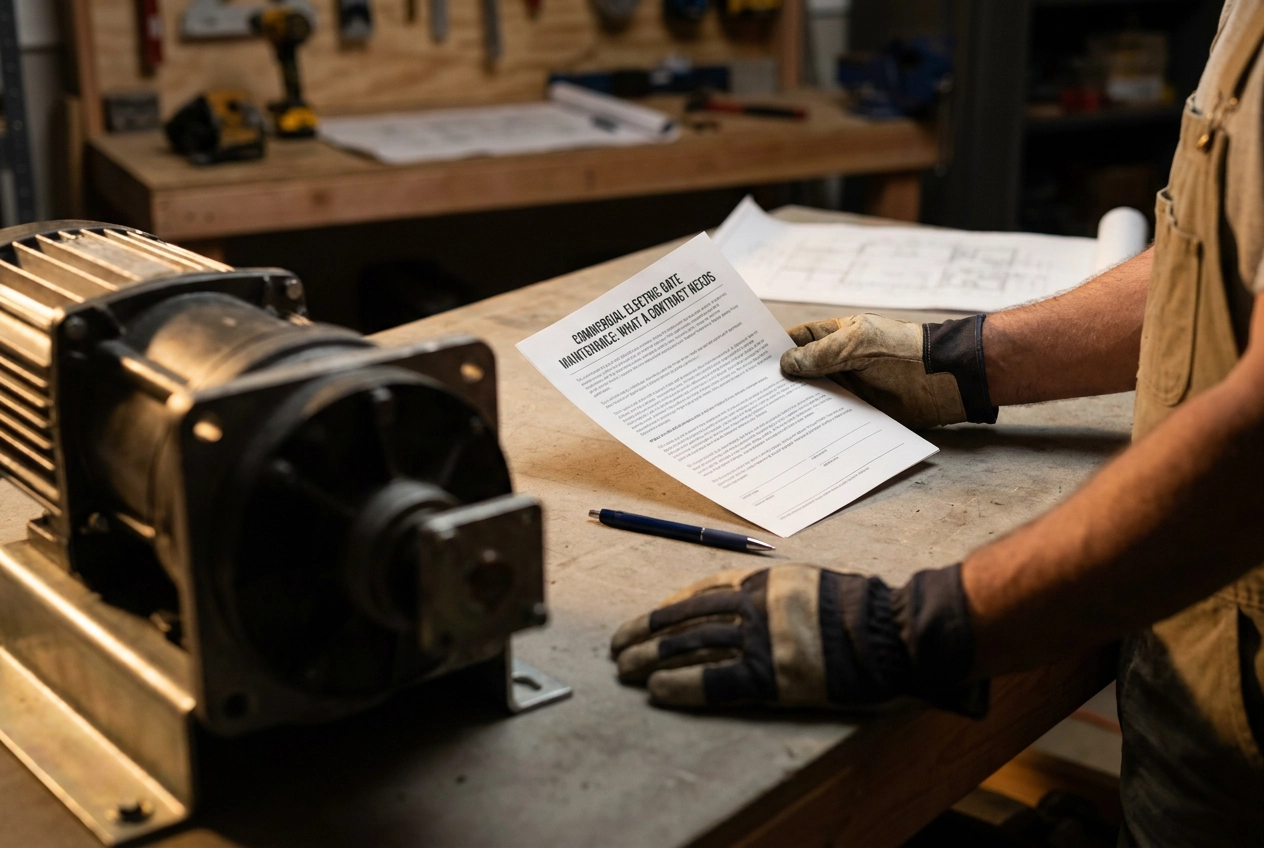
A verbal promise is not a maintenance contract. If you cannot point your budget holder to a document naming visit frequencies, a guaranteed breakdown response window and recorded safety-device testing, you are not buying automatic gate maintenance. You are buying a call-out arrangement with an annual invoice attached.
That distinction matters. BS EN 12453:2017 and BS EN 12604:2017 replaced four older standards, and while the HSE calls them a significant move forward, it states they do not completely address the risks. Gate Safe adds that standards alone will not satisfy every Essential Health and Safety Requirement: each powered gate needs a risk-by-risk assessment. A contract that ignores this leaves the organisation exposed, not just the gate.
This tutorial covers what a commercial servicing contract should contain. You will work through why a verbal promise fails the budget test, the standards behind the paperwork, visit frequencies by component, the breakdown response clause, recorded safety-device testing and the parts policy. It closes with red flags, a negotiating checklist and guidance on who to appoint, so you can turn four clauses into a defensible budget case.
Why a Verbal Promise Fails the Budget Test
A regime is judged on what it can prove. If the year's only paperwork is a call-out invoice, the budget holder has no evidence that planned electric gate maintenance happened at all.
A real contract answers four questions in writing: when visits happen and what they cover, the breakdown response time, which safety checks are recorded, and who pays for parts.
Safety duties extend to gate maintainers, so an unrecorded regime exposes the estate or FM company where it matters most.
Frame it in the budget holder's language: a servicing contract turns open-ended spend into a predictable line item, with a documented duty-of-care trail behind it.
Ask for the document, not the pitch. Anything unwritable into a schedule of visits and a response clause is a call-out arrangement with an annual invoice attached, not ongoing gate maintenance. The standards framework creates the obligation; the contract is the mechanism that meets it.
The Standards That Sit Behind a Gate Maintenance Contract
BS EN 12453:2017 and BS EN 12604:2017 replaced four standards from 2000 and 2001. BS EN 12453 covers industrial, commercial and residential powered gates, names service providers among its users, and places maintenance inside its UK safety standards framework.
HSE bulletin EPD1-2018 (26 November 2018) calls the revision significant progress, yet the risks are not fully addressed, so site-specific risk assessment remains necessary. Gate Safe adds that compliance alone falls short of the Essential Health and Safety Requirements of the Supply of Machinery (Safety) Regulations 2008; as the introduction noted, each gate needs a risk-by-risk assessment beyond the standards.
HSE alert FOD 7-2010 on crushing zones may apply to gate maintainers, naming estates and facilities management companies: your organisation, not just the installer's.
BS EN 12604 is now +A1:2020, and BSI lists BS EN 12453 as current but under review. Ask which version a supplier works to.
Visit Frequencies by Component: What the Contract Should Name
Standards set the benchmark; the contract sets when it is checked. No standard sets service intervals for automatic gate maintenance, so treat visit frequency as a negotiated commercial term, not a regulatory minimum.
Name frequency per component group in visits per year, with each visit's scope listed, so invoices can be checked against a schedule rather than one annual service line.
Tie frequency to duty of use: a yard gate running hundreds of cycles daily needs different attention from an office entrance used a handful of times.
Structure, posts and piers belong in scope as well as the operator. Gate Safe notes that where a post or pier is not fit for purpose, the related accident is inevitable; no visiting frequency compensates. See How Often Does an Electric Gate Need Servicing?.
The Gate Structure, Posts and Piers
Give structural checks their own line in the visit report, separate from motor checks. A gate is only as safe as the structure it hangs on, and inspection must confirm the gate, piers and structure are fit for purpose rather than assumed sound.
Inspection should cover post and pier condition, foundation movement, hinge and pivot mounting, and whether the leaf runs true through its full travel. Check the fabric too: frame distortion, weld condition, corrosion at ground level, and alignment at both fully open and fully closed positions.
Finally, confirm that repair as well as replacement of structural elements sits inside the parts and labour terms. Structural work is the item most often quietly excluded from a maintenance price.
The Operator, Controls and Power Supply
With the structure covered, the schedule turns to the equipment driving it. The drive unit visit should name motor and gearbox condition, manual release function, limit or encoder settings, and the state of the arm, track or chain.
Controls and access equipment belong in the same schedule: control panel fault logs, keypads, intercoms, access control devices, detection loops and remote triggering equipment. Power supply items are checked, not assumed: supply integrity, isolation points, battery backup condition and the emergency release, which is a safety device as much as a manual convenience.
Record every adjustment. Limit positions and programmed parameters drift and can be hardest to reconstruct after an unrecorded visit. Planned electric gate maintenance is about catching wear before it becomes a failure, which is why the operator section should be explicit rather than folded into a generic service.
Safety Devices and Sensors
The operator is only half the system. The HSE's 2010 alert on powered gates and crushing zones names the devices that matter: force measuring equipment and force limits, reversing on contact, presence sensors such as photoelectric beams, pinch point protection at the gate post, and emergency release. The contract should commit to testing each device, not merely looking at it; where technology permits, HSE advises that the safety function is monitored and checked before each movement. Record each test, dated, showing what was verified, by whom and when. A device found defeated, bypassed or missing must trigger a documented action and timescale, not a margin note. The visit should also re-check safe distances and gaps around moving parts: electronics alone do not make a badly installed system safe. See what safety devices should be installed when auditing a specification.
Hardware, Fixings and Moving Parts
Safety devices protect the gap; the hardware moving through it wears. Name the predictable wear items a contract should cover: rollers, hinges, guide rails, locking mechanisms, bolts, fixings, and the drive cable or chain. Lubrication and adjustment belong in the scheduled visit, not in a chargeable call-out when something stiffens.
Consumables are a commercial question. State whether rollers, fixings and lubricants sit inside the visit price or are billed separately, because this is where annual costs diverge most between proposals; the same dividing line governs consumables and maintenance tools that prevent repairs.
Loose or corroded fixings on a powered gate are a safety matter, not housekeeping: a mounting that no longer resists dynamic load undercuts every device above it. Ask for a written condition report after each visit, so deterioration is visible across the year rather than discovered at failure.
The Breakdown Response Clause: What a Guaranteed Window Should Specify
That report tracks wear. When a gate stops, the response clause decides how long the entrance stays unsecured.
A guaranteed response window is negotiated, not a legal duty: no regulation sets attendance times, so the clause is worth what you agree. Define response precisely. A call answered, an engineer on site and a temporary make-safe are three different products, and only the third secures a commercial entrance.
State when the clock starts, the hours covered, and whether the window changes for total, partial or safety device failures. Name the remedy for a missed window: a service credit or escalation step. Without a consequence, the clause is decoration.
Insist on a documented make-safe when the gate cannot be restored same day, especially if the site stays open or unsecured overnight. Confirm coverage of every gate you run: legacy automation, mixed-vendor systems, inherited equipment. The document is the protection, as with maintenance, servicing, and warranties generally.
Recorded Safety-Device Testing: The Clause That Protects the Organisation

Response times restore access; recorded testing protects the organisation. The HSE 2010 alert requires a technical file recording installation and test details: name who holds it, who updates it, and what each visit adds.
Gate Safe estimates that nearly 300,000 new automated gates are installed each year, and firms have been fined up to £80,000 for gate-related failures, with one installer receiving a 42-month prison sentence. Each device named in the Safety Devices and Sensors section should be tested on a defined cycle, with results recorded; state what the control system verifies automatically and what an engineer verifies on site.
Review each gate's risk assessment alongside its test record.
That dated account of what was tested, found and done answers the budget holder's liability question. Agree the record format and retention period up front, so evidence is retrievable on demand.
The Parts Policy: Consumables, Failures and Lead Times
With the safety record defined, the parts policy decides whether the annual figure holds. Treat it as a scope document: state what is included in the service price, what is quoted separately, and what falls outside the agreement. The consumables-versus-failures distinction introduced in the hardware section applies here as a pricing principle too. Name expected lead times for common parts and the position if a component is obsolete, a real risk on older or non-standard systems. Agree who can authorise spend above a set threshold and how quickly, so a breakdown does not stall on a purchase order. Ask whether parts fitted under the contract carry their own warranty, and how that interacts with the annual agreement if the same component fails again. If a supplier cannot define a parts policy, assume everything is chargeable. Anything less leaves the response clause to carry a cost the contract never defined.
Red Flags: What Looks Like a Contract but Is Not
Parts are not the only omission to watch for.
A single annual service line with no component breakdown is a call-out arrangement on a schedule, whatever the covering document is called. No named response window, or one expressed as best endeavours, leaves nothing to hold a supplier to when a gate fails.
No mention of testing safety devices, and no sample of the record you would receive, signals that safety is not the organising principle. A contract covering only the operator addresses half the system, and Gate Safe links the ignored half, the structure, directly to serious accidents.
Finally, check for a statement of competence. Gate Safe runs an installer accreditation check and a property management section, so verifying who attends site is reasonable.
The Negotiating Checklist to Take to a Supplier
The red flags mark what to reject. These clauses mark what to require.
Visit schedule: frequency and scope named per component group, with structure, posts and piers listed separately from the operator.
Response clause: a definition of response, the hours covered, when the clock starts, and the remedy attached to a missed window.
Safety testing: which devices are tested, on what cycle, who signs the record, and its format and retention period.
Parts policy: what is included, what is quoted separately, expected lead times, obsolete part handling and warranty on fitted parts.
Commercial terms: contract length, notice period, price review mechanism, and what happens at renewal if visit findings escalate.
Ask for a sample visit report before signing. A supplier who cannot produce one has not built the system that generates it.
Who to Appoint, and Why Local Coverage Matters
With the checklist agreed, a guaranteed response window is only as good as the distance behind it. For anyone searching electric gate maintenance near me, local coverage is what makes that clause credible; an engineer two counties away cannot honour a short response window.
Check competence, not insurance alone. Gate Safe's installer accreditation check is a public starting point, and DHF offers training for those working with automated gates and traffic barriers. Ask whether attendees hold relevant industry training credentials. Ask for evidence they work to current standards and can produce each gate's risk assessment. Verify this article's guidance against current regulation and, where appropriate, with a competent person.
Whoever you appoint, the contract should name the schedule and clauses, not the brand.
Conclusion: Turning Four Clauses Into a Budget Case
Whichever provider you appoint, four clauses decide whether the agreement is real. Ask for the document: the four clauses above are the evidential trail that justifies the spend.
Take those into the budget conversation as the reason for the spend, and keep the sample visit report as evidence of what the money buys.
Verify the current version of the relevant standards, and review each gate's risk assessment against the test records the contract produces.
This is guidance on contract scope, not legal advice. Check duties against current regulation and take advice from a competent person where the risk assessment or site conditions warrant it.