
Metal Driveway Gates: The Complete UK Buyer's Guide
Compare steel, wrought iron and aluminium driveway gates. UK planning rules, automation options, climate performance and expert buying advice covered.
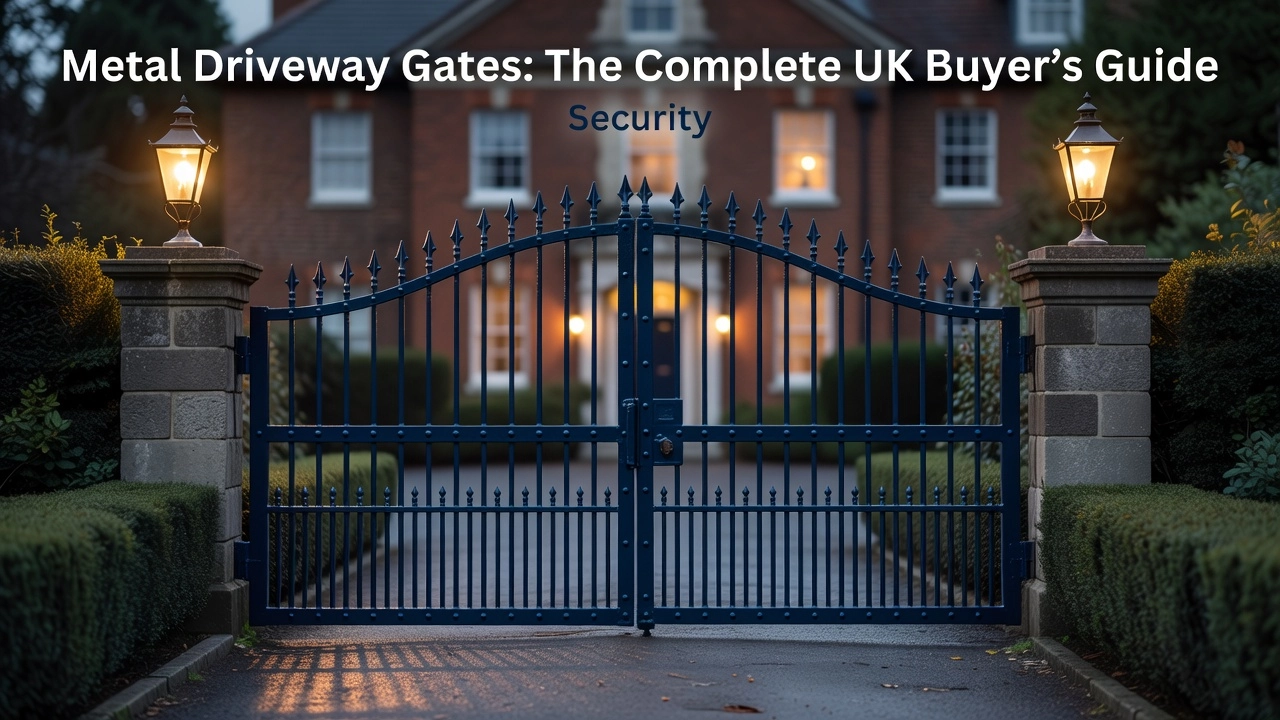
Your driveway makes a statement before anyone even reaches your front door. For homeowners across the UK, investing in driveway gates metal construction offers one of the most effective ways to combine robust security with lasting kerb appeal. But with so many materials, styles, and suppliers available, choosing the right gate can quickly become overwhelming.
This guide cuts through the noise. Whether you are weighing up wrought iron against steel, trying to understand automated versus manual options, or simply working out what your budget should realistically cover, we have done the research so you do not have to. You will find clear, honest comparisons of the most popular metal gate types available in the UK market, alongside practical advice on sizing, planning permissions, installation considerations, and long-term maintenance.
By the time you finish reading, you will have a thorough understanding of what separates a quality metal driveway gate from a poor investment, and you will feel confident making a decision that suits your property, your lifestyle, and your budget. Let us get started.
Why Metal Remains the Material of Choice for Driveway Gates
The global market for metal driveway gates was valued at $3.8 billion in 2025 and is projected to reach $6.4 billion by 2034, advancing at a compound annual growth rate of 5.9%. Some independent forecasts place growth even higher, citing a CAGR of 13.5% through 2033, driven by escalating residential construction investment and demand for industrial-grade security. Either projection tells the same story: metal driveway gates are not a niche product. They represent a mainstream, fast-expanding category underpinned by durable homeowner demand.
Residential applications account for 52.3% of global revenue share in 2025, confirming that homeowners are the dominant force shaping product development, design innovation, and installation growth across the entire sector. Three primary drivers are consistently cited for the 2026 to 2034 period: rising home security concerns, smart home integration, and urbanisation. Automated gate systems with smart connectivity are widely described as transforming how homeowners manage access and perimeter security, reinforcing the case for metal as the foundation material for any serious installation. You can explore the broader global metal driveway gates market outlook for further context on these growth projections.
When compared directly against timber and composite alternatives, metal gates offer clear structural advantages. Metal supports its own weight across wider spans without warping, sagging, or loosening at the joints. Welded construction delivers far greater long-term stability than the bracket-and-fastener assemblies required by wooden gates. Fire resistance and structural rigidity make metal the practical choice for high-traffic driveways and properties with genuine security requirements.
Professional contractor installation is also growing as a preferred channel over DIY kits, reflecting the technical complexity of automated and access-controlled gate systems. Buyers increasingly recognise that terrain, slope, and automation requirements demand expert assessment rather than a flat-pack solution.
Steel, Wrought Iron or Aluminium: Which Metal is Right for Your Gate?
Steel accounts for 38.2% of the global metal gate material segment in 2025, making it the clear volume leader. However, market dominance reflects manufacturing scale and accessible price points, not universal suitability. For homeowners in the UK, where persistent maritime humidity and coastal salt air accelerate corrosion, the right material choice requires a closer look at how each metal performs across the criteria that determine real whole-life value.
Each of the three primary metals presents distinct trade-offs. Steel and mild steel offer exceptional tensile strength, rigidity, and fabrication flexibility, accepting intricate CNC plasma-cut detailing that off-the-shelf products simply cannot replicate. The trade-off is corrosion vulnerability: rust is porous and self-accelerating, continuously exposing fresh metal unless coatings are actively maintained. Wrought iron delivers unmatched ornate character and suits period or heritage properties, but carries the heaviest maintenance burden of the three, requiring regular inspection and recoating to prevent structural degradation. Aluminium sits at the opposite end of the maintenance spectrum; its naturally forming oxide layer is the end point of corrosion rather than the beginning, making it the practical frontrunner for coastal or high-humidity locations. For an informed comparison of wrought iron, steel, and aluminium gate materials, understanding these corrosion profiles is the starting point for any serious evaluation.
Bespoke fabrication changes the equation for steel significantly. Portara's CNC plasma cutting service in East Sussex enables complex decorative profiles, personalised panel designs, and precise geometric patterning in mild steel, producing results that mass-produced aluminium systems cannot match aesthetically. For properties where design distinction and architectural coherence matter, this fabrication flexibility often justifies steel's higher maintenance commitment, particularly when professional powder coating and hot-dip galvanising are applied at manufacture.
The decision is rarely a straight choice between one metal and another. Hybrid constructions combining a galvanised steel structural frame with aluminium infill panels are a growing option, balancing the strength and rigidity of steel with aluminium's corrosion resistance and reduced dead weight. Lighter overall gate weight also has a practical downstream benefit: smaller automation motors, reduced load on hinge posts, and lower long-term mechanical wear. Reviewing what the best and worst metals for gates actually are across these combined criteria helps homeowners move beyond surface aesthetics and match material selection to their specific driveway configuration, local climate, and budget with confidence.
Swing Gates vs. Sliding Gates: Which Design Suits Your Driveway?
Swing gates account for 44.7% of the global gate design segment in 2025, and their popularity is well-founded for the right site conditions. On a flat driveway with adequate clearance behind the gate line, a paired swing configuration offers straightforward installation, familiar operation, and strong kerb appeal. However, that market dominance conceals a critical caveat: swing gates are inherently geometry-dependent, and a significant proportion of residential plots simply cannot accommodate them correctly.
The selection between swing and sliding gates should begin with a site assessment, not an aesthetic preference. A 12-foot single swing gate requires 12 feet of unobstructed clearance behind it to open fully. Obstructions that routinely compromise this arc include drainage channels at the gate threshold, road camber that lifts the outer edge of the opening, boundary walls positioned close to the gate post, and upward driveway gradients. On a sloped driveway, a swing gate leaf that opens inward will drag or bind against rising ground before reaching its full travel, making automation unreliable and manual operation difficult. This is not a minor inconvenience; it is a specification failure that costs significantly more to rectify after installation.
Sliding gates eliminate the swing arc entirely, travelling parallel to the boundary line rather than into the driveway space. This makes them the correct specification for sloped plots, narrow frontages, and any opening where swing clearance is constrained. In higher-density East Sussex residential developments, where boundary-to-boundary distances are frequently tight, the sliding gate is increasingly the default engineering choice rather than a stylistic alternative.
The automation requirements of each design differ in ways that carry direct cost and maintenance implications. Swing gate operators require either paired surface-mounted linear actuators or underground linear drives, one per leaf on a double gate. Sliding gates use a single motor driving a rack-and-pinion track system, generally making them more cost-efficient to automate and simpler to service. Underground swing operators offer a cleaner aesthetic but involve more complex installation and access for maintenance.
For driveways surfaced in gravel, or where a floor-level track would obstruct drainage or create a trip hazard, cantilever sliding gates provide the most practical solution. The gate is suspended from an overhead rail and counterbalanced behind the post, with no ground contact along the travel path. This removes the track debris and alignment problems associated with standard sliding systems, making cantilever the preferred specification on unbound driveway surfaces across the region.
Manual or Automated? Understanding Your Gate Drive Options
Gate automation has shifted decisively from a premium upgrade to a standard residential specification. Fuelled by smart home integration, video intercom technology, and smartphone-controlled access platforms, the sector is forecast to grow at a CAGR of up to 13.5% between 2026 and 2033. Homeowners who previously viewed automated gates as an aspirational feature are now treating them as a practical baseline, particularly where security, convenience, and kerb appeal all factor into a single purchasing decision.
Selecting the Right Drive System
Choosing the correct automation system is not a matter of preference; it is an engineering decision determined by gate type, weight, usage frequency, driveway gradient, wind exposure, and proximity to mains power. Swing gates are compatible with linear electromechanical actuators, articulated arm openers, and underground operators. Underground operators are increasingly specified for high-end residential projects where concealed hardware preserves a clean architectural finish. Sliding gates require rack-and-pinion motor systems and suit heavier structures, sloped driveways, and exposed sites where swing clearance is restricted or wind loading is a concern. Specifying the wrong system for the site conditions creates costly problems; professional assessment before committing to an operator type is strongly recommended, as gate weight, hinge condition, post integrity, and structural balance all affect motorisation suitability.
Access Control: Beyond the Motor
A motor alone opens and closes a gate. Pairing it with access control peripherals transforms the installation into a fully managed entry system. Keypads and proximity fob readers handle routine user access; video intercoms with smartphone integration add remote visual verification; remote handsets allow gate operation directly from a vehicle. For commercial users and security-conscious homeowners alike, audit-trail capability, logging entry and exit events with timestamps, adds a layer of operational oversight that a manual gate simply cannot provide.
Safety Compliance Under BS EN 13241
Safety devices are a legal requirement, not an optional extra. Under BS EN 13241, every automated gate system installed in the UK must include photocell sensors, safety edges, and where applicable, induction loops for vehicle detection. These components prevent the gate closing on an obstruction, a person, or a stationary vehicle. Incorrectly specified or poorly commissioned safety systems expose both the installer and the property owner to serious liability. Any reputable installer will treat compliance as a non-negotiable element of every project, not an upsell.
Retrofitting Automation to Existing Metal Gates
Many homeowners do not need a new gate to gain the benefits of automation. Provided the existing structure is structurally sound, with adequate post fixings, rated hinges, and a balanced gate leaf, automation can be retrofitted at a fraction of the cost of full replacement. Portara's team regularly carries out motorised gate assessments across East Sussex, West Sussex, and Kent, evaluating existing manual metal gates for automation suitability and specifying the appropriate drive system, access control, and safety devices to bring them fully up to current standards.
UK Planning Permission and Gate Safety Regulations Explained
Before committing to a gate design or placing a fabrication order, understanding the regulatory landscape is essential. Getting this wrong can result in enforcement notices, costly retrospective applications, or safety liability.
Permitted Development Heights and When They Apply
Under England's permitted development rights, front boundary gates adjacent to a highway used by vehicles require planning permission if they exceed 1 metre in height. Gates positioned at the rear or side of a property, away from a highway, are generally permitted up to 2 metres without requiring a formal application. Like-for-like replacements at comparable or lesser height in the same position also typically fall within permitted development. However, these are defaults rather than guarantees. Title deeds may contain restrictive covenants, and Section 106 agreements or other land charges can impose additional constraints that override the standard rules entirely. For detailed guidance specific to your location, this planning permission resource for driveway gates provides a useful practical reference.
Conservation Areas, Listed Buildings, and East Sussex Specifics
Permitted development rights are removed entirely in several circumstances. Properties that are listed buildings, or that fall within the curtilage of a listed building, may require Listed Building Consent even for changes that would be straightforward elsewhere. In designated conservation areas, almost any alteration to boundary features can require prior approval, since the character and appearance of the area carries significant weight as a material planning consideration. Article 4 directions can impose similar constraints in specific local zones.
East Sussex contains numerous conservation areas, including within Lewes, Rye, and Battle, where standard gate replacements can trigger consent requirements. Homeowners across the region should verify their property's status with the relevant local planning authority, whether that is Lewes District Council, Rother District Council, or another LPA, before finalising any design. An up-to-date guide to planning permission for driveway gates outlines many of these triggers clearly.
Safety Standards, Electrical Compliance, and GDPR
For automated gates, BS EN 13241 is the governing standard, retained in UK law post-Brexit. It covers force limits, entrapment prevention, and failsafe requirements, and compliance is a legal obligation rather than best practice. Non-compliant installations expose both the installer and the property owner to liability, particularly in the event of an injury caused by a moving gate.
Any electrical installation forming a new circuit from the consumer unit must comply with Part P of the Building Regulations. Homeowners should confirm that their installer holds registration with a recognised competent persons scheme, such as NICEIC or NAPIT, or ensure the work is formally notified to building control. Failure to obtain correct certification creates complications when selling a property or making insurance claims.
Camera-equipped intercom and entry systems introduce a further consideration. Where footage captures images beyond the property boundary onto a public highway or neighbouring land, UK GDPR obligations apply. Camera positioning and recording configuration should be planned carefully from the outset to minimise unnecessary data capture, and signage or ICO registration may be required where wider capture is unavoidable.
Bespoke Fabrication vs. Off-the-Shelf Gates: An Honest Comparison
Catalogue metal gate products from suppliers such as Mighty Mule, ALEKO, and Cannock Gate carry an obvious appeal: competitive upfront pricing and stock availability measured in days rather than weeks. The practical limitation surfaces quickly, however. These products are manufactured in fixed width and height increments, typically stepping in 300mm to 600mm intervals, which rarely align with the precise dimensions of a real residential entrance. When the gate is too narrow, installers must introduce infill panels, packing pieces, or weld-on extensions to close the gap. Each adaptation adds cost, creates a visual inconsistency, and introduces additional joints that can become structural weak points over time, particularly in exposed coastal or rural environments common across East Sussex.
Bespoke fabrication removes every one of those compromises from the outset. A gate engineered to the exact opening width, height, and structural loading requirements of a specific property sits correctly in its frame, operates without binding, and presents a clean, intentional finish. The structural integrity of a purpose-built gate is also fundamentally superior; the steel sections are specified for the actual span and weight distribution of that particular leaf, rather than being a generic solution stretched or trimmed to approximate fit.
CNC plasma cutting elevates the design possibilities further still. Complex infill panel artwork, property logos, geometric lattice patterns, and wildlife motifs can all be cut from sheet steel to tolerances of fractions of a millimetre. As noted in recent industry commentary on custom driveway gates, demand for this level of personalisation has surged considerably, with homeowners increasingly seeking gates that reflect the character of their property rather than a catalogue standard. No off-the-shelf supplier offers an equivalent capability.
On total cost of ownership across a 10 to 15 year horizon, the industry case for bespoke becomes compelling when correctly accounted for. Properly specified finishes such as hot-dip galvanising combined with powder coating significantly outlast the basic paint systems applied to catalogue products. Automation motors sized and programmed for a gate of known, purpose-designed weight and balance operate more efficiently and with lower mechanical stress than motors retrofitted to ill-fitting catalogue leaves.
Portara Automation delivers all of this through a single-point-of-accountability model operating from their East Sussex fabrication workshop. From initial site survey and structural assessment through to fabrication, installation, automation commissioning, and ongoing maintenance, every stage of the project is managed within one organisation. Catalogue gate supply chains fragment responsibility across manufacturer, distributor, third-party installer, and separate automation supplier; when problems arise, accountability is unclear. With Portara, the same team that fabricated your gate services it, a practical advantage that global product brands are structurally unable to replicate.
Metal Gates for Agricultural, Rural, and Commercial Properties
Not all metal driveway gates are built to the same specification, and agricultural, rural, and commercial installations operate in an entirely different performance bracket from standard residential entrances.
Agricultural and Rural Gate Requirements
Working farm and rural estate environments place structural demands on metal gates that catalogue products simply cannot meet. Field gate openings typically span 3 to 5 metres to accommodate tractors and agricultural equipment, while farmyard access points frequently require clearances of 5 to 8 metres for combine harvesters, grain trailers, and HGV deliveries. Beyond opening width, agricultural gates must withstand repeated physical contact from large vehicles, meaning structural steel profiles, robust post anchoring, and welded rather than bolted frame construction are essential. Exposed rural positions compound the challenge: without adequate corrosion protection, untreated mild steel deteriorates rapidly in the wet conditions typical of East Sussex and Kent farmland. Hot-dip galvanising to BS EN ISO 1461:2009, combined with powder coating, delivers the long-term corrosion resistance these installations demand, reducing ongoing maintenance costs across a gate's working life.
Fabricated steel field gates to five-bar or palisade specifications can be manufactured to any required opening width and finished in agricultural green (RAL 6005 or RAL 6025) or black (RAL 9005) to satisfy both practical preference and planning authority conditions. In rural areas where permitted development rights may not apply, colour and design compliance with local authority requirements is not optional.
Commercial Property Gate Specifications
Commercial sites present a different set of priorities: vehicle throughput, security zoning, and access audit capability. Retail parks, industrial estates, and business premises across East Sussex and Kent increasingly specify automated sliding or bi-folding metal gates, where restricted forecourt depth makes swing gate clearance impractical. Sliding gate mechanisms and locking hardware are concealed from the exterior, providing a meaningful security advantage over swing configurations at high-traffic perimeter points. Keypad entry, GSM remote access, intercom systems, and integrated access logging give commercial operators the audit trail and zoning control that standard residential automation does not provide.
For agricultural operators, electric farm gates with remote or keypad access remove the repetitive time cost of manual operation across a working day. On a busy estate where gates are operated dozens of times daily, automation repays installation investment through labour efficiency alone, quite apart from the security benefit.
Driveway Gates Installation East Sussex provides useful context on automated gate safety commissioning requirements, including photocell sensors and emergency manual release, which are directly relevant to commercial and agricultural sites with regular third-party vehicle access. For design reference across metal gate types, Creative Ironworks illustrates the range of fabricated solutions available in the region.
Portara serves agricultural operators, commercial developers, and businesses alongside residential customers across East Sussex, West Sussex, and Kent. With in-house CNC plasma cutting, bespoke steel fabrication, and full automation capability, Portara delivers engineered gate solutions from single garden entrances through to wide-span farm access points, handling design, manufacture, installation, and access control as a single integrated service.
Maintaining Metal Driveway Gates: What to Expect Over Time
A correctly specified and installed metal driveway gate should deliver a functional lifespan of 20 to 30 years or more, but that figure is conditional. It assumes a structured maintenance programme is followed consistently across both the physical gate structure and any associated automation components. Neglecting either dimension does not simply shorten gate life; it can compromise perimeter security, create safety hazards, and expose property owners to liability under UK-retained safety legislation.
Annual inspections form the foundation of any credible maintenance programme. Key areas to assess include hinge wear and lubrication, using lubricants rated for outdoor exposure; gate leaf alignment and sagging, which typically develops as hinges wear or ground conditions shift; and surface coating integrity, with particular attention to weld points, hinges, and lower rails where water pooling accelerates corrosion. Automation motor performance should also be assessed at each annual service interval, checking for unusual noise, response lag, or increased current draw that signals bearing wear.
For automated systems, manufacturer service intervals are not optional advisory guidance. Safety photocells, obstruction detection sensors, and access control electronics must remain fully functional to maintain compliance with BS EN 13241, the UK standard governing the safety of powered gates. Failure to service these components risks non-compliance and will void most manufacturers' product warranties, an important consideration given the cost of motor and control panel replacement.
The most common repair requirements on ageing metal gates follow a recognisable pattern: hinge replacement at high-cycle pivot points, post re-setting where ground movement has altered leaf alignment, re-coating of corroded sections particularly around welds, and automation motor replacement as units reach the end of their operational life.
Portara provides ongoing maintenance and repair services for metal driveway gates and automation systems across East Sussex, West Sussex, and Kent, including emergency callout for gates that fail to open or close safely.
Choosing Your Metal Driveway Gate: Key Takeaways
The decisions covered throughout this guide converge on five practical principles worth holding in mind before you finalise any specification.
Match material to environment and purpose. Steel with hot-dip galvanising delivers the structural integrity and corrosion resistance demanded by high-security installations and coastal properties across East Sussex and Kent. Aluminium suits low-maintenance boundary applications in salt-laden air. Ornamental iron remains the correct choice where period character and visual authenticity lead the brief.
Let your driveway geometry guide the design. Swing gates suit level, spacious approaches; sliding and cantilever configurations are the engineering answer to sloped ground or constrained openings.
Resolve planning status early. Conservation area properties in East Sussex carry specific constraints, and any automated system must be specified to BS EN 13241.
Treat automation as integral, not incidental. If you already have a manual gate, investigate retrofitting before committing to full replacement.
Commission a professional site survey first. Contact Portara Automation for a bespoke assessment covering opening dimensions, ground conditions, and security requirements before confirming material, design, or automation choices.
Conclusion
Choosing the right metal driveway gate comes down to four essentials: selecting the material that suits your climate and budget, understanding your sizing and planning requirements before you buy, deciding whether automation genuinely adds value to your lifestyle, and committing to a maintenance routine that protects your investment long term.
A well-chosen gate does far more than secure your property. It elevates your home's appearance, adds measurable value, and delivers daily peace of mind for years to come.
You now have the knowledge to make a confident, informed decision rather than an expensive mistake. The next step is simple. Take your measurements, set your realistic budget, and begin requesting quotes from reputable UK suppliers.
Your driveway deserves a gate built to last. Start your search today and make the entrance to your home one you can genuinely be proud of.