
Electric Driveway Gates: The Complete UK Buyer's Guide
Everything UK homeowners need to know about electric driveway gates: types, costs, safety standards, planning rules, and access control options.
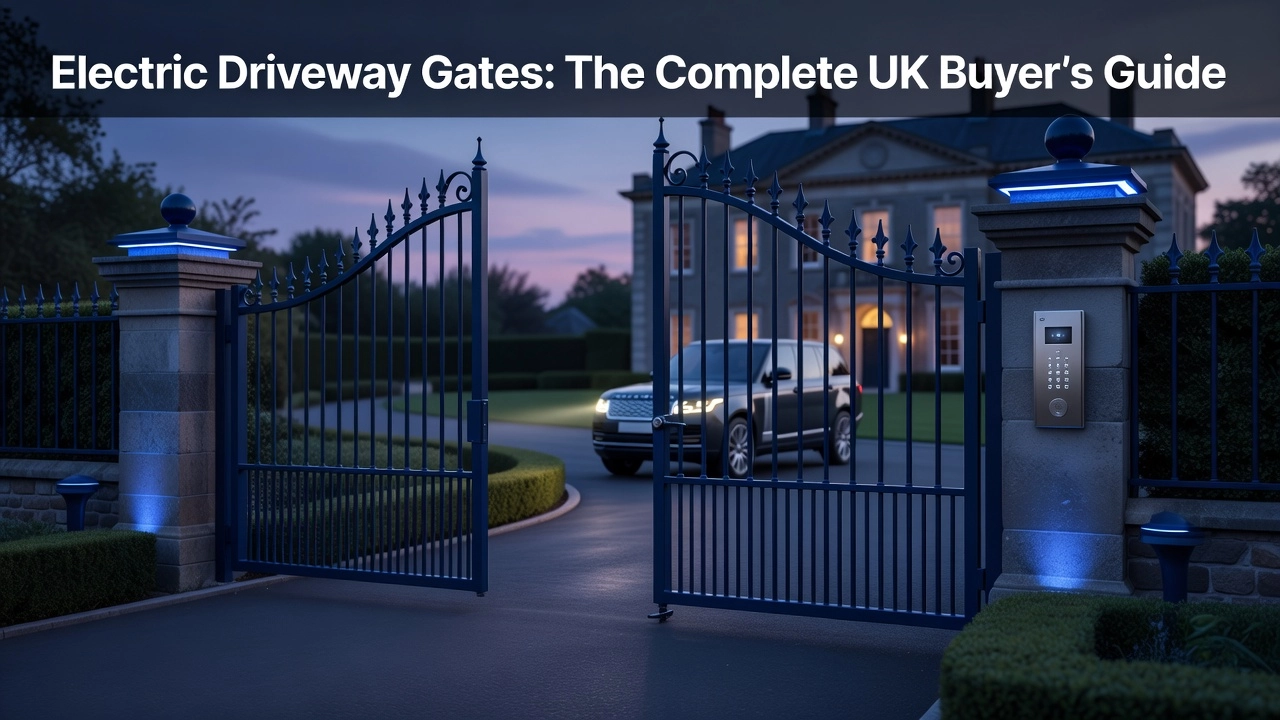
Securing your home has never looked better. Whether you are protecting your family, boosting your kerb appeal, or simply tired of getting out of the car in the rain, electric driveway gates are one of the smartest investments a UK homeowner can make right now.
But with so many styles, materials, and automation systems on the market, knowing where to start can feel overwhelming. Gate widths, motor types, safety regulations, planning permission, prices; the list of things to consider seems endless, especially if you have never bought a gate before.
That is exactly why we put this guide together. This complete UK buyer's guide to electric driveway gates will walk you through everything you need to know, from choosing the right gate style for your property to understanding installation costs and legal requirements. We have broken it all down into clear, digestible sections so that even a first-time buyer can make a confident, informed decision.
By the time you finish reading, you will know precisely what to look for, what to avoid, and how to get the best value for your budget.
What Are Electric Driveway Gates?
Electric driveway gates are motorised barrier systems designed to open and close without any manual effort, responding instead to authorised signals from remote controls, keypads, intercoms, or smart devices. Rather than a single component, a complete system is built from several integrated layers working in harmony. The four core hardware elements are the motor/operator unit, which physically moves the gate; the control board, which processes every signal and decision; safety devices such as photocells and pressure-sensitive edges; and the remote receiver, which accepts access signals from whatever input method you choose.
How the Drive Technology Actually Works
At the heart of every electric driveway gate is an electromechanical drive. When the motor receives an electrical input, it converts that energy into rotational or linear mechanical movement. That movement is then transmitted through a drive mechanism, typically a rack-and-pinion gear, screw drive, or articulated arm, directly to the gate leaf or sliding panel. For a swing gate, the arm pushes or pulls the leaf through its arc. For a sliding gate, the mechanism drives the panel along a ground track. The control board governs every stage of this cycle, managing soft start-stop speed ramping, direction reversal when an obstruction is detected, and the precise timing of each open and close sequence. According to market analysis from Fact.MR, electromechanical drive technology leads the market precisely because of its reliability, low maintenance demands, and strong compatibility with modern smart access control platforms.
Manual Gates vs. Automated Systems
A manual gate requires someone to physically open, swing, or slide the panel and secure it each time. An automated gate replaces that effort entirely. The motor responds to a permitted signal, completes the movement sequence, and holds or returns the gate without any human involvement. This distinction matters beyond mere convenience; automated systems also improve accessibility significantly for anyone with mobility challenges. Consumer demand for upgrading existing manual gates to automated ones is one of the documented growth drivers in this sector.
The Control Board: The Brain Behind the Gate
The control board deserves particular attention because it is far more than a simple on/off switch. It continuously monitors inputs from every safety device connected to the system. If a photocell beam is broken mid-cycle, the board halts or reverses movement immediately. If a pressure-sensitive edge registers contact with an obstacle, the response is automatic and instantaneous. Beyond safety, the board manages access control signals arriving from remote fobs, coded keypads, intercoms, RFID readers, and increasingly from mobile applications. Modern boards are IP-enabled, supporting remote diagnostics and integration with video surveillance and alarm systems. As noted in research from 360iResearch, fully specified systems now combine all of these elements into a single connected access-control platform.
A Fast-Growing Global Market
The scale of adoption reflects genuine, widespread demand. The global automated gate opening system market is valued at between USD 3.5 billion and USD 6.95 billion in 2025, with projections pointing toward continued strong growth through the next decade. Residential security is the dominant application, accounting for approximately 56% of market share in 2026. For homeowners considering an investment in electric driveway gates, that figure is reassuring confirmation that this technology is well-proven, widely adopted, and supported by a mature, competitive supply chain.
Types of Electric Driveway Gates
Not all electric driveway gates are built the same, and choosing the wrong configuration for your property can be a costly mistake. There are three primary gate types available for UK residential driveways: swing gates, sliding gates, and bi-folding gates. While personal taste naturally plays a role, the correct choice is ultimately determined by your site conditions, including the slope of your driveway, the space available on either side of the entrance, the proximity to the road, and the type of ground beneath the gate. Understanding these distinctions before committing to an installation will save you both money and frustration.
1. Sliding Gates
Sliding gates are the most widely installed gate type globally, holding approximately 51% of the automatic gate opening system product segment in 2026. That dominance is no accident. Sliding gates operate by moving laterally along a track or via a cantilever system, meaning they require no swing arc in front of or behind the opening. This makes them exceptionally well suited to driveways that sit close to a public road or pavement, or to properties where the ground slopes significantly. Rather than fighting gravity, a sliding gate simply moves parallel to the boundary.
The trade-off is that sliding gates require a run-back clearance along the fence line equal to at least the full width of the gate. Track-based systems also need solid, level concrete foundations; cantilever systems demand robust footings to support the gate's weight. Professionally installed automation for sliding gates typically falls in the range of £1,500 to £4,000 depending on gate size, material, and motor specification. For a detailed overview of how these systems compare, The Ultimate Guide to Electric Gate Types provides a useful independent reference.
2. Swing Gates
Swing gates are the traditional choice and the type most homeowners picture when they first consider automating their entrance. They open inward or outward on hinges and can be configured as a single leaf or double leaf depending on the width of the opening. Their primary advantage for retrofit projects is simplicity; hinge-mounted actuators can generally be fitted to existing brick or stone pillars without major structural alterations, making swing gates the most accessible starting point if you are automating a gate that is already in place.
The critical constraint is the swing arc. The gate leaf must travel through a clear arc equal to its own length, either in front of or behind the gate line. On short driveways, sloped approaches, or entrances close to the highway, this space simply may not exist. Automation costs for swing gates typically range from around £1,000 to £3,000, making them the more budget-accessible option in many scenarios.
3. Bi-Folding Gates
Bi-folding gates fold back on themselves along a central hinge point, meaning the clearance required is a fraction of what a conventional swing gate demands. They are also significantly faster to open and close than swing or standard sliding alternatives, making them well suited to busy entrances with frequent daily use. Wider residential openings where a sliding run-back is unavailable are a particularly strong application. Automation costs are generally higher, reflecting the more complex mechanical assembly, typically starting from around £3,000 and rising with gate size and material specification.
Quick Comparison at a Glance
Factor
Swing
Sliding
Bi-Folding
Space needed
Full swing arc
Side run-back
Minimal
Sloped driveways
Poor suitability
Excellent
Good
Aesthetic style
Traditional
Contemporary
Contemporary
Retrofit ease
High
Moderate
Moderate to complex
Typical automation cost
£1,000 to £3,000
£1,500 to £4,000
£3,000 and above
Ideal scenario
Flat driveways, period properties
Slopes, tight road access
Wide or high-frequency entrances
For a broader view of how gate configurations translate into real installations, Electric Gates UK: Cost, Types and Installation Guide for 2026 offers further context on current pricing and practical considerations across the UK market. Whichever type suits your property, a professional site survey is the essential first step to confirming which configuration is genuinely viable before any investment is made.
Swing Gates
Swing gates are the most popular choice for residential driveways across the UK, offering a classic aesthetic combined with reliable automated operation. Understanding the key configuration decisions before installation will save you significant time, money, and structural headaches later.
Single-leaf vs. double-leaf configurations come down primarily to your opening width and the available clearance on your driveway. A single-leaf gate uses one panel spanning the entire opening and works well for entrances up to approximately 4 metres wide. Beyond that width, the weight and leverage placed on a single hinge post becomes problematic, increasing wear on both the hardware and the automation system. A double-leaf configuration splits the opening across two panels that meet in the centre, which is the practical solution for wider entrances. Crucially, a double-leaf gate also requires far less driveway depth when swinging inward; a 3.6-metre double gate needs only 1.8 metres of clearance behind it, while a single gate of the same total width would require the full 3.6 metres. You can read more about how to decide between single and double swing gate configurations if you are weighing up both options for your property.
The two main automation methods for swing gates each suit different priorities. Underground actuators are buried directly beneath the gate at the hinge point, making them completely invisible when the gate is closed. This gives prestige and heritage installations a clean, uncluttered appearance with no surface-mounted hardware to distract from the gate design. The important consideration is maintenance; servicing an in-ground unit requires access to a sealed housing, so the quality of waterproofing is critical, as groundwater ingress is the most common cause of failure in these systems. Above-ground operators, either ram-style linear actuators or articulated arm operators, are mounted to the pillar face and the rear of the gate leaf. They are straightforward to inspect and service without disturbing any groundwork, making them a practical and cost-effective choice for most residential installations.
Pillar and hinge-point requirements are non-negotiable structural considerations that directly affect which operator you can use. Masonry pillars for heavier gates typically need substantial blockwork or reinforced concrete cores to withstand the cantilever loading of a heavy steel or iron leaf. Hinge fixings must penetrate deep into the pillar to resist both the dead weight of the gate and the dynamic shock loads generated by wind and repeated cycling. Ram operators apply push-pull forces to a bracket bolted onto the pillar face, so the pillar must have sufficient mass to absorb these without cracking. In-ground actuators transfer thrust forces into the post foundation, which must be properly engineered to prevent any movement over time.
Swing direction is a practical and regulatory consideration that many homeowners overlook entirely. Inward-swinging gates are the standard residential choice because they open onto your own property, reinforce security against forced entry, and avoid any encroachment onto public land. Outward-swinging gates are sometimes necessary on very short driveways, but if the gate arc sweeps over a public pavement, verge, or carriageway, you will likely need to consult your local highway authority before proceeding, as this may require formal approval under highway legislation. Always seek advice from your local council before committing to an outward-swinging design.
Sliding Gates
Sliding gates travel horizontally along the fence line rather than swinging into the driveway, making them a fundamentally different solution to the swing gate configurations covered above. The key practical requirement is a clear run-back space beside the opening equal to at least the full width of the gate leaf. This zone must remain completely free of obstacles such as utility boxes, planted borders, pillars, or parked vehicles. Without adequate run-back clearance, a sliding gate simply cannot be installed, so measuring this space accurately before specifying any system is essential.
Why sloped driveways demand sliding gates
If your driveway rises or falls away from the road, a sliding gate is almost always the correct choice. Swing gates operate on a fixed arc, and any significant gradient causes the bottom of the gate leaf to drag on the ground, bind against the surface, or create an uneven gap that worsens over time. A sliding gate avoids this problem entirely by moving parallel to the fence line rather than swinging across an uneven plane. This makes it the go-to recommendation for the many properties across East Sussex, West Sussex, and Kent where driveways are anything but level. As explained in this swing vs slide vs cantilever gate comparison, a sliding or cantilever system moves sideways rather than into uneven ground, resolving the slope problem completely.
Tracked versus cantilever systems
There are two principal sliding gate mechanisms, and understanding the difference helps you choose correctly. Ground-tracked systems, sometimes called V-track gates, run on a steel rail laid along the driveway surface, with rollers on the gate's lower frame engaging the track. They are generally more economical to install and suit clean, paved, level surfaces well. As outlined in this cantilever vs V-track guide, the trade-off is maintenance; tracks accumulate debris and can become problematic where drainage channels cross the entrance.
Cantilever sliding gates carry no ground contact at all. The gate is supported entirely by rollers mounted to posts beside the opening and counterbalanced by a rear extension, typically requiring approximately 1.5 times the opening width as run-back space. This makes cantilever the preferred choice wherever a floor track would interfere with vehicle tyres, catch grit, or obstruct drainage. Commercial sites and high-traffic entrances particularly benefit from the cantilever system's durability and lower long-term maintenance demands.
Security and safety benefits
Sliding gates are widely regarded as more secure than swing gates. The locking mechanism engages across the full travel of the gate rather than at a single latch point, making forced entry considerably more difficult. From a safety perspective, sliding gates eliminate the exposed hinge pivot that creates pinch and entrapment risks on swing gate installations, a meaningful advantage for households with children or pets. Safety edges and loop detectors at the leading edge and drive mechanism provide straightforward, standards-compliant protection.
Bi-Folding Gates
Bi-folding gates work on a straightforward but highly engineered principle. Rather than a single panel swinging or sliding in one direction, each side of the entrance features two panels that fold back against each other, connected by a top track and a bottom pivot point. This accordion-style action means the gate occupies roughly half the clearance space of a comparable swing gate when open, making bi-folding gates an excellent solution for driveways where space is restricted, entrances with sloping approaches, or any site where a standard configuration simply will not fit.
The speed advantage is where bi-folding gates genuinely stand apart from the alternatives covered above. A bi-folding gate can complete a full opening cycle in approximately 3 to 5 seconds, compared to the 10 to 20 seconds typical of swing or sliding gate systems. For homeowners making multiple daily trips, or for commercial premises with high vehicle throughput, that difference is significant. Bi-fold gates fold in on themselves to save space while offering dependable access control, combining speed with practical functionality whether the setting is a tight residential driveway or a busy commercial entrance.
That speed and precision comes at an engineering cost. The overhead beam carrying the top track must be structurally robust, and the tolerances across the entire system must be exact from the outset. Any misalignment in the posts, track, or pivot points will worsen over time under repeated cycling. Professional design and installation is therefore not optional; it is a technical necessity.
On the aesthetic side, bi-folding gates can be fabricated in steel, aluminium, or timber-effect composite materials, making them adaptable to both contemporary and traditional property styles. They are increasingly specified in upscale residential developments and commercial settings where a dramatic, high-impact entrance is part of the design brief.
Key Features to Look for in an Electric Gate System
Once you have selected the right gate configuration for your property, the next step is understanding what separates a basic automated gate from a properly engineered, future-ready system. The features below represent the core selection criteria every buyer should evaluate before committing to an installation.
Safety Devices
Safety is not optional on a powered gate system; it is a legal and ethical requirement. Photocells are infrared sensors that project an invisible beam across the gate opening. When any obstruction breaks the beam, whether a child, a pet, or a vehicle, the gate stops and reverses automatically, typically within one to two seconds. Best practice is to mount photocells at multiple heights, around 24 inches for smaller obstacles and 36 inches for adults, ensuring comprehensive detection across the full gate aperture. Pressure-sensitive safety edges provide a physical backup layer. Unlike photocells, which detect obstructions before contact, safety edges are contact strips fitted to the leading edge of the gate that trigger an immediate reversal the moment the gate meets resistance. This catches anything the beam may miss, such as a slow-moving object approaching at an angle. Soft start-stop technology completes the safety stack by gradually accelerating and decelerating the gate motor, reducing the kinetic impact force if the gate does reach an obstruction and lessening mechanical wear over the long term. Together, these three features form a layered, compliant safety system that meets EN 12453, the European standard governing powered gate safety.
Power Supply Options
Most residential gate operators run from a mains power supply, with a transformer converting standard household current to the low-voltage DC power the motor requires. This is the reliable baseline for the majority of UK properties. Battery backup units are an increasingly standard addition, keeping the gate fully operational during a power cut, which is particularly important for properties where a locked-closed gate would present an access or safety problem. For rural properties or eco-conscious installations, solar-compatible controllers are a practical and growing alternative. Modern solar gate systems deliver dependable performance when properly specified, and the technology has matured considerably in recent years.
Access Control Integration
The access control layer is where an electric gate system becomes genuinely tailored to your household. Remote fobs are the everyday baseline for vehicle users. Keypads allow PIN-based entry for visitors or tradespeople. Proximity and RFID fob readers suit higher-security or multi-user settings. Video intercoms, combining a camera with two-way audio, allow you to visually verify a visitor and grant access remotely. GSM and IP-based mobile app controllers complete the picture, enabling smartphone-based gate operation from anywhere. A layered strategy, combining daily fobs with a keypad for contractors and a video intercom for guests, gives you granular control over who enters your property and when.
Smart Home and IoT Connectivity
IP-enabled control boards are now moving gate automation firmly into the smart home space. These systems integrate with home automation platforms, support remote monitoring and live status updates via smartphone, and connect wirelessly to alarm panels and CCTV networks to create a unified perimeter security layer. Remote diagnostics mean that a qualified engineer can often assess a fault without attending site, reducing both downtime and call-out costs. For buyers already invested in a wider smart home ecosystem, gate compatibility is increasingly a baseline expectation rather than a premium feature.
Manual Override and Fail-Safe Modes
Every automated gate must include a mechanical release key that allows the gate to be disengaged from the motor and operated by hand during a power failure or complete system fault. This key should be weather-resistant, simple to operate, and stored in an accessible location known to all household members. Equally important is how the gate behaves when power or control is lost entirely. A gate protecting a high-security boundary may be configured to fail closed, remaining locked until power is restored. A gate on a fire egress route or in a setting where entrapment is a risk should be configured to fail open, ensuring people can always leave the property safely. Discussing this fail-safe configuration with your installer before the system is specified, not after, is one of the most important decisions in the entire process.
UK Safety Standards and Compliance for Electric Gates
Safety is not optional when it comes to electric driveway gates. With approximately 3 million automated gates currently installed across the UK and around 300,000 new systems added every year, the compliance picture is sobering: industry surveys have found that as many as 90% of gates fail to meet legal safety requirements. Understanding the standards that apply to your gate is not just about paperwork; it directly affects your liability, your insurance, and the safety of everyone who uses your property.
BS EN 12453: The Force Limit Standard Explained
BS EN 12453 is the key harmonised European standard governing the safety of power-operated pedestrian and vehicle gates, and it remains fully in force under UK law following Brexit. In plain terms, it sets the maximum force that an automated gate is permitted to exert when closing, in order to prevent entrapment injuries. The standard specifies a peak dynamic closing force of no more than 400 Newtons and a quasi-static force limit of 150 Newtons at any point along the gate's travel. If a gate's drive system cannot be mechanically configured to stay within these limits, the installer must compensate by fitting additional safety devices such as safety edges, photocells, or light curtains at the relevant contact points. Every compliant installation must demonstrate, by measurement or device, that these thresholds are met.
BS EN 13241: The Product Safety Standard
BS EN 13241 (updated as EN 13241:2003+A2:2016) is the harmonised standard that addresses the performance and safety of industrial, commercial, and garage doors and gates as products placed on the market. Where BS EN 12453 focuses on operational force limits, BS EN 13241 covers the gate as a physical product: its structural integrity, wind resistance, thermal performance, and safe behaviour under failure conditions. This standard is particularly relevant for commercial properties, agricultural entrances, and larger residential installations where the gate itself must be demonstrated to meet defined performance benchmarks before it is installed.
Machinery Classification and the Declaration of Conformity
Automated gates are legally classified as machinery under UK product safety legislation, derived from the retained Machinery Directive. This classification carries real obligations. The installer or manufacturer must compile a technical file containing the risk assessment, design drawings, test records, and instructions for use, and must issue a Declaration of Conformity confirming the installation meets all applicable standards. Before Brexit, this was evidenced by a CE mark; UK-market products are now transitioning to the UKCA mark, though CE marks have retained transitional validity during the changeover period.
Entrapment Risk Zones You Must Protect
The specific hazard zones around an electric gate are well-defined. The closing edge (where the gate meets the post or strike point), the hinge or pivot point on swing gates, the leading edge during travel, and the gap between the gate and any adjacent fixed structure all represent areas where a person, child, or animal could be crushed, trapped, or sheared. Each zone requires either a demonstrated force-limit solution or a dedicated safety device. Photocells and light curtains interrupt the gate's travel cycle if a beam is broken; pressure-sensitive safety edges trigger an immediate stop or reversal on contact; and correctly configured auto-reverse functions provide a last line of defence.
Why Professional Installation Is Non-Negotiable
A professionally installed electric gate system is not simply a convenience; it is the mechanism by which all of the above obligations are met and evidenced. A competent installer conducts a site-specific risk assessment (because, as the HSE notes, automated gates are frequently unique machines and no generic document is sufficient), selects the appropriate safety device for each identified risk zone, commissions the system to verified force limits, and provides the homeowner with a complete Declaration of Conformity and technical file. This documentation is increasingly scrutinised by insurers and conveyancers when a property changes hands. While health and safety law does not apply directly to private domestic homeowners, civil liability for any harm caused by a non-compliant gate remains fully in place, making professional installation the only responsible choice.
Do Electric Driveway Gates Need Planning Permission?
For most homeowners in England, the good news is straightforward: the majority of residential electric driveway gate installations do not require planning permission. Under the Town and Country Planning (General Permitted Development) Order 2015, gates fall within permitted development rights provided they meet specific height thresholds. If your gate is adjacent to a highway used by vehicles, it must not exceed 1 metre in height. If it sits elsewhere on your boundary, the limit rises to 2 metres. Stay within these measurements, and you can proceed without submitting a planning application to your local authority.
When Planning Permission Is Required
Several circumstances remove the protection of permitted development rights and make a formal planning application mandatory. The most common trigger is simply exceeding the height thresholds described above. Beyond that, properties in conservation areas face stricter controls, as the character and appearance of these designated zones are protected by law. Properties in Areas of Outstanding Natural Beauty and World Heritage Sites carry similar restrictions. If your home is a listed building, or sits within the curtilage of one, you will need both planning permission and listed building consent, even for a gate that would be entirely permissible elsewhere. Finally, Article 4 Directions issued by local planning authorities can withdraw permitted development rights across defined geographic areas, meaning a formal application becomes required regardless of gate height. Existing planning conditions on your title, particularly common on newer housing estates designed with open-plan layouts, can impose equivalent restrictions.
Planning Permission, Building Regulations, and Product Safety Are Three Separate Things
A common source of confusion is conflating these three distinct legal frameworks. Planning permission addresses whether the gate structure is acceptable in land-use terms: its height, location, and visual impact on the surroundings. Building regulations, which govern structural safety in new dwellings and major alterations, do not apply to standard domestic gate installations in the same way. However, product safety compliance is entirely separate and non-negotiable. Any electric gate system installed in the UK must comply with BS EN 12453 (the standard governing force limitations and safe use of powered pedestrian and vehicular gates) and must carry UKCA marking under the post-Brexit machinery safety framework. These obligations fall on the installer independently of planning status. You can find further detail on planning permission for driveway gates via the Jacksons Fencing resource.
Practical Guidance for East Sussex, West Sussex, and Kent Homeowners
East Sussex, West Sussex, and Kent contain a significant number of designated conservation areas, particularly across historic towns and villages such as Lewes, Rye, Tunbridge Wells, and Canterbury. Before ordering any gate system, check your local authority's planning portal for Article 4 Directions or conservation area designations affecting your specific address. You should also verify listed building status through the Historic England National Heritage List. At Portara Automation, our site survey process includes identifying any planning constraints at your property before design work begins, ensuring there are no unwelcome surprises after fabrication has started.
Dropped Kerb Considerations
One additional approval is frequently overlooked. If your new gate installation involves creating or widening a driveway access onto a public road, you will need a separate dropped kerb application submitted to the relevant county council highways department. This applies in East Sussex, West Sussex, and Kent regardless of whether your gate falls within permitted development. It is an entirely separate process with its own application, assessment, and approval timeline, so factoring it into your project schedule from the outset avoids unnecessary delays.
How Much Do Electric Driveway Gates Cost in the UK?
Cost is one of the first questions homeowners ask, and it is entirely reasonable to want a clear picture before committing to a project. The honest answer is that prices vary considerably depending on what you are buying, but the ranges below give you a reliable framework for budgeting a standard residential installation in 2026.
Indicative Installed Cost Ranges by Gate Type
Swing gate pairs are the most common residential choice and typically represent the most accessible entry point into electric gate ownership. A fully installed swing gate pair, including operators, control board, safety devices, and basic remote control, generally ranges from around £3,000 to £8,000. The lower end of that range reflects a standard steel or aluminium gate on a straightforward site; the upper end reflects larger, heavier gates with premium fabrication or upgraded access control.
Sliding gates carry a higher base cost because they demand more substantial groundwork, including track preparation, drainage provision, and a more powerful motor to manage the cantilevered weight of the panel. Budgeting between £4,000 and £10,000 installed is a realistic guide for most residential sliding gate projects.
Bi-folding gates sit at the premium end of the market. Their engineering complexity, heavier-duty operators, and the precision fabrication required to achieve smooth folding action push costs to £6,000 to £15,000 or more for bespoke fabricated steel designs.
Key Factors That Affect Final Price
Several variables explain why two installations of the same gate type can differ by thousands of pounds. Gate material has a significant effect: mild steel is the most cost-effective fabricated option, aluminium adds corrosion resistance at a mid-range premium, and stainless steel commands the highest material cost. Timber-infill panels within a steel frame add further cost depending on the timber species chosen.
Overall gate width and height matter too. Wider entrances and taller panels require heavier-gauge steel, larger posts, deeper foundations, and more powerful operators, all of which push the budget upward. The operator specification itself is another major variable; entry-level residential motors are considerably cheaper than commercial-grade units designed for high daily cycle rates. Groundworks, cable ducting, and any reinstatement of hard-standing surfaces also make up a meaningful proportion of total project cost on more complex sites. Bespoke fabrication or custom design work adds further investment but delivers a result that standard off-the-shelf panels simply cannot match.
Retrofitting Versus a Full New Installation
If you already have a structurally sound manual gate that is physically suited to automation, retrofitting an electric operator is typically far more cost-effective than replacing the gate entirely. Where the existing gate structure is in good condition, with adequate post strength and correct clearances, automation kits and installation generally range from around £800 to £2,500 depending on operator type and any minor remedial work required. The important caveat is that if existing posts are inadequate or the gate panels are warped or overweight for standard operators, retrofit costs can rise quickly toward full replacement territory.
Access Control Cost Tiers
Access control is frequently underestimated in initial budgets. A basic two-channel remote control system adds minimal cost and is often included within the standard automation package. A standalone keypad adds a modest few hundred pounds. However, a full video intercom with GSM or IP connectivity, smartphone app integration, and a proximity reader can add £800 to £2,500 to the overall project budget, depending on system complexity and cabling requirements.
Get an Accurate Quote for Your Property
Published cost ranges are a useful starting point, but your final price depends heavily on your specific site. Driveway width, ground conditions, proximity to a power supply, and your access control requirements all vary from one property to the next. The most reliable way to understand your true budget is to arrange a no-obligation site survey with the Portara team, who can assess your site, recommend the right gate type and operator, and provide a detailed quote with no pressure to proceed.
Maintaining Your Electric Driveway Gates
Once your electric driveway gates are installed and operational, protecting that investment comes down to one consistent habit: regular, professional maintenance. Industry guidance is clear that residential electric gate systems should receive a minimum of one professional service visit per year. That annual visit should cover lubrication of all mechanical components, including hinges, rollers, the rack or drive arm, and operator pivot points, using the correct lubricant type for each component as specified by the manufacturer. It should also include a full inspection and live testing of every safety device on the system: photocell alignment and response times, pressure edge sensitivity, and obstacle detection performance. Finally, a qualified engineer should review the control board settings, check for stored fault codes, and assess the condition of the battery backup unit. Most backup batteries have a working lifespan of one to three years, and a failed battery discovered during a service is far preferable to one discovered during a power cut.
Warning Signs You Should Never Ignore
Between annual services, the gate system itself will often signal that something is developing before a full breakdown occurs. Slower-than-normal opening or closing cycles are frequently the first indicator of a motor or mechanical issue. Unusual grinding or clicking sounds during operation typically point to worn components or lubrication failure. If the gate reverses unexpectedly mid-cycle, the cause is usually a misaligned photocell or an over-sensitive pressure edge rather than a major electrical fault, but it still requires prompt attention. A gate that consistently fails to reach its fully open or closed position suggests a limit switch problem or a developing obstruction. Reduced remote control range indicates battery degradation, antenna damage, or receiver failure. Any fault codes appearing on the control board display should be treated as a direct instruction from the system to call a professional, not as a message to be dismissed until something stops working entirely.
Repair or Replace: A Practical Framework
Not every fault justifies a full system replacement. Minor issues such as worn motor brushes, a failed photocell, or a damaged remote receiver are cost-effective repairs on a gate that is structurally sound and less than 10 to 15 years old. However, if the operator itself has suffered major failure on an older system, or if the gate posts, leaf, or ground track show meaningful structural deterioration, a full replacement will typically be both more economical and considerably safer over the long term.
Predictive Maintenance and Remote Diagnostics
Modern IP-enabled control boards are changing how servicing works. Installers can now monitor motor current draw and operating cycle data remotely, identifying anomalies such as rising current that indicates increased mechanical resistance before they result in a failure. This predictive capability reduces emergency callouts and system downtime significantly, and it represents a meaningful step forward in how gate systems are maintained.
Portara Automation offers dedicated servicing and repair for electric driveway gates across East Sussex, West Sussex, and Kent, whether as the original installer or as a local specialist taking over aftercare responsibilities. Professional servicing through a qualified provider ensures your system remains compliant with UK safety standards including BS EN 12453, keeps any applicable manufacturer warranties valid, and gives you documented evidence that safety obligations have been met.
Why Choose a Bespoke Local Specialist Over a National Supplier?
Understanding who actually delivers your gate project matters far more than most buyers initially realise, and the market structure explains why.
The Brand on the Motor Is Not the Whole Story
The electric gate industry operates on a two-tier model. Global hardware manufacturers such as FAAC, BFT, CAME, and Nice produce motors, control boards, and automation components to a high technical standard. However, these manufacturers do not typically install their own products. They supply equipment through regional and local installers, which means the quality of your finished installation depends almost entirely on the competency of the company you hire, not the label on the motor housing.
This distinction carries real consequences. A gate automation system is a safety-critical installation involving moving machinery, electrical connections, access control programming, and a legal duty of care to every person who might interact with the gate. The risk assessment, compliance documentation, commissioning records, and aftercare schedule are all responsibilities that sit with the installer. A premium motor fitted poorly, without a proper force-limitation test or adequate safety edge installation, is a liability rather than an asset.
Bespoke Fabrication Versus Off-the-Shelf Panel Gates
Standard catalogue gates are manufactured to fixed widths and heights for cost efficiency. That approach works for straightforward openings, but it falls short for the huge variety of real-world sites. An unusually wide driveway entrance, a sloped approach, a listed property requiring sympathetic ironwork, or a farm gate designed to handle agricultural vehicles all demand something more considered.
A specialist who designs and manufactures gates in-house can produce a gate sized precisely to the opening, weighted correctly for the chosen drive system, and finished to complement the property's specific architectural character. Across East Sussex, West Sussex, and Kent, that architectural variety is considerable; flint-faced cottage walls, Victorian brick piers, and weatherboarded rural outbuildings each call for a different design response. For complex sites requiring ANPR, GSM modules, or multi-zone access control, in-house fabrication also allows the structural specification and the automation specification to be engineered together from the outset, rather than one being retrofitted around the other.
One Team, One Responsibility
When a gate is manufactured by one company, installed by a second, and supported by a third-party access control provider, accountability for any failure becomes a negotiation between suppliers. The homeowner is caught in the middle of that conversation at exactly the moment they least want to be.
Portara's model removes that ambiguity. As a specialist who designs, fabricates, installs, and services gate systems across East Sussex, West Sussex, and Kent, a single team holds the fabrication drawings, the installation records, and the service history. If something needs attention, whether mechanical, electrical, or access-control-related, there is no question about who to call and no dispute about whose scope the problem falls within.
Local knowledge reinforces this further. Regional planning constraints, the clay-heavy soils of the Weald that affect post-foundation depth for sliding gate installations, and familiarity with conservation area requirements all influence what will work on a specific site. That contextual judgement is something a national web-based supplier dispatching an unfamiliar fitter cannot reliably replicate.
Take the First Step With a Free Site Survey
The only way to know the right gate configuration for your entrance, the correct motor specification for your site conditions, whether planning consent applies, and what the project will realistically cost is to have a specialist assess the property in person. Portara offers a free, no-obligation site survey covering exactly those questions. It is a low-commitment starting point that gives you a clear picture of what is possible, what is required, and what it will cost for your specific property, with no pressure to proceed. Get in touch with Portara to arrange your survey and take the first step towards a gate system built precisely for your property.
Making the Right Choice for Your Property
Four decisions define every successful electric driveway gate project. First, gate type: swing, sliding, or bi-folding, selected on the basis of your driveway's slope, width, and available space rather than aesthetics alone. Second, automation and access control specification, covering the motor technology, intercom, remote access, and smart integration that suits your daily routine. Third, compliance with UK safety standards, ensuring your system meets the requirements that protect your household and visitors from entrapment hazards. Fourth, whether you are starting from scratch or retrofitting automation onto existing manual gates, since each route carries different structural and engineering considerations.
The UK is one of Europe's most active and fastest-developing markets for automated gate systems, meaning the technology, installer base, and product range available to homeowners right now is stronger than it has ever been. That abundance makes choosing the right specialist more important, not less.
A free site survey resolves most of the uncertainty before any commitment is made. It confirms which gate configurations are physically possible on your plot, flags any planning or compliance considerations specific to your property, and produces a realistic written cost estimate.
Portara Automation offers exactly that service across East Sussex, West Sussex, and Kent. As a local specialist handling design, manufacture, installation, and aftercare under one roof, we remove every layer of uncertainty from the process. Get in touch today for your free, no-obligation site survey and quote.
Conclusion
Choosing the right electric driveway gate does not have to be complicated. You now know the key factors that matter most: selecting a gate style and material that suits your property, understanding the automation systems available, budgeting realistically for installation and maintenance, and staying compliant with UK safety standards and planning regulations.
The right gate adds genuine value to your home, improves security for your family, and makes everyday life noticeably more convenient.
Now it is time to take the next step. Use what you have learned here to compare suppliers, request quotes, and ask the right questions with confidence. Whether you are just starting your research or ready to buy, you are now equipped to make a smart, informed decision.
Your perfect driveway gate is closer than you think. Start exploring your options today.