
Electric Gate Installation Costs Explained: What You'll Actually Pay in 2026
Understand the real cost of electric gate installation in 2026. From materials and motors to groundworks and compliance, we break down every cost driver.
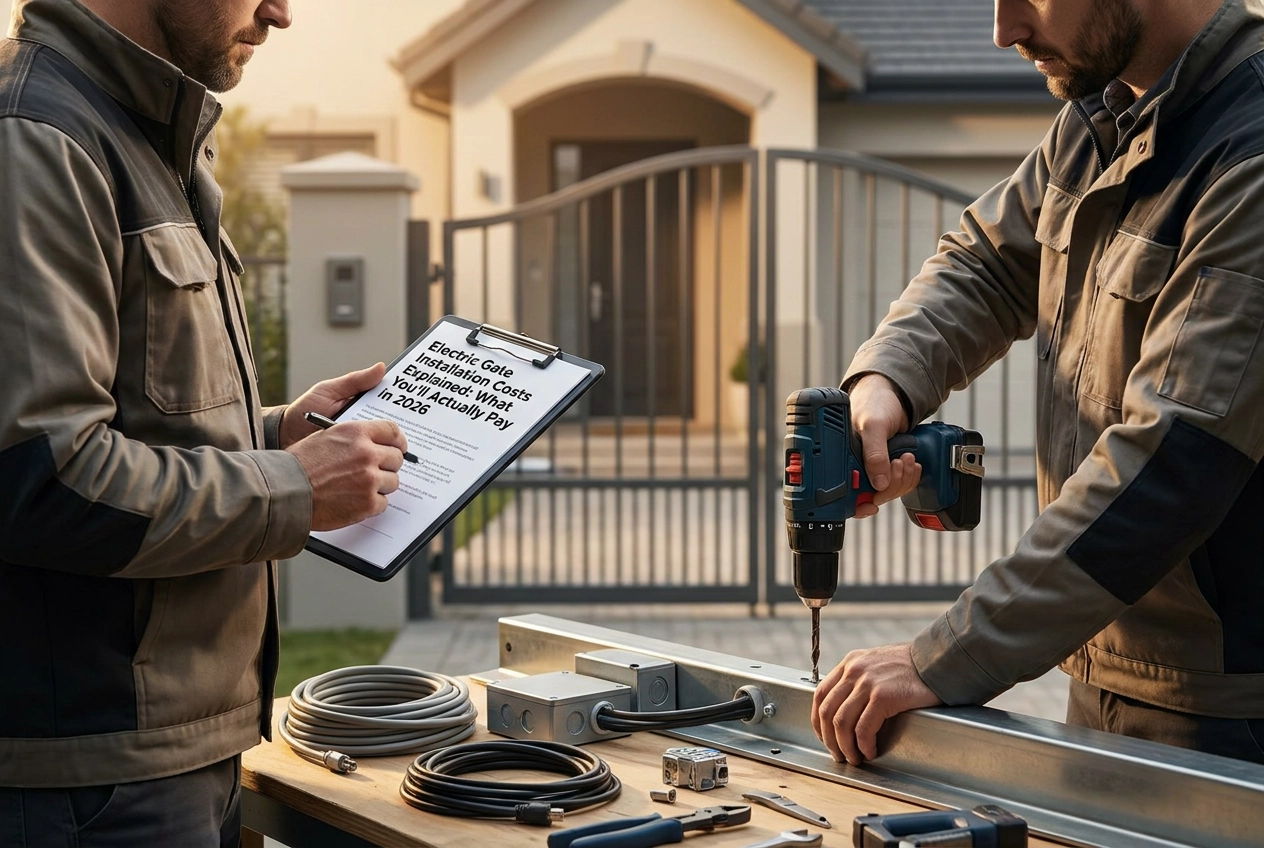
Most online guides tell you electric gates cost "anywhere from £2,000 to £15,000" and leave you to figure out the rest. That range is technically accurate, but it is almost useless when you are trying to plan a real project with a real budget.
Electric gate installation cost is not a single number. It is the result of at least six separate variables working together: gate type, material, automation system, access control, groundwork requirements, and compliance obligations. Change one of those variables and the final figure can shift by thousands of pounds. Understanding how each factor influences the total is the difference between setting a realistic budget and being blindsided by your first quote.
This guide breaks down every major cost driver in plain terms, with indicative price ranges for common residential configurations. You will learn why sliding gates typically cost more than swing gates, what labour and groundwork actually contribute to the total, and how to read competing quotes on merit rather than headline price alone. By the end, you will have a clear framework to scope your project confidently before a single contractor visits your property.
Why Electric Gate Installation Prices Vary So Widely
Most residential electric gate installations cost between £5,000 and £12,000+, but that headline range tells you almost nothing useful on its own. A single-leaf swing gate on a flat driveway with a basic remote fob sits at a completely different price point to a double sliding gate with video intercom, CCTV integration, and substantial groundwork. Both fall within that range. Neither is the same project.
Six variables determine where any specific installation lands: gate type and configuration, material selection, automation system specification, access control technology, groundwork and electrical infrastructure, and compliance obligations. This article examines each in detail, with indicative figures, so you can scope your project before the first quote arrives rather than after.
The gap this piece is designed to close is a real one. Generalist cost guides report ranges without explaining which combination of decisions pushes a project to the bottom, middle, or top of them. If you understand what moves the number, you can identify where a low headline price reflects genuine simplicity and where it reflects an incomplete scope.
One thing surprises most first-time buyers: the gate itself is rarely the largest line item. Automation hardware, electrical infrastructure, and groundwork frequently account for more than half the total cost. For a deeper overview of what affects the price of electric gate installation, that context matters before you request a single quote.
Labour alone typically runs to £4,000 to £6,000 or more, and that figure does not include the gate or the automation system. Understanding that distribution early means you can evaluate competing quotes on merit, spot omissions, and make informed decisions about where to invest and where a simpler specification is entirely adequate.
Gate Type and Configuration: The First Major Cost Variable
Gate configuration is the first decision that shapes your budget, and the cost hierarchy between types is consistent enough to use as an early planning tool.
Swing gates are the lower-cost starting point for automation. They require shallower foundations than sliding alternatives and simpler groundwork overall. That base price, however, is conditional: a sloped driveway may require uphill-opening adjustments or hydraulic operators, limited clearance behind the gate line adds engineering complexity, and posts that are not structurally sound will need replacement before any automation can be fitted.
Sliding gates sit higher in the cost hierarchy as a category. A ground-track system must be laid into or alongside the driveway surface, drainage channels are needed to prevent debris blocking the track, and the motor operator must be sized to handle the full cantilevered weight of a leaf spanning the opening. Groundwork is more disruptive and more expensive than for swing equivalents.
Cantilever sliding gates remove the ground track entirely, which benefits driveways where a clean surface or drainage requirements make tracking impractical. The trade-off is a gate leaf longer than the opening width to provide the counterbalance run, plus heavier-duty automation to manage the additional load. This makes cantilever systems the premium choice for commercial entrances or high-traffic residential sites. For a full comparison of how these configurations differ structurally, see the guide to types of electric driveway gates.
Double-leaf configurations cost more than single-leaf in every category. Two motor operators, a synchronised control system, and additional wiring runs all add to both supply and installation costs.
Bi-folding gates suit short driveways where a full swing arc is not available. The additional leaves, hinges, and automation complexity push costs above a standard swing gate of equivalent width, making them a practical solution but not an economical one.
Material Costs: Steel, Aluminium, and Timber Compared
Once gate type and configuration are settled, material choice becomes the next significant lever on cost.
Mild steel is the most widely used material in bespoke residential and commercial gate installations. It is weldable, structurally strong, and highly adaptable to custom fabrication, including CNC plasma-cut decorative panels and intricate infill patterns. The trade-off is corrosion vulnerability: mild steel gates must be galvanised, powder coated, or both to resist rust. That surface treatment adds to the upfront material cost but is non-negotiable for long-term performance.
For properties across East Sussex, West Sussex, and Kent, where coastal salt air and semi-rural damp conditions accelerate corrosion, galvanised and powder-coated steel is particularly well suited. The upfront premium typically pays for itself through reduced maintenance over the gate's service life.
Aluminium typically carries a higher per-leaf cost than mild steel in bespoke configurations, but it offers genuine compensating advantages. It is inherently corrosion-resistant, requires no surface treatment to prevent rust, and is considerably lighter. That reduced weight matters beyond aesthetics; lighter gate leaves place lower load demands on motor operators, which can partially offset the higher material cost when the full system is priced. For a detailed comparison of how these metals perform in practice, Steel, Wrought Iron or Aluminium: Which Metal is Right for Your Gate? covers the trade-offs directly.
Timber carries the lowest entry-level material cost, but that figure rarely tells the full story. Hardwood and softwood gates require regular treatment to maintain structural integrity, are heavier than aluminium, and are generally considered unsuitable for fully automated systems in high-use settings. Seasonal moisture absorption can cause dimensional movement that affects automation hardware and accelerates mechanical wear.
Custom design complexity applies across all materials. Laser-cut decorative panels, bespoke infill patterns, and CNC plasma-cut motifs each add fabrication time and material cost. Buyers who treat design as a late-stage decision frequently find it disrupts an otherwise settled budget; raise it at the first quoting conversation, not the last.
Automation System Costs: Motors, Controls, and Infrastructure
Once material selection is settled, the automation system becomes the next significant cost decision, and it is where many buyers are caught off guard.
Motor operators sit at the heart of any automatic gate installation. For swing gates, the main choice is between above-ground electromechanical arm operators, suited to lighter residential use, and hydraulic ram systems, which handle heavier gates or high-cycle commercial applications. Hydraulic operators carry a higher unit cost but are better specified for demanding environments. For a detailed breakdown of what different operator types cost and what each delivers, this guide to automatic gate motor costs and budgeting is worth reading before you request quotes.
Underground operators for swing gates conceal the mechanism below the gate post, producing a cleaner finish. That aesthetic comes at a price premium over surface-mounted equivalents, both in the unit itself and in the additional installation labour. They also require proper drainage provisions; water ingress into an underground housing is a common cause of premature failure and a cost that surface-mounted installations avoid entirely.
Sliding gate motors are a separate product category, sized to the gate's weight and expected daily cycle count. Choosing an undersized motor to reduce upfront cost is a false economy; it accelerates wear, shortens service life, and increases maintenance frequency over the system's lifetime.
Safety components are not optional. Under the UK powered gate safety framework, control boards, safety edges, photocells, and loop detectors are mandatory elements of a compliant installation. Any quote that excludes them is either incomplete or non-compliant; neither is acceptable.
Battery backup systems add to the upfront cost but maintain gate function and safety during power cuts. For rural and semi-rural properties across Sussex and Kent, where brief outages occur, and for most commercial sites, backup power is a practical necessity rather than a luxury.
Access Control Costs: Intercoms, Keypads, and Smart Integration
With the motor operator and safety infrastructure specified, access control is the next decision, and one of the most variable cost lines in the entire project.
At the lower end, a basic remote fob system adds relatively little to the overall budget. At the upper end, a multi-user video intercom with RFID reader, keypad entry, and smartphone integration represents a substantially larger investment. The gap between those two configurations is wide, and it is worth understanding what drives it before committing to equipment.
Video intercoms are a widely specified access control option for residential electric gates. They allow visual verification of visitors before the gate releases, which is the primary reason most homeowners choose them over audio-only alternatives. Cost scales with camera resolution, whether the system uses a wired GSM or IP architecture, the specification of any indoor monitor, and the number of call points required. Smart home-compatible units with touchscreen monitors sit at the top of that range. For a detailed breakdown of how these systems are specified and priced together, the guide on Access Control Integration: Intercoms, Keypads, and Video Entry covers each component in depth.
Keypads and RFID readers are rarely installed as standalone solutions. They are typically added alongside an intercom to give regular users, family members, staff, or contractors, a fast entry method without triggering a call. Budget for them as part of a single access control package rather than as separate items.
Smartphone-controlled access via GSM diallers or gate apps removes the need for an indoor monitor entirely. Integration costs vary depending on whether the system runs independently or connects into an existing smart home platform; the latter generally costs more.
CCTV is a separate budget line, but compatibility matters. Specifying access control and CCTV together from the outset is consistently less expensive than retrofitting mismatched systems after installation.
Groundwork and Electrical Infrastructure: The Hidden Cost Driver
Access control choices shape the upper half of your budget; groundwork and electrical infrastructure quietly reshape the lower half too, and they catch more buyers off guard.
As noted earlier, labour represents £4,000–£6,000 or more; a significant share of that figure is groundwork: post foundations, cable ducting, surface reinstatement, and, for sliding gates, track installation. Buyers comparing headline gate prices frequently overlook these items entirely.
Post foundations are not a formality. They must be engineered to the specific weight and leaf span of the gate being installed. Undersized foundations allow posts to shift over time, which gradually misaligns the automation components and creates costly remediation work. On soft, waterlogged, or made-up ground, which is common across parts of East Sussex and the wider region, foundation requirements increase substantially and so does the cost.
The electrical supply is its own budget line. A dedicated circuit must run from the property's consumer unit to the gate position, typically in armoured cable through conduit or ducting. On a long driveway, that cable run alone adds meaningfully to the electrical installation cost. If the existing consumer unit has no spare capacity, an upgrade or sub-board may be required before any gate work can begin.
Sliding gate installations carry proportionally heavier groundwork costs than swing alternatives. A ground track requires trenching into the driveway surface; a cantilever system requires an extended counterbalance run alongside the opening. Either route involves more disruption and reinstatement than swing gate foundations. For a full picture of what that means in practice, see our breakdown of Electric Sliding Gate Costs in the UK.
Finally, if existing posts or piers are already in place, do not assume they can be reused without assessment. Structurally sound posts, correctly positioned for the chosen automation system, can save cost. Posts that are not will need remediation, and that cost must be scoped from the start rather than discovered mid-installation.
Compliance and Safety Obligations: What the Regulations Add to the Budget
Groundwork and electrical infrastructure are not the final budget variable. Regulatory compliance carries its own cost, and it is not negotiable.
Automated gates in the UK fall under the Supply of Machinery (Safety) Regulations 2008, which carries the Machinery Directive into retained UK law. Installations must meet BS EN 12453 requirements for force limitation and entrapment prevention. This is a legal obligation, not a quality upgrade. Any quote that does not itemise safety devices should be queried before proceeding.
Mandatory safety components include safety edges or pressure-sensitive strips on the leading and trailing edges of the gate leaf, photocell beams across the opening, and correctly configured force-limiting settings on the motor operator. Each has a supply cost and an installation labour cost. They must appear as line items in any compliant quote. If they do not, ask the installer to account for them explicitly before proceeding.
A responsible installer delivers a declaration of conformity and a written risk assessment as part of the handover package. These are not optional additions. If a quote makes no mention of compliance documentation, treat that as a warning sign. For a fuller overview, the UK Safety Standards and Compliance for Residential Electric Gates guide covers the key obligations in detail.
If you are automating an existing manual gate, compliance introduces a further cost consideration. Hinge ratings, leaf weight, and post structural integrity all determine whether the gate can be safely automated. Remediation work such as reinforcing hinges or replacing posts must be scoped and costed before a motor operator is selected.
On planning permission: most residential electric gate installations do not require consent, but exceptions exist. Gates above certain heights, particularly on boundaries adjoining a highway, may require planning permission, check with your local planning authority. Listed building or conservation area designations add further obligations. A pre-application enquiry to the local planning authority is a modest cost on complex sites and worth factoring in early.
Indicative Cost Ranges by Gate Type and Specification
With the compliance obligations established, it helps to see where different project types actually land in monetary terms.
Entry-level automated swing gate (single leaf, mild steel, surface-mounted operator, basic remote control, standard groundwork): expect to pay toward the lower end of the overall £3,000–£8,000+ residential range, assuming no significant site complications. This represents the most straightforward residential specification available.
Mid-specification double-leaf swing gate (powder-coated steel or aluminium, underground operators, video intercom, keypad entry, standard groundwork): expect to pay in the mid-to-upper portion of the £6,000–£,12000+ range. Gate size, design complexity, and the cable run distance from the gate position to your consumer unit all move the number within that bracket.
Sliding gate installation (mild or galvanised steel, track or cantilever system, appropriately rated operator, access control package, extended groundwork): residential specifications typically fall at or above the upper end of the £7,000–£14,000+ residential range. For a fuller breakdown of what drives sliding gate pricing specifically, the dedicated guide on how much an automatic sliding gate costs in the UK covers that in detail. Gate weight, site complexity, and access control specification all push costs upward from the base figure.
Bespoke and heavily customised gates, including CNC plasma-cut decorative panels, ornate ironwork, or non-standard sizes, carry a fabrication premium that sits on top of the installation cost. Treat custom fabrication as a separate budget line; it is not absorbed into a standard installation quote.
These figures are indicative benchmarks. The only reliable number for your specific project comes from a site-assessed quote produced by a specialist installer who has physically surveyed the driveway, evaluated the electrical infrastructure, and specified the automation system to the actual gate weight and usage requirements.
Ongoing Maintenance and Long-Term Costs to Budget For
Those indicative price ranges represent your installation investment; the following costs are what you will spend to protect it.
Annual servicing is the most predictable ongoing expense. A professional service visit covers lubrication of mechanical components, safety device testing, limit switch adjustment, and firmware checks on the control board. Expect a predictable annual cost that is modest relative to what neglected maintenance eventually costs.
Motor operator lifespan is directly tied to duty cycle and maintenance discipline. A residential operator running 10–20 cycles per day in a well-maintained system will outlast the same unit running 50+ daily cycles in a commercial setting without regular servicing. The difference in service life can be substantial. Ask your installer for a realistic expectation based on your specific usage level before committing to a motor specification.
Battery backup systems require replacement on a periodic schedule determined by battery chemistry and usage frequency. The cost is minor, but it belongs in your long-term budget, particularly where power outage operation is a safety or security requirement rather than a convenience.
Access control equipment ages differently from the gate and motor hardware. Intercom units with cameras and touchscreens have a shorter functional lifespan than the gate and motor hardware; budget for a technology refresh separately rather than treating the access control as a permanent installation.
The single most common cause of premature gate failure or safety defects is skipped routine maintenance. An annual service agreement with your installer spreads this cost predictably and ensures that wear is identified before it escalates into operator replacement or structural remediation. The arithmetic is straightforward: consistent servicing costs far less than the failures it prevents.
DIY vs. Professional Installation: Why the Cost Differential Exists
Maintenance costs are largely predictable. The decision about who installs the system in the first place carries a different kind of risk entirely.
Gate automation kits are available from trade suppliers and online retailers, and the appeal of self-installation is straightforward: the upfront saving appears real. It is, to a point. What is equally real is that an improperly installed automated gate is a safety hazard under UK law, and liability for any incident sits with the person who carried out the installation, not the kit manufacturer.
Professional installation costs reflect far more than fitting time. A compliant installation includes foundation engineering, a dedicated electrical circuit certified to Part P, safety device commissioning, and a full compliance documentation package, none of which come in a kit box.
Groundwork is the cost element DIY buyers most consistently underestimate. Incorrect post foundations are among the most common causes of automation failure within the first few years of operation. Post movement misaligns mechanical components, and the cost of remediation once the driveway has been reinstated and the automation commissioned is consistently higher than correct installation at the outset would have been.
Retrofit projects carry an additional risk. Fitting a motor operator to an existing manual gate requires professional assessment of the gate's structural suitability before a motor is selected. DIY retrofits with incorrectly specified operators are a frequent source of early mechanical failure and safety non-compliance, particularly where leaf weight has not been accurately measured or hinge ratings have not been checked.
The cost differential between DIY and professional installation narrows considerably once all the components are accounted for honestly. Site survey, foundation materials, electrical certification, safety devices, and documentation all carry cost whether you source them yourself or commission a specialist. For most residential projects, the professional route eliminates liability exposure and delivers better long-term value.
How to Evaluate Electric Gate Installation Quotes on Merit

Choosing the right installer matters just as much as choosing the right gate. Once you have professional quotes in hand, here is how to assess them properly.
Insist on an itemised breakdown. A credible quote separates gate supply, automation system components (motor operator, control board, safety devices), access control hardware, groundwork, electrical installation, and commissioning into distinct line items. A single lump-sum figure makes it impossible to compare competing proposals meaningfully, because you cannot see where one installer has cut and another has included.
Check whether safety devices are explicitly listed. Safety edges, photocells, and loop detectors (where applicable) must appear in the quote. Their absence is either a cost omission or a compliance shortcut; neither is acceptable. Under the UK powered gate safety framework, these are mandatory components of any compliant automatic gate installation, not optional additions to negotiate in later.
As covered under compliance obligations, a declaration of conformity and site-specific risk assessment are legal requirements, their absence from a quote is a warning sign, not a negotiating point.
Reject any quote produced without a site survey. Without a physical assessment of your driveway, existing infrastructure, electrical supply position, and ground conditions, what you are receiving is an estimate. It will change once work begins. A site survey is the only basis for accurate pricing.
Price is one factor, not the only one. Installer experience with your specific gate type and automation system, their relationships with manufacturers (which affects warranty support and parts availability), and their post-installation service provision all determine the long-term value of the installation. The cheapest quote is rarely the best-value quote once these factors are properly weighted.
Setting a Realistic Budget Before Your First Quote
Evaluating quotes well is only half the equation. Arriving with a clear sense of your own project scope is what turns a good evaluation process into a confident decision.
As this guide has shown, installation cost is the product of six variables, and understanding each one is what enables you to evaluate quotes on merit rather than headline price. Buyers who understand the cost drivers covered here can spot where a low headline price reflects genuine simplicity and where it reflects an incomplete scope.
Before requesting any quote, four practical steps sharpen your brief considerably:
Assess your driveway gradient and clearance. A slope affects gate type suitability and foundation engineering. Swing gates need unobstructed arc clearance; sliding gates need a clear run along the boundary.
Locate your consumer unit and estimate the cable run. A long driveway can add meaningfully to electrical installation costs, and a full consumer unit may require a sub-board.
Decide on access control requirements. Remote fob, video intercom, keypad, smartphone integration; knowing your preference before the survey focuses the conversation.
Check for planning or compliance obligations. Listed buildings, conservation areas, and boundary-adjacent gates over certain heights all carry additional considerations.
At Portara Automation, every quote across East Sussex, West Sussex, and Kent follows a physical site survey. Each proposal specifies a fully compliant automation system and includes all required safety documentation as standard.
Getting the specification right at the outset is always less costly than correcting it post-installation. The purpose of this guide has been to ensure the first quote you accept is also the right one.
Conclusion
Electric gate installation costs are shaped by far more than the gate itself. Material choice, automation specification, groundwork complexity, access control requirements, and compliance obligations all contribute to what you will realistically pay. Understanding each variable puts you in control of the conversation, not at the mercy of it.
The difference between a satisfying installation and a frustrating one almost always comes down to preparation. A clear brief, a site-surveyed proposal, and a specification that accounts for safety and long-term maintenance from the outset will always deliver better value than the lowest headline figure.
If you are planning an electric gate installation across East Sussex, West Sussex, or Kent, contact Portara Automation to arrange a no-obligation site survey. The right installation begins with the right conversation, and that conversation starts before the first quote arrives.