
Electric Gate Locks: Types, Uses and What to Know Before You Buy
Discover the types of electric gate locks, how they integrate with automation systems, UK safety standards, and how to choose the right lock for your property.
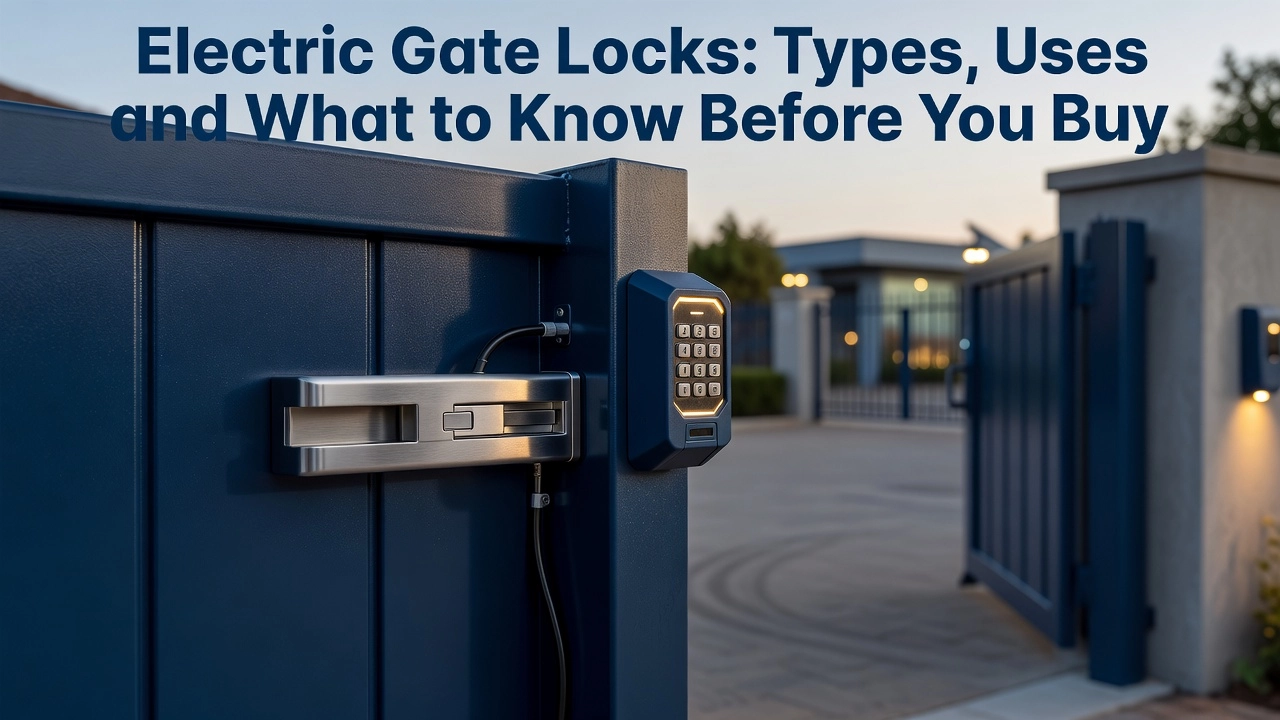
Securing a gate is no longer just about padlocks and heavy chains. Today, property owners, facility managers, and security-conscious homeowners are turning to smarter, more reliable solutions. An electric gate lock offers automated control, enhanced security, and seamless integration with modern access systems, making it one of the most practical upgrades you can make to any entry point.
But with so many options on the market, choosing the right one can feel overwhelming. Should you go with an electromagnetic lock or an electric strike? Is a solenoid bolt the better fit for your setup? Understanding the differences matters more than most buyers realize before making a purchase.
This guide breaks down the most common types of electric gate locks, explains where each one is best used, and walks you through the key factors to consider before buying. Whether you are securing a residential driveway, a commercial parking facility, or an industrial access point, you will leave with a clear picture of which lock type suits your needs and what specifications to prioritize. Let's get into it.
Types of Electric Gate Lock
Choosing the right electric gate lock starts with understanding the distinct mechanisms available, since each type offers a different balance of holding strength, installation profile, and operational behaviour.
1. Electromagnetic Locks (Maglocks)
Electromagnetic locks, commonly called maglocks, use a powerful electromagnet mounted on the gate frame that bonds to an armature plate on the gate leaf. When energised, they can generate a holding force of up to 1,200 kg, making them highly effective for high-traffic access points on commercial and industrial sites. Critically, maglocks are fail-safe devices; they release instantly when power is removed. This makes them suitable where rapid egress is a priority, though it also means a supplementary mechanical lock is advisable to maintain security during power outages. Outdoor gate-specific maglock variants are rated for weather exposure, with IP65 or IP67 ratings ensuring reliable performance in the wet and variable conditions typical of UK installations. As detailed in this guide to electronic locking, specifying the correct holding force for the gate weight and usage frequency is essential from the outset.
2. Electric Strike Locks
Electric strike locks replace the fixed keep plate in a gate frame with an electronically controlled keeper. When a valid credential is presented, the strike activates and releases the latch, allowing the gate to open while the latch mechanism itself remains intact. They can be configured as either fail-safe or fail-secure, giving specifiers the flexibility to prioritise egress or perimeter security. Electric strikes are well suited to pedestrian swing gates and lighter vehicular access points where a cost-effective, compact locking solution is appropriate.
3. Solenoid Bolt Locks
Solenoid bolt locks drive a physical bolt into a keep plate using electrical energy. Unlike maglocks, this creates a positive mechanical lock that physically prevents gate movement, independent of magnetic attraction. They are frequently specified on automated swing and sliding gates where robust physical retention is needed alongside the gate operator's own holding force.
4. Monitored Lock Systems
Monitored lock systems incorporate built-in sensors that continuously report gate position and lock status to a control panel or cloud-based access management platform. This means operators receive real-time alerts if a gate is forced, left open, or fails to latch correctly. Audit trails are generated automatically, which is valuable for commercial properties managing compliance or multi-user access. The growing integration of electric gate locks with intercoms, video surveillance, and management dashboards, as explored in this overview of electric locks versus magnetic locks, reflects how locking hardware is now a component within a broader connected security ecosystem.
5. Specification: Load Ratings, IP Ratings, and Compatibility
Every lock type carries distinct technical requirements that affect suitability for a given gate. Load ratings must match the gate's weight and the forces it experiences in operation. IP ratings determine whether the unit can withstand outdoor exposure; IP65 is typically the minimum recommended for exterior gate applications in the UK. Compatibility with the gate operator's control board is equally critical, since the lock must receive the correct output signal to open and close in sequence with gate movement. These interdependencies make professional specification, rather than off-the-shelf selection, the only reliable approach.
Residential, Commercial, and Agricultural Use Cases
Selecting the correct electric gate lock becomes significantly more straightforward once you map lock characteristics to the specific demands of your property type. Each setting carries distinct operational, aesthetic, and environmental requirements that directly influence which mechanism will perform reliably over its lifetime.
Residential Properties in East Sussex and Kent
Homeowners across East Sussex and Kent consistently prioritise aesthetics, quiet operation, and convenient access. Electric strike locks and monitored electromagnetic locks align well with these priorities, offering low-profile installations that integrate cleanly into timber, wrought iron, or steel gate designs without bulky external hardware. Smartphone-integrated access is increasingly expected at the residential level, and with app-based unlocking mechanisms projected to hold a 38% share of the residential smart lock market, demand for gate locks compatible with intercom apps and cloud-based access platforms is accelerating. Properties in conservation areas or with listed boundaries should also consider fail-safe operating modes, ensuring gates open automatically during a power cut rather than trapping occupants.
Commercial Sites: Business Parks, Industrial Units, and Retail Premises
Commercial installations demand considerably higher performance thresholds. The commercial application segment already accounts for 36.2% of automatic gate lock market revenue in 2025, reflecting the scale of demand from business parks, logistics yards, and retail sites. These environments require locks rated for high duty cycles, robust holding forces under sliding vehicle gate loads, and seamless integration with visitor management systems, intercoms, and CCTV. Mismatching a residential-grade electromagnetic lock to a heavy commercial sliding gate will accelerate wear and introduce security gaps within months.
Agricultural and Rural Estates
Rural and agricultural properties present unique challenges that urban-focused lock specifications frequently overlook. Unreliable mains power supply makes battery backup compatibility essential, while exposure to driving rain, mud, and frost demands IP65-rated or higher solenoid bolt locks capable of sustained outdoor performance. Solar-compatible gate systems are gaining traction in off-grid settings, and choosing a lock with low-power standby modes extends battery autonomy considerably between charges.
Multi-Gate Properties and Centralised Control
Farms and large estates managing separate vehicle, livestock, and pedestrian access points benefit most from centralised IP-enabled control platforms. These systems allow different lock types across multiple gates to be monitored, scheduled, and operated from a single interface, reducing management complexity and enabling remote diagnostics. According to 360iResearch analysis of the automatic gate opening system market, demand for modular systems supporting remote troubleshooting is growing rapidly, a clear advantage for multi-gate rural properties where a technician visit carries significant cost and downtime.
Matching lock type to setting is not a cosmetic decision. Getting it wrong risks non-compliance with BS EN 12453 powered gate safety standards, accelerated component failure, and access control gaps that undermine the entire installation.
Fail-Safe vs. Fail-Secure: What Happens During a Power Cut?
Power cuts are an unavoidable reality, and how your electric gate lock responds in those moments is not a minor technical detail. It is a decision with genuine safety and security consequences that should be made deliberately, not by default.
Fail-safe locks release when power is lost, allowing the gate to open freely. This prioritises egress above all else, which is why fail-safe operation is commonly mandated by fire safety regulations and building codes on any gate or door forming part of a designated escape route. If a power failure, tripped breaker, or fire alarm signal cuts the supply, the gate releases automatically. For occupied residential sites, staffed commercial premises, and any property where people must be able to exit without assistance, this is typically the correct and often legally required configuration. As Detex explains in their breakdown of fail-safe and fail-secure locking devices, choosing the wrong mode on an egress path carries serious compliance and liability risk.
Fail-secure locks remain locked when power is cut, maintaining physical security through an outage. This is the preferred configuration for high-security commercial gates, storage compounds, and any perimeter where assets must remain protected even when systems go offline. A gate securing a cash storage yard or restricted-access industrial unit should not swing open the moment the lights go out.
Hardware type significantly influences which mode is achievable. Electromagnetic maglocks are inherently fail-safe by design; they hold only while energised, so cutting power always releases them. Solenoid bolt locks, by contrast, can be ordered in either configuration depending on how the solenoid is wired, making them more versatile across different security requirements.
Battery backup units and uninterruptible power supplies (UPS) offer a practical middle ground, maintaining lock operation during short outages regardless of the chosen mode. This is particularly important for properties without a secondary access point, where a power cut unexpectedly locking or releasing a gate could leave a site unsecured or inaccessible for an extended period.
The correct mode depends on your property type, occupancy levels, local authority requirements, and in some cases insurer stipulations. It should always be confirmed with a qualified installer before specifying hardware, not assumed from a product datasheet after the gate is already in the ground.
Integration with Gate Automation, Intercoms, and Access Control
An electric gate lock does not operate in isolation. It functions as one component within a broader system, designed to receive a trigger signal from a gate operator, access control panel, keypad, proximity fob reader, or intercom unit. When these components communicate reliably, the result is seamless automated entry and exit with no manual intervention required. The electrical interface is typically straightforward, with most locks accepting a dry contact or voltage signal from whichever upstream device initiates the access event, whether that is a coded keypad at the entrance or a vehicle loop detector embedded in the driveway.
Smartphone integration has become a dominant force in how property owners manage gate access. App-based unlocking mechanisms are projected to account for a 38% share of the residential smart lock market, reflecting sustained consumer demand for remote, on-demand control. This is particularly relevant for households where occupants arrive at irregular hours, or for businesses that need to grant temporary access to contractors without issuing physical credentials. The practical appeal is clear: a resident can unlock a gate from inside the property, from a parked car, or from a different location entirely, provided the system has cellular or Wi-Fi connectivity.
Video intercom integration adds a critical verification layer before any lock release occurs. A resident or staff member can visually confirm a visitor's identity on a screen or smartphone before triggering the electric gate lock remotely. This combination of visual confirmation and remote release reduces the risk of tailgating and unauthorised access, making it a standard expectation in commercial and multifamily residential installations.
Cloud-connected and cellular-first systems now allow property managers and homeowners to monitor gate lock status, review access logs, and receive alerts via a web portal or app. According to access control trend data for 2026, cellular-first solutions are reshaping how multi-site operators manage entry points without depending on on-site Wi-Fi infrastructure. This level of visibility is increasingly expected rather than optional.
Integration complexity, however, varies considerably between properties. Existing wiring, gate operator compatibility, and the age of installed hardware all influence what is achievable without significant modification. A professional site survey is the most reliable way to establish a clear integration pathway before committing to any system, ensuring that the chosen electric gate lock works precisely as intended within your specific setup.
UK Safety Standards and Compliance for Electric Gate Locks
Compliance is not a box-ticking exercise when it comes to electric gate locks. It carries direct legal, financial, and safety consequences for anyone responsible for an automated gate installation.
BS EN 12453 is the cornerstone standard for powered gate systems in the UK, setting mandatory requirements for force limitation, protection against entrapment, impact forces, and control system reliability. The current version, BS EN 12453:2017, applies to sliding gates, swing gates, rising barriers, and all comparable powered access systems. Critically, it governs the locking mechanism as part of the wider installation, not as a separate component. If a lock engages or releases at the wrong point in a gate's travel cycle, or if it contributes to an entrapment risk, it falls within the standard's scope. The DHF has confirmed that BS EN 12453 remains an active, evolving standard, subject to ongoing amendment, so installers and property managers must track revisions rather than treat compliance as a one-time obligation.
BS EN 1303 and associated security grading standards provide a separate but equally important benchmark, covering the performance of lock cylinders and locking devices across defined security grades. Specifying the correct grade for your property type, whether residential, commercial, or agricultural, ensures the physical lock hardware meets an independently verified level of resistance to attack and manipulation. This is particularly relevant on commercial and high-traffic gates where duty cycles and attack resistance requirements are significantly higher than on a private driveway entrance.
HSE guidance makes a site-specific risk assessment a legal requirement, not optional guidance, for every automated gate installation. Under the post-Brexit UK Machinery Directive (UKMD), every powered gate system must also carry a Declaration of Conformity and satisfy the Essential Health and Safety Requirements. As Gate Safe confirms, conformity with BS EN 12453 alone does not automatically satisfy all UKMD obligations; a risk assessment addressing the specific site, its users, and foreseeable misuse scenarios is always additionally required.
Using non-compliant or misspecified locking hardware creates serious downstream risks. If an incident occurs and the installation lacks a valid risk assessment or Declaration of Conformity, insurance cover may be invalidated entirely. On commercial and agricultural sites, the gate is classified as work equipment under UK law, meaning facility managers carry ongoing legal responsibility. Non-compliance can result in HSE enforcement action, civil liability, financial penalties, and reputational damage.
A reputable installer will provide a full compliance handover pack on completion, including the risk assessment, Declaration of Conformity, force test results, and operational instructions. They should also advise on periodic maintenance obligations, including annual force testing and re-assessment of safety devices, since compliance is a continuing duty rather than a one-off installation milestone.
Can You Retrofit an Electric Lock to an Existing Gate?
The short answer is yes, in most cases. Timber, steel, and aluminium gates that are structurally sound, correctly hung, and well-aligned with their posts are strong candidates for an electric lock retrofit without requiring full gate replacement. The critical prerequisite is condition rather than age. A gate that sags, binds, or struggles to close manually under its own weight will not perform reliably with an electric lock attached. Posts must be firmly set, hinges must be in good order, and the leaf must sit squarely in its frame before any electrical hardware is specified.
Once structural suitability is confirmed, the appropriate lock type is determined by a combination of factors: the gate leaf's thickness and material, the construction of the receiving post, and whether an automated gate operator is being installed at the same time or is already present. Timber gates typically suit surface-mounted bolt locks or mortise-style electric locks, while steel fabrications can accommodate weld-in variants. Aluminium gates often require bracket adaptors to achieve the correct mounting depth and alignment. Where a gate operator already exists, the electric lock must be wired into the operator's control board so both components work in coordinated sequence.
Wiring routes and power supply proximity are among the most practical constraints on any retrofit project. On older stone or brick gate pillars, which are a common feature across East Sussex and Kent, surface conduit or core-drilled cable channels are often the only viable options. Where mains power cannot be practically reached, solar-powered supply is an established alternative for more remote gate positions.
Upgrading to a fully integrated system that combines an operator, electric lock, intercom, and keypad in a single planned installation consistently delivers better value and a cleaner result than fitting a lock in isolation. Retrofitting the lock alone typically leaves cable infrastructure incomplete, requiring revisiting when an operator is added later.
Portara Automation carries out retrofit assessments for existing gates across East Sussex, West Sussex, and Kent. Each assessment evaluates the gate's condition, identifies the most suitable locking hardware, maps viable cable routes, and recommends the most practical and cost-effective path to electric locking for that specific property.
Why Choosing a Local Installer Matters in East Sussex, West Sussex, and Kent
The global access control market is valued at $11.31 billion in 2025 and projected to exceed $20 billion by 2033, reflecting a sector growing at pace. That growth, however, has accelerated consolidation among large national platforms, with major providers merging, rebranding, or restructuring their service models. For customers whose gate systems sit within those platforms, consolidation creates a genuine risk: engineers who knew their site move on, support desks become centralised, and accountability becomes difficult to pin down. Choosing a local installer from the outset removes that vulnerability before it materialises.
Regional specialists operate differently by design. A local installer serving East Sussex, West Sussex, and Kent can visit your property, assess your specific gate configuration, and specify an electric gate lock system calibrated to your exact requirements, rather than defaulting to a standardised product package built for volume deployment. That difference in approach matters whether you are a homeowner in Lewes, a business owner in Tunbridge Wells, or managing a working farm estate in the Kent Weald.
South East England presents a genuinely varied property landscape, and local knowledge is not a soft advantage here; it is operationally significant. Coastal properties around Eastbourne and Bexhill-on-Sea face salt-air corrosion that accelerates wear on exposed hardware. Rural agricultural gates in Kent and West Sussex demand heavier motor specifications, wider clearances, and field-entry configurations that a remote specification template is unlikely to capture accurately. Local installers who work regularly across these property types carry accumulated, site-specific expertise that cannot be replicated from a centralised office.
Ongoing aftercare reinforces the case further. Emergency callouts, scheduled maintenance, and system upgrades are straightforwardly arranged when your installer already knows your driveway gradient, underground cable routing, motor model, and access control configuration.
Portara Automation designs, manufactures, installs, and services bespoke electric gate systems across East Sussex, West Sussex, and Kent. As a single point of contact from initial specification through to long-term aftercare, Portara provides the direct accountability and hands-on expertise that larger, consolidated platforms are increasingly unable to match.
Making the Right Choice for Your Property
The sections above have covered lock types, use cases, power behaviour, integration, compliance, and retrofit options in detail. What follows is a practical checklist to bring those considerations together before you commit to any specification or installation.
Start with your primary use case. Residential convenience, commercial security, and agricultural resilience each point toward different lock types, holding forces, and integration requirements. A swing gate on a private driveway demands very different hardware from a sliding gate securing a distribution yard or a field entrance exposed to livestock and weather. Defining this upfront prevents costly specification errors.
Confirm your power failure preference before ordering hardware. Decide whether fail-safe or fail-secure behaviour is appropriate for your site, and establish whether battery backup is necessary to support that decision. Document this requirement in writing before any equipment is quoted.
Request BS EN 12453 compliance documentation as part of your formal handover pack. This includes the declaration of conformity, risk assessment, force test records, and manual release instructions. Do not accept a completed installation without it.
Commission a retrofit assessment if you have an existing gate. Many structurally sound gates are suitable for electric locking upgrades without full replacement, and a professional assessment will confirm this quickly.
Contact Portara Automation to arrange a site survey and receive a bespoke recommendation tailored to your property across East Sussex, West Sussex, and Kent.
Conclusion
Choosing the right electric gate lock comes down to understanding your specific needs, knowing the differences between lock types, and matching the right technology to your entry point. Electromagnetic locks offer powerful holding force for high-traffic areas, electric strikes work well for standard gate frames, and solenoid bolts deliver reliable performance where direct locking is required.
Before you buy, always consider your power supply options, fail-safe versus fail-secure requirements, and compatibility with your existing access control system. The right choice protects your property without creating unnecessary complications.
Now that you have the knowledge to make a confident decision, take the next step. Evaluate your current setup, identify your security priorities, and invest in an electric gate lock that works as hard as you do. A smarter entry point is one of the best upgrades you can make today.