
Electric Gate Repairs in Heathfield: Fixed in One Visit
What a mobile gate engineer can fix in one visit in Heathfield, from control panels to safety edges, and when a second visit with parts is unavoidable.
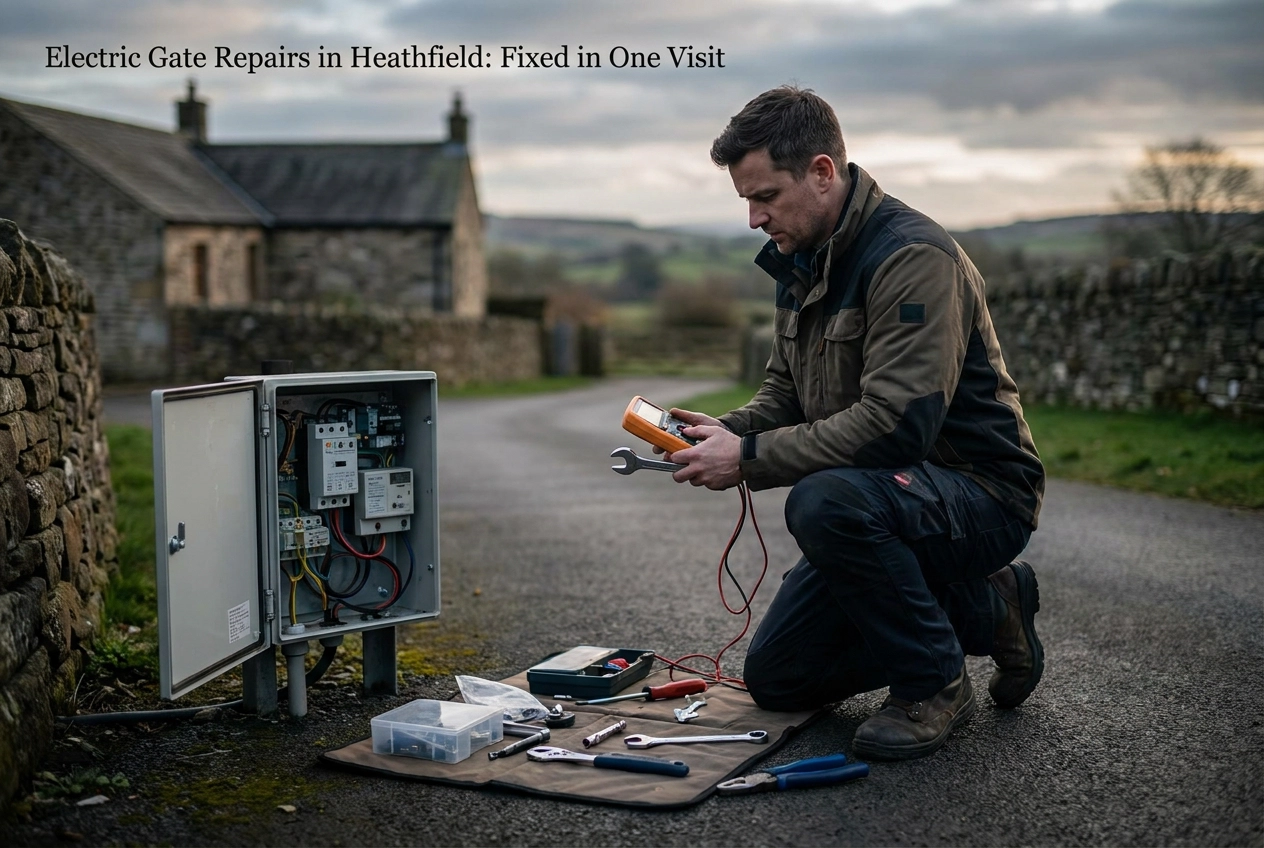
A gate that will not open is more than an inconvenience on a Heathfield farm track. It can leave livestock, vehicles, or family members stuck behind a barrier while rain runs down a steep lane. If you are searching for electric gate repairs near me, the decisive question is not whether a repairer is nearby. It is whether the right engineer arrives with the right parts and the right test equipment. This guide explains how Heathfield's dispersed rural properties change repair times, then walks through the faults a stocked local van can fix in one visit: control panels and boards, safety edges and protection devices, rams, actuators, mechanical parts, locks, latches, and access control. You will also learn how to match symptoms to likely causes, when a second visit is unavoidable, which safety checks every repair should include, and how to vet a repairer before booking. The aim is simple: help you get the first visit to count.
Why a Heathfield Repair Is Decided Before the Engineer Arrives
Heathfield does not deal in straight-line distances: properties sit along steep lanes, single-track farm tracks and clusters of outbuildings, so the gap between two gates is measured in drive time, not miles. Two homes a mile apart can be ten minutes apart on a Wealden lane in winter mud or ice, or after hedge-cutting leaves debris across a farm track.
That travel time is the first thing that decides whether a visit ends as a repair or a diagnosis. Access is part of the job: gate width, turning space, and whether a van can reach the control cabinet on a wet slope or behind a locked field gate all shape what an engineer can complete.
Any response time, attendance or first-visit figure we quote comes from our own job records and is labelled as Portara company data, not an industry average.
This page sets out what is genuinely fixable in one visit, so you book with realistic expectations rather than hope for a same-day fix on every fault; how a repair visit works explains what happens on the day.
The Two Variables That Decide Whether It Is Fixed Today
Two variables decide whether your gate is fixed on the first visit: drive time and van stock.
A local engineer attending from East Sussex can reach your gate quickly and return if a part is needed. A national call centre that subcontracts the job out cannot promise that honestly.
Van stock turns diagnosis into repair: a control board, actuator, safety edge profile or lock on the van means the same-visit fix happens. The identical fault with an empty van becomes a parts order and a second appointment. Stocked means Portara's van stock: common service items for the gate types its engineers attend, not a universal industry list.
The variables interact. A fully stocked van two hours away still loses the day. An engineer five minutes away with no parts leaves you with a diagnosis and a gate still stuck open.
Some faults cannot be fixed on visit one. Saying so in advance beats a blanket same-day promise that quietly does not hold. To describe your fault clearly before calling, use our guide to diagnosing common electric gate faults.
Faults a Stocked Local Van Fixes in One Visit
Most first-visit fixes fall into four families: control panels, safety edges, rams and actuators, and locks. Each is described by what your gate is doing, not by component names, because a search for gate repairs near me begins with a symptom. Underneath every job sits section 3 of the Health and Safety at Work Act 1974: anyone maintaining, repairing or modifying an automated gate must leave it safe, so every repair ends with a check, not a test drive. Each entry below states what a Electric and automatic gate faults we diagnose and repair stocked van can finish on visit one, and what pushes the same fault into a return trip. That makes this an expectation-setting list, not a sales page.
Control Panel and Board Faults
Symptoms first. The gate is completely dead. The remote works only intermittently. One leaf moves, the other does not. The gate stops in exactly the same place every time. Or the fuse trips the moment it is asked to move.
All point to the board, the diagnosis point for the "gate did nothing" call and the part most frequently on our vans. Stocked for control panels and electrical faults, an engineer can replace or reprogram the board, replace a blown fuse or rectifier, reset travel limits, re-teach remotes and check the standby battery, all on visit one.
Two faults force a return: a board discontinued for an older gate model, or water ingress in the cabinet needing a replacement enclosure and resealing, not just a new board. HSE notes gate design must account for wind and rain.
Safety Edge and Protection Faults
When the control panel is fine but the gate still misbehaves, protection is often the cause. Symptoms include the gate reversing on contact with nothing, refusing to close, closing then reopening, or edge rubber visibly split, loose or waterlogged.
The dhf position changes what counts as a repair: a single through-beam is too easy to defeat and must never be the sole protection measure unless it is multi-beam curtaining. Leaving one beam guarding the gate is a liability, not a fix.
A stocked van closes first-visit jobs with a replacement safety edge profile, edge transmitter and receiver, photocell, connectors and weatherproof glands. Our guide to safety sensors and safety edges covers diagnosis.
Then re-verify. The dhf states protection effectiveness must be checked with a force testing metre, and HSE says installers need equipment to measure opening and closing forces and should not leave gates they cannot verify.
Ram, Actuator and Mechanical Faults
When a gate drags, grinds, drifts open or will not hold position, it is mechanical. Symptoms include a dropped leaf catching the ground, a leaking hydraulic ram, sluggish or grinding movement. A stocked van can reseat and re-shim a dropped leaf, replace a worn roller or hinge pin, top up or assess a ram, adjust mechanical stops, and check mounting movement. HSE notes safety depends on mountings, foundations and wind loading; Gate Safe states that if the pier or post is not fit for purpose this type of accident is inevitable. A ram fault can therefore be a post or foundation fault. Expect a second visit for a cracked pier, failed foundation pad, a one-off bracket, or a ram not carried for your model. In-house fabrication can make a bespoke bracket or hinge repair fit rather than waiting on a part. Related symptoms: common electric gate faults we repair.
Lock, Latch and Access Control Faults
Not every fault is mechanical. Lock, latch and access faults are common first-visit fixes.
Symptoms: the gate will not latch, the keypad is dead, the intercom stays silent, the magnetic lock hums, the gate holds but is not locked, or one leaf opens by code.
A stocked van closes most in one visit: swapping lock and latch hardware, adjusting the keeper, fitting a keypad or handset, reprogramming codes and fobs, and checking the 12 or 24 volt supply.
Two cross into bigger jobs. An intercom sharing a house line, or a networked entry system across a multi-property farm conversion, may need a return visit with a specific module.
One point outranks the rest: the emergency release must still work afterwards. The HSE states gates must have an emergency release mechanism in case someone gets trapped, so a stronger lock that defeats it is a safety defect, not a security upgrade.
Gate Repairs Near Me: Match Your Symptom to the Likely Cause
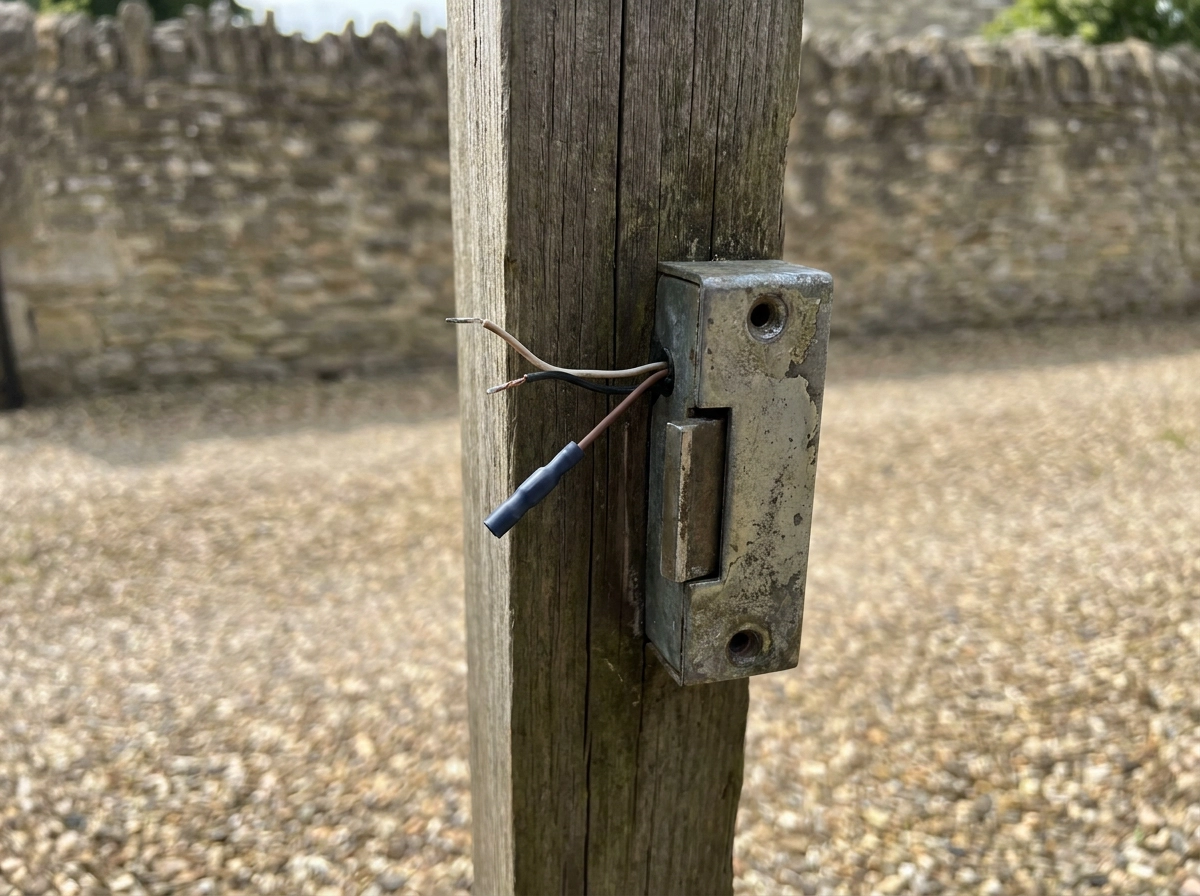
Lock faults are one symptom with a predictable cause:
Dead gate: power or control panel.
Reverses on nothing: safety edge or beam.
One leaf only: limit switch, motor or board channel.
Intermittent remote: battery, receiver or aerial.
Grinding or dragging: mechanical or actuator wear.
Won't lock: lock, latch or intercom.
How to Diagnose Common Electric Gate Faults Before Calling an Engineer covers each in more depth.
When you call, describe what the gate does, when it started, whether it ever worked correctly, what changed recently (a storm, power cut, new remote, planting blocking a beam) and which leaf is affected.
This books the right visit, not a repair manual. Section 3 of the Health and Safety at Work Act 1974 requires repairs to leave the gate safe, and testing needs equipment most households lack.
Have the make and model, approximate age, service history, cabinet photographs and access instructions for a long track or shared drive ready.
Searching electric gates repair near me with the gate stuck open? Ask whether the engineer carries the part for your gate type, then book.
When a Second Visit and New Parts Are Unavoidable
Some faults genuinely cannot be completed in one visit: a discontinued control board on an older gate, a failed pier or foundation pad, a bespoke bracket or leaf repair, a model-specific hydraulic ram, or underground cable damage feeding a beam or intercom at the bottom of a long drive. Availability depends on gate make and age, so the engineer confirms parts on the day rather than quoting a stock position that may not hold.
This is where a stocked van plus on-site fabrication changes the odds: a bent bracket, worn hinge or damaged gate frame can be made to fit, so fewer faults become second appointments. Where a repair alters the gate's safety function or design, it becomes a modification, with CE marking and technical documentation requirements. Confirm that boundary with Portara per job, not as a blanket rule.
Documentation keeps a second visit predictable. dhf recommends a log book recording maintenance and repair work, telling the next engineer what was replaced and what remains outstanding. Questions to ask before you book set that expectation early.
The Safety Checks That Are Part of Every Repair
The log book entry is only as good as the checks behind it.
Force testing is repeated. HSE says installers need test equipment to measure closing and opening forces and should not leave gates they cannot verify. DHF says protection effectiveness must be checked with a force testing metre. Changing a board, motor or safety edge alters those forces, so the test is redone before hand-back.
Current standards apply: BS EN 12453:2017+A1:2021 and BS EN 12604:2017+A1:2020 replaced the 2000/01 editions. Ignore older leaflets citing BS EN 12453:2001.
Protection is checked at every point DHF lists: leading-edge, lower-edge, hinge-gap and shear-gap. Hinge areas have caused serious injuries, so hinge-gap protection is not optional.
A single light beam is a supplement, never the whole solution. It is too easy to defeat and must not be the sole protection unless it is multi-beam curtaining.
Emergency release is tested. HSE states gates must have a release mechanism in case someone is trapped.
We do not quote incident counts or fix rates; the guidance bodies publish none.
How to Check a Repairer Before You Book
The checks above depend on who attends. Verify rather than trust a badge.
Check accreditation independently. dhf advises homeowners to check for the dhf logo, and Gate Safe offers an installer accreditation check with a postcode search. Ask which schemes it holds, then confirm. If it cannot name one, assume nothing.
Ask what the van carries. Whether the van stocks the part for your gate type is the best predictor of a first-visit fix, and it should have an immediate, specific answer.
Ask what the visit includes. Force testing and an emergency release check should be included, with results written down, not merely demonstrated.
Request the log book entry. What was replaced, when, and what was flagged for next time. That record stops the same fault being rediagnosed two years later.
Treat annual maintenance as standard. dhf calls it inconceivable for an automated gate not to need at least an annual visit, with more frequent attention for heavy use. A farm gate opening throughout the day has a very different duty cycle to a domestic gate used twice a day.
Conclusion: Getting the First Visit to Count
Three things decide whether a Heathfield repair is finished on visit one: how far the engineer travels, what is already on the van, and whether the fault sits in control panel, safety edge, ram or lock work. The first two are fixed before you call. The third is what your symptom description tells the engineer.
So before booking, describe the fault precisely, ask what the engineer carries for your gate type, and confirm that force testing and an emergency release check are included and documented.
If a part has to be ordered, accept that answer. A second visit with the correct part beats a first visit that leaves the gate half-repaired and a safety function unchecked.
Book maintenance rather than waiting for failure. An annual visit suits most domestic gates; farm and shared-access gates need more, which costs less than an emergency call in bad weather on a lane the van can barely reach.
Verify any repairer through the dhf and Gate Safe accreditation checks, and keep the log book entry from every visit so the next repair starts from facts.