
Electric Gate Servicing: What's Included, How Often, and What It Costs
Find out what electric gate servicing covers, how often you need it, and what it costs in 2026 -- with UK price data and a property-type schedule.
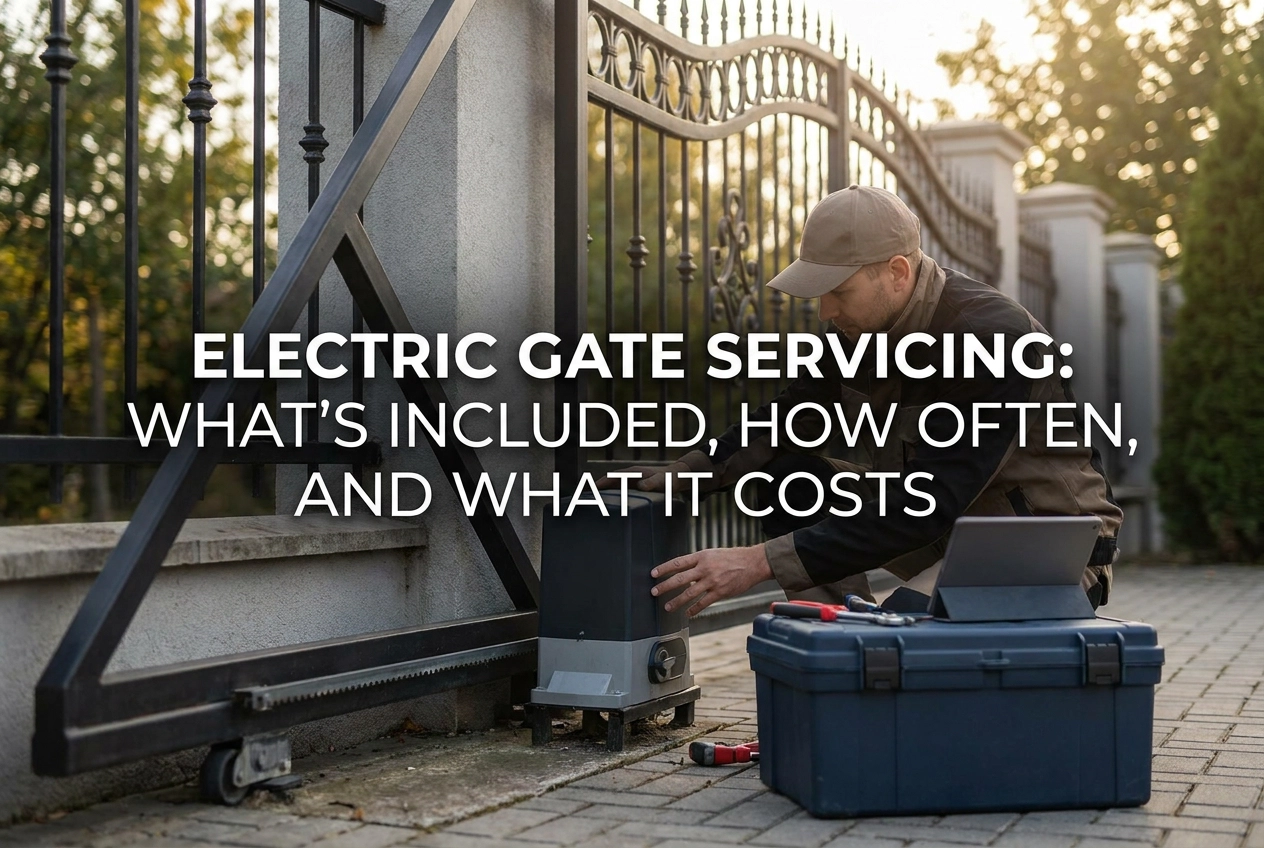
Most gate owners only think about maintenance when something stops working. By that point, a problem that could have cost a few hundred pounds to prevent has often grown into a repair bill several times larger. Electric gate servicing exists precisely to stop that cycle before it starts.
This guide cuts through the uncertainty around what servicing actually involves, how frequently it needs to happen, and what you should realistically expect to pay. Whether you own a single residential gate or manage automated access across a commercial site, understanding the scope and cost of professional maintenance is what separates a budgeted, manageable decision from an expensive surprise.
You will learn what a qualified engineer actually checks and adjusts during a service visit, which components wear fastest and why, how legal responsibilities differ between commercial and residential owners, and what genuine risk you carry when maintenance gets deferred. You will also find practical guidance on choosing the right provider and what you can safely monitor yourself between visits. By the end, electric gate servicing will feel less like a vague obligation and more like a concrete, plannable part of owning an automated gate.
Why Electric Gate Servicing Is Not Optional
Automated gates are heavy, powerful machines. A typical swing gate leaf can weigh several hundred kilograms, and motors, control boards, hinges, and sensors all degrade continuously, often without visible warning until something fails.
Environmental stress is constant. Rain, dirt, and temperature cycling wear at every joint and connection. In coastal and rural parts of East Sussex, salt air and seasonal mud compound that wear significantly faster than in sheltered inland settings. A gate that might run reliably for years in a dry urban environment may reach the same failure point in half the time when exposed to marine air and heavy clay soils.
For commercial property owners, servicing is also a legal matter. Section 3 of the Health and Safety at Work etc. Act 1974 requires that business activities do not expose members of the public to risk. Operating an automated gate without documented maintenance records creates direct prosecution exposure if an incident occurs.
Residential owners face no equivalent legal mandate, but remain fully liable for injury or property damage caused by a faulty gate, regardless of how infrequently the gate is used.
The figures that make this case concrete are laid out in the servicing cost and risk sections below. For a fuller breakdown of what routine care involves, see our guide to maintenance, servicing, and aftercare for electric gates.
What a Professional Electric Gate Service Actually Covers
Knowing why to service your gate is one thing; knowing what actually happens during a visit is what lets you evaluate a quote and hold a provider to account. A professional service covers six distinct areas.
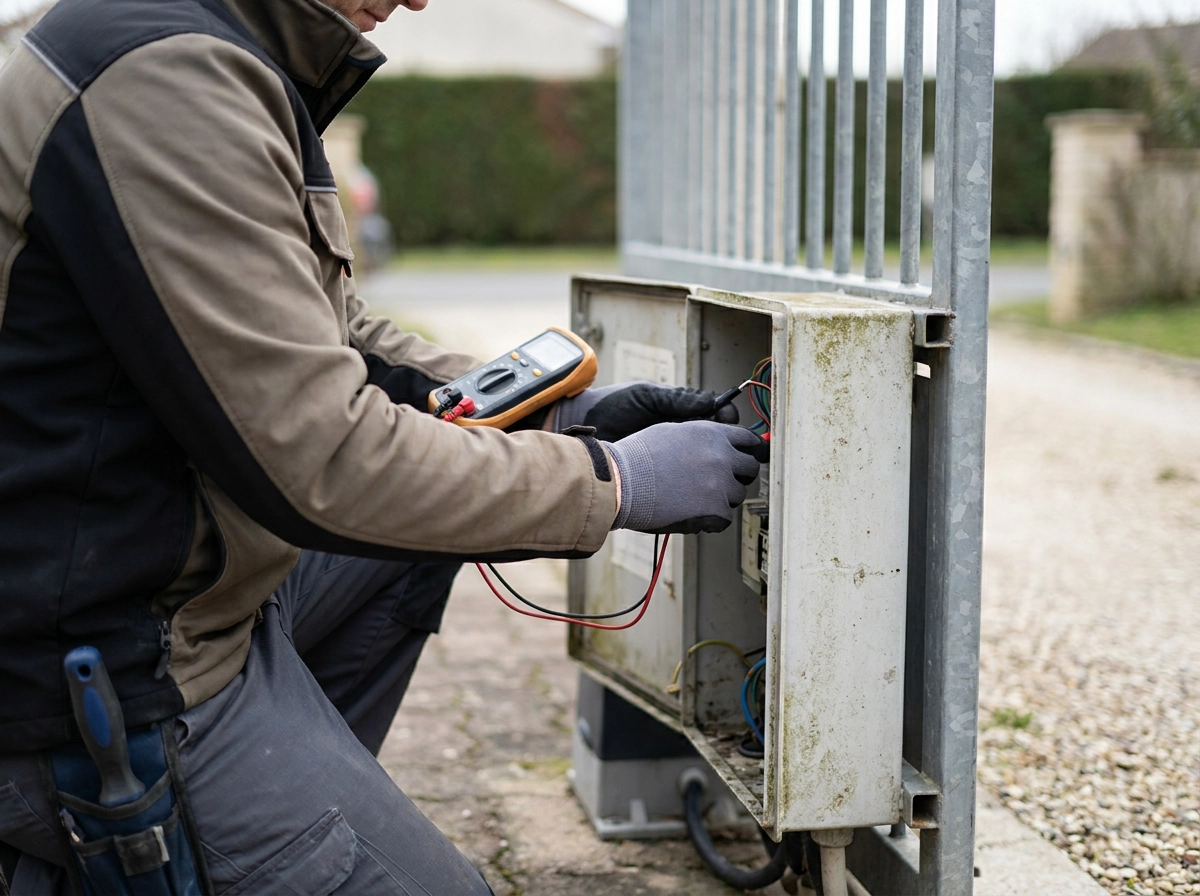
Electrical inspection. The engineer checks all wiring connections, terminal integrity, control board function, and power supply stability. Loose or corroded terminals are among the most common causes of intermittent faults, and they are invisible without opening the operator housing.
Mechanical inspection. Hinges, pivot points, rack-and-pinion drives, and gate leaf alignment are all examined. A misaligned gate leaf forces the motor to work harder on every cycle, accelerating wear across multiple components simultaneously.
Lubrication. All moving joints and drive components are lubricated using greases suited to outdoor, weather-exposed hardware. Under-lubrication is the single most common self-inflicted maintenance failure, and it is entirely preventable.
Safety device testing. Obstacle detection, photocells, safety edges, and auto-reverse functions are verified against specification. The HSE confirms that safety devices must respond correctly to any foreseeable interaction, including children near the gate. This testing is non-negotiable for residential safety and essential for commercial compliance.
Intercom and access control checks. Entry keypads, video intercoms, remote fobs, and loop detectors are tested for correct operation and signal integrity. A gate that opens reliably but admits the wrong people, or admits nobody, has failed its primary function.
Battery and backup power inspection. Battery condition is tested and units replaced where capacity has degraded, particularly on solar-assisted or power-cut failsafe systems.
What separates a basic plan from a comprehensive one is this: basic plans cover checks and lubrication only; comprehensive plans replace identified wearing parts, such as brushes, belts, and limit switches, before they fail. Confirm in writing which tier applies before signing.
The Components That Degrade Fastest and Why
Knowing what a service covers is only half the picture. Understanding which components are most likely to fail, and why, tells you how much that coverage is actually worth.
Motors and actuators are the hardest-working parts in any automated gate system. Most residential motors are rated for around 100,000 operating cycles; on a high-cycle commercial installation, that limit can be reached significantly sooner than it would on a residential driveway gate. Without regular inspection and lubrication, friction and heat accumulate, exhausting that rating far sooner.
Control boards are far more fragile than their function suggests. Control boards are vulnerable to moisture and electrical stress: a corroded board can render an otherwise intact gate completely inoperable, and control board replacement sits at the more expensive end of single-item repairs.
Batteries, particularly in solar-assisted or failsafe systems, degrade gradually and give little warning. A battery that tests as functional in September can fail silently in January, during a prolonged power cut, precisely when reliable gate operation matters most.
Hinges and pivot bearings carry the full dynamic load of the gate leaf on every cycle. Without adequate lubrication, metal-on-metal contact causes scoring. Once scoring progresses to seizure, re-greasing is no longer sufficient; full hinge replacement follows.
Safety sensors and photocells are compromised by mud, spider webs, and condensation, often invisibly. A fouled photocell can prevent a gate from closing, or worse, disable obstacle detection without triggering any visible alert.
This degradation hierarchy has direct implications for how you assess service plans. A plan that includes actuator inspection and sensor testing offers materially stronger protection than one limited to lubrication. For broader context on component wear and ownership costs, the full breakdown of metal security gate maintenance and longevity is worth reading alongside this.
How Often Does an Electric Gate Need Servicing?
Knowing which components degrade fastest informs how you maintain a gate; knowing your property type determines when.
Residential gates in typical low-use settings require a minimum of one professional service per year. A second annual visit is warranted for gates exposed to coastal conditions, heavy rainfall, or significant seasonal temperature swings, where accelerated corrosion and thermal movement compound normal wear.
Residential gates serving multiple dwellings, or with higher daily use, should move to semi-annual servicing. Moving to every six months reflects the realistic rate at which drive components accumulate wear under sustained operation.
Commercial and agricultural sites with heavy daily use should consider servicing more frequently than the semi-annual minimum, your installer or Gate Safe guidance can advise based on actual cycle counts. For lower-traffic commercial gates, semi-annual is the minimum defensible interval, particularly where legal compliance records must be maintained under the Health and Safety at Work etc. Act 1974.
The Southeast UK operating environment adds a genuine layer of urgency to all of this. The regional combination of coastal salt air, clay-heavy soils, and wet winters accelerates corrosion and mechanical wear beyond what inland conditions produce. For properties across East Sussex and the surrounding area, servicing at the more frequent end of any given range is a practical necessity, not a commercial suggestion. Our guide to maintaining your electric driveway gates covers this environmental context in further detail.
New installations benefit from an early follow-up visit to confirm safety device performance and address any settling issues.
Post-incident inspections sit outside any scheduled interval. A gate struck by a vehicle, affected by a power surge, or showing erratic behaviour must be inspected before returning to normal use.
What Electric Gate Servicing Costs in 2026
Once you have your servicing schedule in place, the next practical question is what it will actually cost.
Annual service plans run from £150 to £750 per year, with a UK average of approximately £450. The lower end applies to single-gate residential systems on basic lubrication-and-check plans; the upper end reflects comprehensive plans covering wearing-part replacement on larger or commercial installations.
Unplanned visits cost considerably more. Callout charges for non-contracted or emergency automatic gate repairs typically run £50 to £100 per visit, with labour charged at £65 to £85 per hour on top. A reactive callout for a gate that has seized can reach £300 to £500 before a single part is ordered.
Component replacement puts the plan cost in sharp relief:
Motor replacement: £300 to £1,800, depending on system type and gate weight. One motor failure can cost more than four years of preventative servicing.
Intercom and access control repair or replacement: £250 to £1,200. Most intercom failures traced to moisture ingress or corroded wiring are preventable with routine checks.
Confirm in writing which tier applies, basic plans cover checks and lubrication only, while comprehensive plans include wearing-part replacement.
Your original installer typically offers the best value. They know your specific system, hold appropriate parts, and can spot deviations from the original installation that an unfamiliar contractor would likely miss.
The Real Cost of Skipping Automatic Gate Maintenance
Those repair figures are not abstract. A neglected gate degrades in stages: intermittent faults, then motor strain from a misaligned or stiff leaf, then component failure, then structural damage. Each stage costs more to fix than the last.
As the cost section above shows, the maths strongly favour prevention over reaction. A single reactive repair can easily reach four figures before secondary damage and access disruption are factored in. One bad failure erases much of the saving from skipping servicing; a second eliminates it.
For commercial operators, the exposure goes beyond the repair bill. Under the Health and Safety at Work etc. Act 1974, an incident involving a gate with no maintenance record creates direct enforcement risk for the property manager, not just a contractor problem.
The right question is not whether £450 per year is affordable. It is whether unpredictable repair costs, access failure, and safety liability are preferable.
What Gate Owners Can Check Themselves (and What They Should Not)
Between scheduled professional visits, owners can contribute meaningfully to their gate's reliability through observation alone.
What to monitor regularly:
Listen and watch for unusual noise, juddering, or sluggish movement during operation
Clear debris from photocell and sensor faces, and keep drainage channels free
Test remote fobs and keypads for consistent, reliable response
Verify that the gate reverses correctly when it contacts a solid object
Visually inspect for bent hinge plates, cracked gate leaves, or vegetation pressing against the structure. These are things any owner can spot and report before they escalate into mechanical damage.
Where to stop: Do not attempt electrical diagnostics, control board adjustments, safety edge calibration, or motor torque settings. These tasks require specialist tools, professional training, and detailed knowledge of your system's wiring schematics. Opening the operator unit without that competency creates risk rather than resolving it.
Battery replacement sits in a middle ground. On simple systems, it is owner-manageable if the manufacturer's documentation explicitly describes the procedure. On solar-integrated or UPS-backed systems, attempting it without guidance risks damaging the control board. Consult your documentation first, or ask your engineer.
The practical rule is straightforward: monitor and report, do not diagnose and repair. For a fuller picture of what professional attention covers, our guide to automatic gate maintenance, servicing, and repairs explains what qualified engineers address that owners cannot.
How to Choose the Right Electric Gate Servicing Provider
Once you know what your gate needs and how often, the remaining question is who should deliver it.
Your original installer is the strongest first choice, assuming they offer ongoing service plans. They hold records of your specific installation, understand how your system was configured, and have a direct interest in keeping it performing as designed. Gate Safe confirms that automated gates must be "approached on an individual basis," which is precisely the knowledge an original installer carries.
If your original installer is unavailable, verify that any replacement provider has hands-on experience with your gate type, whether sliding, swing, or bi-folding, and with your specific operator brand. Generic contractors servicing many different systems may lack the diagnostic depth your installation requires. The principles outlined in choosing an electric gate installer apply equally when selecting a service provider.
Confirm in writing that the provider will issue a service report after each visit and that the contract specifies exactly what is and is not included.
Portara Automation provides professional electric gate servicing across East Sussex, West Sussex, and Kent. As original installers for many systems in the region, we bring system-specific knowledge to every visit rather than a generic checklist.
Turning Maintenance Anxiety into a Scheduled Decision
With the right provider selected, the only remaining step is committing to a schedule.
As shown above, preventative servicing averages around £450 per year against the potential for four-figure reactive repair bills.
Three actions to take now:
Confirm your frequency, annual for low-use residential, semi-annual for higher-use and commercial, and book accordingly.
Contact your original installer first. They hold the system knowledge and installation records that make a service visit genuinely diagnostic rather than generic. If that is not possible, seek providers with demonstrable experience on your specific gate type and operator brand.
Book now, not when something fails. A scheduled visit today costs a fraction of an emergency callout tomorrow. Waiting for a fault to appear is always the more expensive strategy.
For gate owners across East Sussex, West Sussex, and Kent, Portara Automation provides professional electric gate servicing, automatic gate repairs, and tailored maintenance plans. Contact us to discuss a service schedule that fits your system and your property.
Conclusion
Electric gate servicing is not a luxury or an afterthought; it is the foundation of a system that performs reliably, safely, and without costly surprises. The key takeaways are clear: regular servicing prevents expensive failures, extends the lifespan of every component, and keeps your gate legally compliant. A structured maintenance schedule transforms unpredictable repair costs into a manageable annual investment. And the owners who act before something fails always spend less than those who wait.
Your gate protects your property every single day. It deserves the same planned attention you give to any other critical system.
If your gate has not been serviced in the past twelve months, that appointment is already overdue. Contact Portara Automation today to book a professional service visit and put a maintenance plan in place that works for your system, your usage, and your peace of mind.