Commercial Electric Gates: The Complete UK Buyer's Guide
Discover gate types, UK safety standards, smart access control, and ROI considerations for commercial electric gates. Expert guidance for UK businesses.
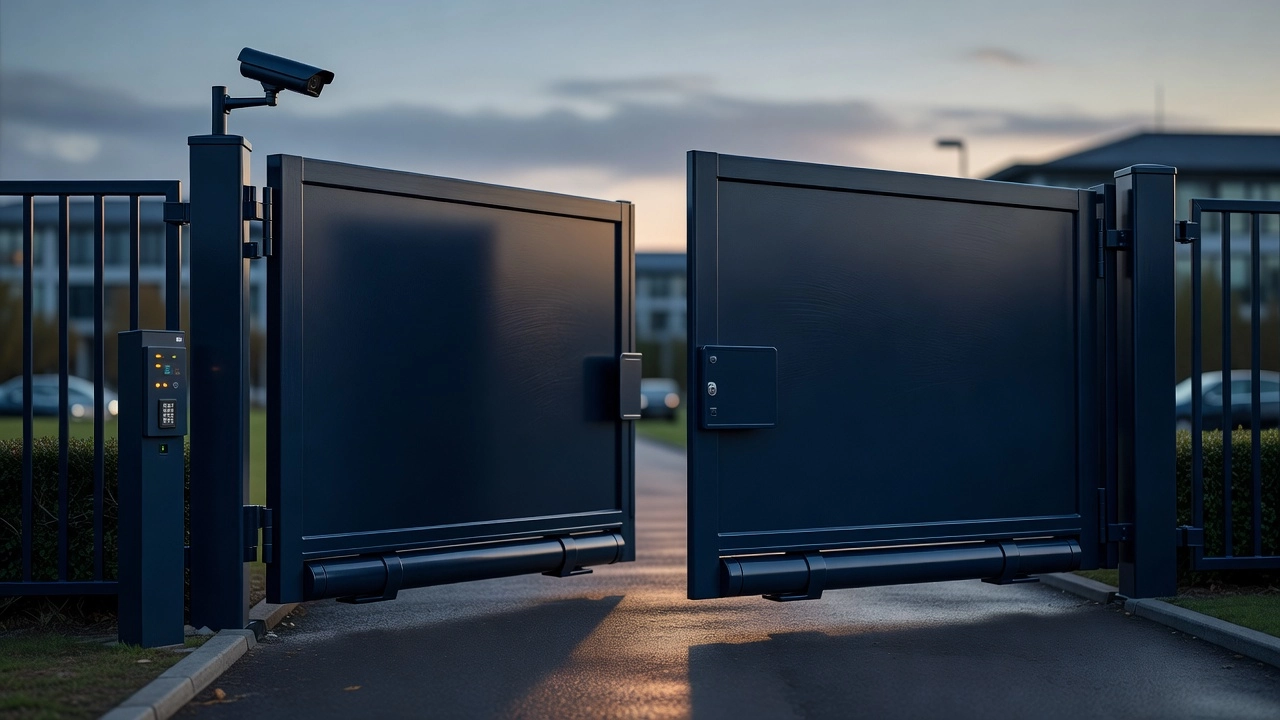
Every second your commercial premises sits without proper access control, you are leaving security, efficiency, and professional image on the table. For business owners, property managers, and facilities teams across the UK, electric gates commercial installations have become less of a luxury and more of an operational necessity.
But navigating the market is far from straightforward. With dozens of gate styles, automation systems, safety regulations, and installation considerations to weigh up, making the wrong choice can cost thousands in retrofits, downtime, or compliance failures.
That is exactly why we put this guide together. Whether you are securing a retail car park, a logistics depot, a business park, or an industrial facility, this complete UK buyer's guide walks you through everything you need to make a confident, well-informed decision. You will discover the key gate types available for commercial use, the regulations you must comply with, the access control options worth considering, and the critical questions to ask any installer before signing a contract. By the end, you will have a clear picture of exactly what your site needs and how to get it right the first time.
Gate Types for Commercial Properties: Matching the Right Solution to Your Site
Choosing the wrong gate type for a commercial property is a costly mistake, and it happens more often than most procurement teams expect. The right solution depends on operational realities; traffic volume, available space, security requirements, and system integration needs should all take priority over visual preference alone.
1. Sliding Gates: The Dominant Commercial Choice
Sliding gates account for an estimated 51% of the commercial automation market in 2026, and the reasons are straightforward. They operate horizontally along a track or cantilever rail, requiring no swing arc clearance and performing reliably on constrained or sloped sites. For high-traffic logistics parks, industrial estates, and manufacturing facilities, sliding gates deliver the cycle frequency and structural robustness that these environments demand. Cantilever variants, which suspend the gate on post-mounted rollers rather than a ground track, are particularly valued on sites where debris, heavy vehicles, or ground movement would compromise a tracked system. If your site handles multiple vehicle movements per hour, a heavy-duty sliding gate is almost certainly the correct starting point.
2. Swing Gates: Office Entrances and Business Parks
Swing gates remain a practical and attractive option for lower-traffic commercial settings such as office campuses and business parks. They hinge at one or both sides and open through a full arc, which demands adequate setback depth and level ground. Cycle times are slower than sliding or bi-fold alternatives, making them unsuitable for high-frequency entry points. Where perimeter width, aesthetics, and moderate traffic volumes align, however, swing gates deliver a professional, welcoming entrance that complements the surrounding environment. Specifying a swing gate on a site without sufficient clearance or with a significant gradient will result in expensive corrective work.
3. Bi-Folding Speed Gates: Built for Throughput
Bi-folding speed gates use interconnected panels that fold open rapidly, driven by multiple motors or linkage arms. They are the preferred solution for distribution centres and logistics hubs where opening cycles are frequent and throughput speed is a measurable operational requirement. Their compact fold mechanism means they work in wider openings without needing the long run-back space a sliding gate requires. Structural reinforcement is essential on exposed or high-wind sites. For choosing the right automatic gate system in a logistics context, bi-fold speed gates consistently outperform alternatives on cycle efficiency.
4. Barrier Arms: Car Parks and Retail Sites
Barrier arms occupy a distinct category from full gate panels, offering an economical solution where the priority is separating vehicle and pedestrian flows rather than providing full perimeter enclosure. They integrate readily with ANPR cameras, ticket dispensers, and parking management systems, making them the standard choice for retail car parks and multi-storey facilities. Fast cycle speeds and low infrastructure costs are the primary advantages, though they offer less physical security than a solid gate panel.
5. Matching Gate Type to Site Requirements
Gate selection must be driven by a structured assessment of traffic volume, lateral or swing space availability, site gradient, security classification, and integration requirements such as access control readers, intercoms, and CCTV. Reviewing driveway gate styles for 2026 confirms that aesthetics should inform the final specification, not lead it. Portara designs and fabricates bespoke gate systems across all commercial configurations, including heavy-duty sliding gates for industrial and agricultural sites throughout East Sussex, West Sussex, and Kent, ensuring every installation is engineered precisely for its operational context.
UK Compliance and Safety Standards Every Commercial Operator Must Know
Selecting a gate type is only part of the commercial procurement decision. Understanding the legal and safety framework governing powered gate systems is equally critical, and for many operators, it is the area where knowledge gaps carry the most serious consequences.
1. BS EN 13241: The Harmonised Product Standard
BS EN 13241:2003+A2:2016 is the harmonised product standard that governs industrial, commercial, and garage doors and gates across the UK and Europe. For commercial operators, this standard requires that any powered gate system supplied and installed in a commercial setting carries either CE marking (for legacy installations) or UKCA marking under post-Brexit UK conformity assessment requirements. Alongside the marking, a Declaration of Performance must be issued by the manufacturer, confirming the product meets relevant performance characteristics. It is worth noting that both the UK HSE and the European Commission have formally warned that reliance on BS EN 13241 alone is insufficient to satisfy all Essential Health and Safety Requirements under the Machinery Directive framework. A full understanding of what EN 13241 actually covers helps procurement teams avoid assuming that a CE or UKCA mark alone closes their compliance obligations.
2. BS EN 12453: Safety-in-Use Requirements
BS EN 12453:2017 sets the safety-in-use requirements for powered pedestrian and vehicle gates, covering sliding gates, swing gates, and rising barriers. It mandates risk assessments specific to each installation, protection against crushing, shearing, and impact hazards, and force limitation testing using calibrated equipment. Safety devices addressed by the standard include pressure-sensitive edges and photocells for presence detection. Critically, the standard does not guarantee Machinery Directive compliance on its own, as BSI has confirmed the standard remains under review, meaning commercial operators should treat it as a floor, not a ceiling, for their safety obligations.
3. Supply of Machinery (Safety) Regulations 2008
The Machinery Directive has been retained in UK domestic law as the Supply of Machinery (Safety) Regulations 2008. Every powered gate installation requires a full risk assessment and a technical documentation file, regardless of what harmonised standards the equipment claims to meet. The DHF Code of Practice and BS EN 12453 framework was developed specifically to address shortfalls in harmonised standards and to define minimum technical documentation and competency requirements for installers.
4. Emergency Manual Release
Every commercial powered gate must be fitted with an emergency manual release mechanism. This is not optional. In the event of a power failure or motor fault, occupants must be able to exit safely without depending on the automation system. The DHF Code of Practice addresses egress requirements explicitly, and failure to provide adequate manual release capability represents both a regulatory breach and a serious duty-of-care failure.
5. Electrical Safety Under BS 7671
All power supplies, control circuits, and wiring associated with gate automation systems must comply with BS 7671, the IET Wiring Regulations (18th Edition). This applies to the gate operator's installation work and to any modifications made to the incoming supply or control infrastructure. Commercially installed gate systems should be accompanied by an Electrical Installation Certificate, and periodic inspection by a qualified electrician is recommended to maintain ongoing compliance.
6. Liability and the Case for Accredited Installation
Non-compliance with the above standards exposes commercial operators to significant liability. In any entrapment or crush injury incident, enforcement bodies will examine whether a proper risk assessment was conducted, whether safety devices were correctly specified and installed, and whether the installer held appropriate competency qualifications. Insurance coverage may be invalidated where non-compliant installations are identified. Using an accredited specialist installer is therefore a legal and insurance priority; it is not a quality preference or a procurement nicety.
Smart Access Control: What Commercial Buyers Should Specify in 2026
Once gate type and compliance requirements are resolved, the specification focus shifts to access control intelligence, and this is where commercial procurement decisions in 2026 demand significantly more technical depth than in previous years.
1. Connected Platforms, Not Standalone Devices
Modern commercial gate systems function as integrated access-control platforms rather than simple open/close mechanisms. A well-specified installation will combine electromechanical drive units with RFID readers, biometric interfaces, loop detectors, video intercoms, and mobile app connectivity within a single managed system. The intelligent gate-control market is forecast to grow at 5.9% CAGR from 2026 to 2033, driven directly by commercial demand for IoT-integrated infrastructure. Buyers who specify only the mechanical gate at procurement stage typically face expensive integration work later. Treating the gate as an access-control node from the outset prevents this.
2. LPR and ANPR for Frictionless Vehicle Access
Licence plate recognition (LPR) and automatic number plate recognition (ANPR) have moved from premium additions to standard specification requests for logistics parks, data centres, and multi-tenancy commercial sites. These systems authenticate vehicle access without driver interaction, eliminating queuing at entry points during peak hours while maintaining a fully auditable record of every vehicle movement. For sites managing regular haulage contractors, supplier deliveries, or shift-pattern workforce traffic, ANPR provides both operational efficiency and a defensible security audit trail for insurance purposes.
3. AI-Enabled Video Analytics
High-specification commercial access control now extends well beyond gate open/close functionality. AI-enabled video analytics, including tailgating detection, loitering alerts, and vehicle classification, allow security teams to identify and respond to access anomalies in real time. Tailgating detection is particularly valuable at pedestrian access points adjacent to vehicular gates, where a single authenticated credential could otherwise admit multiple individuals. According to Electric Gate Openers Market research covering the period to 2034, smart integration and security demand are the primary growth drivers in the commercial segment, confirming that analytics capability is now a core buying criterion.
4. Cloud-Based Access Logs
Cloud-based access management gives commercial operators real-time visibility across all entry and exit events, including multi-site portfolios managed from a single dashboard. This capability directly supports security audits, insurance compliance reviews, and incident investigation, replacing manual gatehouse registers with timestamped, tamper-evident digital records. For operators in regulated sectors, including healthcare, finance, and critical infrastructure, cloud-based logging is increasingly a contractual requirement rather than an optional feature.
5. Video Intercom and Remote Visitor Management
Video intercom systems allow visitor management to be handled remotely, eliminating the need for a permanently staffed gatehouse. A reception team or security controller can verify, communicate with, and admit visitors from any location, with all interactions logged automatically. The staffing cost reduction across a standard commercial working week is substantial, and the audit trail generated supports both compliance and incident response.
6. Specify Interoperability at Procurement Stage
The single most common source of post-installation cost overrun in commercial access control projects is poor interoperability planning. Commercial buyers should confirm, before contract award, that the proposed gate system will integrate natively with existing alarm panels, CCTV platforms, and visitor management software. Retrofitting integration protocols after installation is technically complex and disproportionately expensive. Portara Automation addresses this at the design stage, ensuring that every commercial gate system is specified to work within the client's existing security ecosystem from day one.
Making the Business Case: ROI, Costs, and the Commercial Justification
Once gate type, compliance obligations, and access control specification have been resolved, the commercial procurement decision must ultimately be justified on financial grounds. The business case for electric gates in commercial settings is well-supported by both operational data and market evidence, but it requires a structured approach that goes beyond the capital outlay figure on a supplier quotation.
1. Staffing Cost Savings and Payback Period
One of the most direct financial arguments for automated commercial gates is the reduction or elimination of manned gatehouse requirements. A full-time security officer at a UK commercial site will typically cost between £25,000 and £35,000 per year in salary alone, before factoring in employer national insurance contributions, holiday cover, and management overhead. A well-specified automated gate system, including intercom, access control, and CCTV integration, can be installed for a fraction of that annual recurring cost. When capital installation cost is amortised over a ten-year asset life and set against avoided staffing expenditure, commercial gate automation represents one of the strongest returns on investment available to facility managers. The payback period on many commercial installations is achievable within two to four years, depending on site complexity and prior staffing arrangements.
2. Insurance and Liability Considerations
Commercial insurers assess risk based on documented security measures, and automated perimeter access control is increasingly recognised within that framework. Properties with automated gates, recorded access logs, and integrated surveillance present a demonstrably lower risk profile than those with unmanned, manually operated entrances. While insurers do not universally publish fixed premium reductions for gate installations, brokers working in commercial property and logistics consistently advise that robust physical security can positively influence both property and liability insurance terms. Engaging your broker with documented specifications before and after installation is a practical step that can inform a more accurate cost-benefit model.
3. Equality Act 2010 Compliance
The Equality Act 2010 places a legal duty on commercial operators to make reasonable adjustments for disabled access. A manual gate that requires physical effort to open can constitute a barrier for people with mobility impairments, wheelchair users, or those with limited upper body strength. Automated gates remove that barrier entirely, supporting compliance and reducing exposure to tribunal claims. The World Health Organization estimates that over 1 billion people worldwide live with some form of disability, and for UK businesses, accessibility is not a discretionary consideration but a legal obligation with reputational consequences for non-compliance.
4. Theft, Trespass, and Loss Reduction
Perimeter security automation directly reduces the financial exposure associated with unauthorised vehicle access, opportunistic theft, and trespass incidents. For logistics operators, construction sites, and industrial premises, a single significant theft or vehicle intrusion event can generate losses that exceed the entire cost of a gate installation. Beyond asset loss, trespass incidents carry potential employer liability under the Occupiers Liability Acts, particularly where an intruder sustains injury on an unsecured site. Automated gates with vehicle detection, loop sensors, and audit-trail access logging materially reduce that exposure.
5. Market Maturity as a Procurement Signal
Decision-makers sometimes treat gate automation as a novel or niche investment. The market data suggests otherwise. The global automatic gate opening system market was valued at USD 6.95 billion in 2025 and is forecast to reach USD 11.20 billion by 2032, reflecting sustained commercial adoption across logistics, education, healthcare, and industrial sectors. This is not emerging technology; it is a procurement category with decades of commercial deployment, established maintenance supply chains, and proven asset longevity.
6. Building a Complete Cost-Benefit Model
A rigorous cost-benefit analysis must account for all cost categories, not just the installation invoice. Capital costs should include hardware, civil groundworks, cabling, and commissioning. Ongoing costs should include annual maintenance contracts, energy consumption, and any software or cloud access licensing. Against those costs, the model should set avoided staffing expenditure, quantified security incident risk reduction, potential insurance impacts, and the compliance value of meeting Equality Act obligations. Electromechanical drive systems, which lead the commercial market on reliability and low maintenance requirements, typically offer the most favourable lifecycle cost profile when all variables are modelled together.
Upgrading Existing Manual Gates: The Commercial Retrofit Pathway
For many commercial operators, full gate replacement is neither the most practical nor the most cost-effective route to achieving automated access control. Facilities managers across East Sussex, West Sussex, and Kent are increasingly choosing to automate existing manual gates, preserving their capital investment in the existing structure while adding the operational and security benefits of a fully automated system. This approach reduces upfront expenditure significantly and minimises site disruption, making it particularly attractive for operational sites where downtime carries a direct cost.
Structural Assessment: The Non-Negotiable First Step
Before any motor or drive system is selected, a thorough structural assessment of the existing gate is essential. Frame integrity, post foundations, hinge condition, and leaf weight all directly influence motor specification. An underpowered or mismatched operator fitted to a structurally compromised gate will fail prematurely and, more critically, create entrapment hazards. A professional assessment identifies whether the existing structure can support automation hardware safely, or whether remediation work is required first. Skipping this step is one of the most common and costly errors in commercial retrofit projects.
Remediation Before Automation
Not every manual gate is directly automatable. Gates that are warped, heavily corroded, inadequately hung, or under-specified for their opening width present real engineering challenges. In these cases, fabrication remediation is necessary before any motor can be fitted safely. Common remediation tasks include weld repair, hinge replacement or reinforcement, post re-setting, and in some instances, partial reframing where the original structure is no longer adequate for the intended duty cycle. Being candid about this upfront protects operators from budget surprises and ensures the finished installation performs as intended.
Technology and Compliance
Electromechanical drive systems are the preferred technology for retrofit applications, valued for their reliability, low maintenance requirements, and broad compatibility with access control integrations including intercoms, RFID readers, keypads, and licence plate recognition systems. Critically, a retrofit does not exempt the installation from full compliance obligations. A fresh risk assessment and appropriate safety device installation, covering safety edges, photocells, and warning signage, are mandatory components of any properly scoped retrofit, not optional additions. When completed correctly, a retrofit can deliver full compliance with BS EN 12453 and BS EN 13241 to exactly the same standard as a new installation.
Portara provides complete commercial gate automation retrofit services across East Sussex, West Sussex, and Kent, covering structural assessment, fabrication remediation, motor installation, and integrated access control. Every project is scoped and delivered to meet current regulatory requirements, giving commercial operators a fully compliant, future-ready entrance without the capital cost of full replacement.
Maintenance, Servicing, and Ongoing Compliance for Commercial Gates
Commercial gate systems on business premises are classified as work equipment under UK law, which means the obligation to maintain them safely does not end at installation. The Health and Safety at Work Act 1974 places a clear and continuous duty of care on commercial operators to ensure that powered gate systems remain safe for employees, contractors, visitors, and anyone else who may interact with them. Failing to meet this duty is not a technical oversight; it is a prosecutable offence, and the HSE holds lead enforcement responsibility across commercial and multi-occupancy sites.
PUWER and Your Compliance Obligations
The Provision and Use of Work Equipment Regulations 1998, universally referred to as PUWER, applies directly to automated gates on commercial premises. Under PUWER, duty holders must verify that gate systems are appropriate for their intended use, ensure maintenance is carried out by a competent person regardless of the equipment's age, and retain documented evidence that safety devices remain functional. This is not optional guidance; it is a statutory requirement. Alongside PUWER, the Supply of Machinery (Safety) Regulations 2008 requires that a technical file, including risk assessments, force test results, maintenance logbooks, and a Declaration of Conformity, be retained by the responsible person for a minimum of ten years.
Inspection Frequency and Documentation
PUWER mandates at least annual inspection as a baseline for all work equipment, including gate systems. However, annual servicing is insufficient for high-cycle sites. Logistics hubs, distribution centres, schools, and healthcare facilities may process hundreds of gate cycles daily, generating mechanical wear at a substantially faster rate than a low-traffic office development. For these sites, a quarterly or biannual inspection schedule is a more defensible and operationally sound approach. Every inspection should be formally documented with dated records, pass/fail outcomes for each safety device, and any remedial actions taken, all retained as part of the site's compliance file.
Safety Device Testing at Every Service Visit
Each service visit should include structured testing of photocell alignment, pressure-sensitive edge function, and emergency release operation, with results recorded explicitly rather than noted informally. These devices are the primary safeguards against entrapment, and demonstrating their continued functionality is central to any PUWER compliance audit. Nominated site personnel should also be briefed on what to do if a safety device fails between service intervals.
Predictive Maintenance as a Commercial Advantage
An emerging development worth specifying at procurement stage is AI-enabled predictive maintenance. These systems continuously monitor motor current draw and opening cycle data, identifying statistical anomalies that indicate developing wear before a component fails. For commercial operators running critical access points, the ability to schedule maintenance proactively rather than respond reactively to unplanned downtime represents a meaningful operational and financial advantage.
Portara provides structured service and maintenance contracts for commercial clients across East Sussex, West Sussex, and Kent, covering scheduled inspections, safety device testing, documentation support, and reactive call-out cover. For operators who need confidence that their gate systems remain compliant, safe, and reliably operational throughout their working lifecycle, a managed service contract removes the administrative and compliance burden entirely.
Sustainability and Energy Efficiency in Commercial Gate Specification
Sustainability has moved from a secondary consideration to a primary specification criterion in commercial gate procurement, and buyers who fail to address it at the design stage will face both compliance gaps and avoidable lifecycle costs.
Solar-compatible gate openers are now regularly requested in commercial procurement briefs, particularly where properties operate under corporate ESG frameworks or are subject to sustainability benchmarks such as BREEAM or ISO 14001. Sites with perimeter gates located away from mains infrastructure find solar integration especially practical, but the specification trend extends well beyond remote sites. Facilities managers are increasingly required to demonstrate energy reduction across all building systems, and gate automation is no longer exempt from that scrutiny.
Low-power standby modes have become a baseline expectation rather than a premium feature on commercial gate controllers. During periods of low activity, gates spend the majority of their operational cycle in standby, which means parasitic draw from poorly specified controllers accumulates meaningfully over time. Commercial buyers should request published standby power ratings from suppliers at specification stage, not as an afterthought, since this data feeds directly into lifecycle cost modelling and ESG reporting dashboards.
Electromechanical drive systems offer a clear efficiency advantage over hydraulic equivalents, consuming significantly less power during both active operation and standby. The energy-efficient drive market was valued at USD 15.2 billion in 2024 and is projected to reach USD 31.8 billion by 2033, reflecting the regulatory and commercial pressure pushing procurement teams toward lower-consumption technology. For commercial operators with sustainability targets, this distinction between drive technologies is worth quantifying at specification stage rather than treating as a like-for-like swap.
The European automatic gate and door opening system market is explicitly identifying sustainability-driven specification as a structural growth driver for the 2025 to 2035 forecast period, signalling that supplier investment in energy-efficient product development will continue to accelerate.
Finally, bespoke gate fabrication using responsibly sourced steel and durable powder-coat finishes directly supports sustainability goals by extending product lifecycles. A well-fabricated gate that resists corrosion and structural fatigue over decades reduces the embodied carbon associated with premature replacement, contributing to whole-life environmental performance in a way that standard off-the-shelf products rarely achieve.
Why a Local Specialist Outperforms a National Manufacturer for Commercial Projects
Understanding who actually delivers a commercial electric gate project is one of the most important distinctions a procurement decision-maker can make. The structure of the industry creates a clear separation between product manufacturers and project delivery specialists, and conflating the two leads to significant gaps in accountability, compliance, and service.
1. Manufacturers Supply the Components; They Do Not Deliver the Project
Large international automation brands dominate the product supply chain, providing motors, control boards, hydraulic operators, and associated hardware to installers and distributors worldwide. What these manufacturers do not provide is end-to-end commercial project delivery. Site assessment, structural engineering input, bespoke fabrication, compliant installation, risk documentation, and aftercare contracts are not part of their service model. A commercial operator purchasing through a manufacturer's distribution network receives a product, not a project outcome.
2. The Local Specialist Carries Legal Responsibility
The legal obligations that attach to a powered gate installation on commercial premises fall to the installing company, not the component manufacturer. Under UK machinery safety law, the installer is responsible for producing the CE or UKCA technical file, completing the conformity assessment, and issuing the Declaration of Conformity. The risk assessment, entrapment protection calculations, and ongoing service obligations all sit with the specialist who carries out the installation. This accountability cannot be transferred to a product brand or a national contractor operating remotely.
3. Bespoke Fabrication Delivers Site-Specific Precision
Standard catalogue products are engineered to cover the widest possible market, which means dimensions, infill design, material specification, and finish are compromises. A specialist with in-house fabrication capability manufactures gate leaves to the precise dimensions of the commercial perimeter, specifies steelwork gauge and infill density to match the security requirement, and applies powder coat finishes that align with the site's visual identity. The result is a system built for the specific site, not a standard product adapted to fit.
4. Regional Response Times Are a Commercially Significant Advantage
When an automated gate fails at a commercial premises, every hour of downtime carries an operational and security cost. A regional specialist operating across East Sussex, West Sussex, and Kent can respond to emergency call-outs, carry out planned maintenance visits, and source fabricated replacement components on a timeline that no national contractor or manufacturer's service network can consistently match. Local accountability means a named team, a known site, and a shorter journey time to every service call.
5. Portara Automation: End-to-End Delivery With Local Accountability
Portara Automation, based in East Sussex, provides a fully integrated commercial electric gate service covering system design, in-house metal fabrication, installation, access control integration, and ongoing maintenance across East Sussex, West Sussex, and Kent. Every project is handled from initial site survey through to commissioning and aftercare by the same specialist team. That continuity of responsibility, from the first site visit to the annual service inspection, is what distinguishes a genuine end-to-end provider from a product supplier with an installation sub-contractor attached.
6. Supplier Selection Is a Critical Long-Term Decision in 2026
The UK has been identified as the fastest-growing regional market within Europe for automatic gate and door opening systems. In a market expanding at this pace, the volume of new installations increases alongside the number of operators entering the supply chain with varying levels of competence. Choosing a verified local specialist with demonstrated fabrication capability, compliance expertise, and a regional service infrastructure is not simply a procurement preference; it is a risk management decision that will shape the performance and legal standing of your gate installation for years after commissioning.
Key Takeaways: Choosing Commercial Electric Gates With Confidence
Commercial electric gate procurement is a multi-layered decision, and getting it right means working through each layer in the correct sequence. The key takeaways below distil the essential principles covered across this guide.
Match gate type to operational reality first. Traffic volume, available space, throughput speed, and integration requirements must all be assessed before any budget conversation begins. Sliding gates dominate commercial installations for good reason, but the right choice is always site-specific.
Compliance is non-negotiable. BS EN 13241, BS EN 12453, PUWER, and the Equality Act 2010 apply to every commercial powered gate. Confirm that any prospective installer can demonstrate full compliance before works begin.
Smart access control transforms the gate into a security asset. RFID, licence plate recognition, cloud logging, and video analytics support audit trails, operational efficiency, and ongoing compliance.
Assess retrofit before committing to replacement. Automating existing manual gates is a proven, cost-effective pathway for many commercial sites.
Maintenance is a legal requirement, not an optional extra. Documented service records and structured maintenance contracts are essential for insurance and regulatory compliance.
Work with a bespoke local specialist. Contact Portara Automation for a commercial site survey across East Sussex, West Sussex, and Kent, and ensure your system is designed, installed, and maintained to the highest standard from day one.
Conclusion
Choosing the right commercial electric gate system is one of the most impactful infrastructure decisions your business will make. To recap the essentials: match your gate type to your operational demands, ensure full compliance with UK safety regulations, invest in access control technology that scales with your business, and always work with accredited installers who back their work with proper warranties.
Get these four pillars right and you will gain more than security. You will gain efficiency, professional credibility, and long-term peace of mind.
Ready to take the next step? Contact a qualified commercial gate specialist today for a site survey and tailored quote. The right system is out there for your premises, your budget, and your goals. Do not let another day pass leaving your business exposed when the solution is well within reach.