
Electric Gates on a Shared or Unadopted Road: What to Agree Before You Automate
Automating a gate over a shared or unadopted road raises rights, access and cost questions. Here is what to agree before electric gate installation.
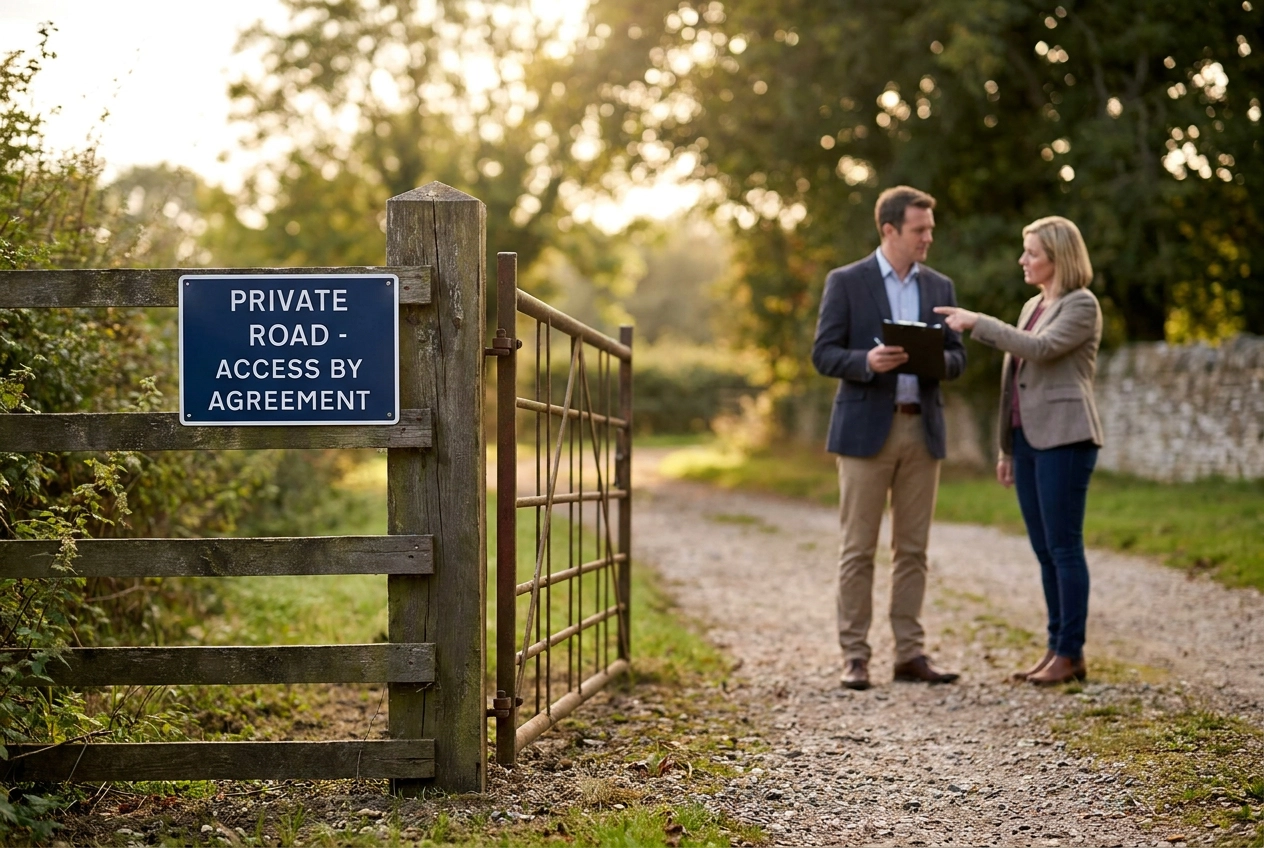
Before you specify a motor, keypad or intercom, answer a harder question: who actually has the right to pass over your road? Electric gate installation on a shared track or unadopted road is not merely a hardware decision. An operator can open and close a leaf, but it cannot determine who holds a right of way, whether the road is a highway, or whether a neighbour's deed permits commercial traffic. Automate too soon and you risk blocking emergency vehicles, utilities, postal deliveries or legitimate users, while creating disputes over codes, costs and maintenance. This tutorial guides owners, developers and farm businesses through the governance that must come first. You will examine what a gate operator cannot answer; how to tell whether your road is unadopted, private or adopted; what recent case law says about permission and rights; how private rights of way and traffic limits work; why an access schedule should be drafted before purchase; how to control credentials on a shared gate; how to keep the route usable for essential services; how maintenance and costs should be shared; and what a specialist needs from you before work begins. It finishes with a pre-installation agreement checklist. Agree first, automate second.
The Questions a Gate Operator Cannot Answer
An automated gate can control who passes and when. It cannot create a right of way, settle who owns a track, or decide who pays for resurfacing.
Frontagers on a shared private road, developers laying out a site with a single access spur, and farm businesses moving machinery across a track all face the same governance gaps before any electric gate installation is specified.
Sequencing matters. How gate automation works with us can show what the technology does, but ordering automated gate installation before rights, credentials and maintenance are agreed can leave a system that is legally obstructive, practically unmanageable, or paid for by the wrong party. This guide covers road status, permission versus right, traffic-type limits, credential ownership, emergency and utility access, cost sharing, and the checklist a specialist installer needs before quoting.
Portara Automation designs, manufactures and installs bespoke electric gate systems, gate automation and access control. The rights and responsibilities behind the gate remain the owner's or frontagers' to establish.
Unadopted, Private or Adopted: Work Out What Your Road Actually Is
Unadopted is a maintenance category, not a statement about rights; public rights may still exist over the route. A private or unadopted road is, by definition, a highway not maintainable at public expense, so the highway authority has no duty to pay for its upkeep. The adoption category tells you who pays for repairs; it does not determine who may use the road.
Confirm the record rather than the rumour. Ask the local highway authority whether the route appears on the definitive map, whether it is maintainable at public expense, and who is recorded as owner. Historical records, including notices of dedication and repair liability, sit partly with The National Archives.
Treat the familiar figures with caution. The figures sometimes quoted for the number of unadopted roads in England come from an old survey; no comparable current data is held centrally.
Estate notices, long-standing gates and neighbour folklore prove intent, not status. Establish the category before specifying any electric gate.
Permission Is Not a Right: What Recent Case Law Changes
Long tolerated passage through an open gate therefore evidences tolerance, not entitlement.
Two limits apply. A ruling on public rights distinguishes a right of way from mere permission; neighbours' private easements over a shared track rest on deeds or long use as of right, decided on different grounds. Separately, presumed dedication under section 31 of the Highways Act 1980 remains a live risk: 20 years of public passage can confer highway status unless there is sufficient evidence of no intention to dedicate. Hence the disclaiming notices on many estates; whether a sign is sufficient to rebut a 20-year claim requires legal advice on the specific road.
Where a public right of way crosses the route, any structure across it requires authorisation from the highway authority.
Private Rights of Way: Deeds, 20 Years and Traffic-Type Limits
Private rights over a shared track differ from public rights. They are usually permanent easements created by deed, or prescriptive rights earned through 20 years of use as of right. Read the deed for limits that shape the specification. Rights may be restricted by traffic type, such as no lorries over 10 tonnes or no commercial traffic. Those limits govern which vehicles and users a gate can lawfully admit. Check whether rights are shared, apportioned or exclusive, and whether they cover pedestrians, vehicles or both. A gate that blocks a lawful class of user is not an access control problem; no intercom setting can fix it.
The 20-year threshold runs in both directions, as noted above. Confirm that entitlement before specifying automation, and before seeking planning permission for sliding driveway gates.
Draft the Access Schedule Before the Hardware
Once rights are documented, convert them into an access schedule before choosing hardware.
Set it out as a plain table: who may pass, in what vehicle, at what hours, and under what restriction. Hand it to the installer as the design brief. Each row maps to a control method: keypads, fobs, intercom systems and access control can express entitlement, but only once entitlement is agreed in writing. For larger sites, a specification framework for commercial gate access control helps structure those choices.
Where rights are unclear, keep the route passable and visible. Landowners must not obstruct or endanger users of a public right of way. Before committing to posts, gates or bollards, check authorisation for structures across a public right of way; GOV.UK guidance covers structures for access, so verify with the highway authority.
Avoid a default fail-shut setting where the route serves lawful users whose access has not been accommodated in the credential register.
Who Holds the Codes: Credential Control on a Shared Gate
With the access schedule agreed, the next discipline is deciding who controls the credentials that enforce it. Build a credential register: every code, fob, keypad entry, app user and visitor arrangement listed with the right it derives from. Name an administrator and a deputy, one frontager or managing agent who can issue, suspend and audit credentials, with a second able to act in their absence. Plan for turnover before it happens: frontagers sell, let, die and leave, so agree how credentials are surrendered, revoked and reissued, and what evidence of right a new occupier must provide. Avoid the single shared code. One universal number cannot be revoked from one user, leaves no audit trail and turns every departure into a full reissue across the road. Cover transient users explicitly: delivery drivers, carers, trades, farm contractors and seasonal workers each need a controlled arrangement, not the same permanent credential as residents. The choice of keypad, fob or app follows from that register, as access control options for sliding gates illustrates.
Emergency Services, Utilities and Post: Keeping the Route Usable
With credentials settled, turn to the users a fob cannot cover: emergency services, utility crews, postal staff and delivery drivers.
Ask the local fire and rescue service and ambulance service what access they expect and how they want it. Do not assume an intercom satisfies them. Emergency entry usually works best as a means of access without a permanent code, with the credential changed afterwards. Match your intercom and access control setup to that requirement.
Water, gas, electricity and telecoms crews may need their apparatus at short notice. The Commons Library briefing covers utilities and the Private Street Works Code in sections outside the research extract, so verify the current position before writing it into an agreement.
Keep deliveries viable: agree a safe delivery point, a courier protocol and a fallback for when no one is in. Failed deliveries are a frequent practical problem on roads with automated gates.
Bins, oil and LPG, livestock movements and seasonal contractors each need a workable arrangement before automation.
Maintenance and Cost Sharing: Who Pays for the Gate and the Road
With access arrangements settled, turn to the money. Frontagers bear repair costs on unadopted roads, as established above. Apportion automation costs on a defensible basis: property count alone ignores heavy users, so weigh usage, vehicle size and whether the gate serves one property or the whole road.
Budget beyond installation. Servicing, power or battery backup, callouts, replacement parts and warranty obligations create recurring costs that need a named owner and a funding route. A small annual sinking fund prevents a single large repair bill from becoming a dispute and keeps electric gate servicing up to date.
Agree edge cases now: a frontager refusing to pay, a property changing hands, and who owns the gate, pillars and cabling if the road is later adopted through the Private Street Works Code process. Document those terms before specifying hardware. For a fuller view of how access and maintenance fit together, see our conclusion on electric gates.
What a Specialist Needs From You Before Work Begins
With the money questions settled, the handover begins. Before any electric gate installation is specified, a specialist needs five things in writing.
Evidence of right -- the documents assembled in the pre-installation checklist.
The access schedule and credential policy, so the control method matches entitlement rather than being decided on installation day.
The maintenance and cost-sharing agreement, naming who authorises servicing, callouts and repairs, and who holds the budget.
Site information: the position and condition of any existing manual gate, power supply and cable routes, ground conditions at the posts, and the exact boundary line and any public right of way.
One point of contact for approvals. Portara Automation designs, manufactures and installs bespoke electric gate systems, gate automation, access control and intercom systems, but cannot determine rights on your behalf. With those agreed, getting the specification right becomes engineering, not negotiation.
Pre-Installation Agreement Checklist
Once the evidence pack is assembled, convert it into five signed items before a deposit is paid.
Road status. Written confirmation from the highway authority stating whether the route is a highway and whether it is maintainable at public expense.
Rights. Easements, deed provisions, traffic-type restrictions (for example, no lorries over 10 tonnes) and any 20-year use evidence, reviewed with a solicitor where the position is unclear.
Access schedule. Signed by every party, listing entitled users, vehicle types, hours and restrictions.
Credentials. A named administrator, a written revocation process for property transfers, and a register kept current.
Access arrangements. Emergency, utility, delivery and service access tested against the schedule before the gate is ordered, with maintenance, servicing and cost-sharing terms signed.
Where an item is missing, the specification waits. A system installed against a position that is not settled is far harder to correct than a quote delayed by a month. What you sign off is the agreement, not the hardware.
Agree First, Automate Second
With those answers on paper, the governance precedes the quote: complete the steps set out in the checklist above before specifying hardware. A system designed around an agreed entitlement performs a defined job; one installed first must be retrofitted around rights never settled.
Keep credentials, emergency access and cost sharing in one written agreement binding on successors. Arrangements built on goodwill do not survive a sale, a death or a change of letting.
Where the law is unclear, verify. Check the definitive map, ask the highway authority, and take legal advice. Research summaries and a neighbour's account of history are starting points, not evidence.
Then bring in a specialist. Portara Automation designs, manufactures and installs bespoke electric gate systems, gate automation, access control and intercom systems across East Sussex, West Sussex and Kent, working from the access schedule, not around it.
Finally, review the agreement whenever a property changes hands or a new use, such as commercial traffic, is proposed. Those are the moments when a gate that once worked becomes a dispute.
Conclusion
On a shared or unadopted road, automation should follow agreement. Where facts are unclear, verify with the highway authority and legal advice before specifying hardware. The next step is to complete the access schedule, then ask Portara Automation to design and install a bespoke electric gate system, gate automation, access control or intercom system across East Sussex, West Sussex and Kent.