
Gate Access Control for Commercial Properties: Systems, Credentials, and Compliance
Commercial gate access control systems require different specification than residential. Learn compliance obligations, credential types, audit trails, and

Specifying a gate for a commercial site and specifying one for a residential property are not the same exercise with a larger budget. They are fundamentally different disciplines, and treating them as equivalent is one of the most common and costly mistakes made at the planning stage.
Gate access control systems for commercial properties carry operational, legal, and security obligations that residential installations simply do not face. Who entered the site, at what time, using which credential, and whether that access was authorised are questions that insurers, regulators, and site managers may need answered at short notice. A system that cannot provide those answers is not just inconvenient; it is a liability.
This post examines what genuinely separates commercial gate access control from its residential counterpart. It covers credential types, audit trail requirements, integration with wider site security infrastructure, the compliance standards that apply in the UK, and the financial consequences of misspecification. Whether you are a facilities manager, a security consultant, or a contractor advising a commercial client, the framework set out here will help you specify the right system from the outset, rather than retrofit an inadequate one later.
Why Commercial Gate Access Control Is a Different Discipline Entirely
A residential gate automation project typically involves one or two credential holders, predictable usage patterns, and a single point of entry. Specifying the right system is largely a question of motor sizing and aesthetics. As the detailed guidance on electric gates for commercial and industrial properties makes clear, commercial sites operate in an entirely different register.
A commercial site may have dozens or hundreds of credential holders across multiple shifts, vehicle types, visiting contractors, and delivery drivers, each requiring different access rights, different time windows, and in some cases different gate access control systems for different zones. The operational complexity alone demands a fundamentally different approach to specification.
The distinction goes beyond user numbers. Commercial gate access control systems must support accountability at every entry and exit event, not merely physical security. Insurers, the Health and Safety Executive, and internal compliance functions all require evidence of who accessed a site, when, and through which access point. A gate that opens and closes without recording those events offers no audit value, regardless of how robust its hardware is.
That accountability requirement reframes what a commercial gate actually is. It is not a boundary feature; it is a node within a wider security infrastructure, expected to communicate with CCTV systems, intruder detection panels, and site management platforms. Treating it as a standalone product is a specification error with significant downstream consequences.
This is precisely where the most avoidable and expensive mistakes occur. As the analysis of why residential, commercial, and agricultural gates are not the same job sets out, misspecifying a commercial system as a scaled-up residential product typically produces credential limitations, no audit logging, and no integration capability. These are not gaps that can be filled by adding peripherals. They require replacing the controller entirely, which means unplanned capital expenditure, access point downtime, and recabling.
The insurance dimension is increasingly consequential. UK facilities managers and commercial property owners face access control questions during underwriting, lease renewals, and post-incident reviews. A gate and access control system that cannot produce a time-stamped audit trail or support multiple credential types may not satisfy insurer requirements, and that can affect both the availability and the terms of cover. Specifying correctly at installation is not a technical preference; it is a commercial and compliance obligation.
Credential Types in Commercial Gate Access Control Systems
Once the accountability requirement is established, the next question is practical: which credentials will actually deliver it across every user category on the site?
Proximity fobs and smart cards remain the most widely deployed credential type in commercial gate access control. Each fob is issued to a named individual, which means every access event in the audit log is attributable. Revocation is immediate at controller level, with no need to recover physical keys, making them well suited to environments with staff turnover or rotating contractors.
PIN entry addresses the gap fobs cannot fill. Delivery drivers, one-off contractors, and visitors who arrive without a pre-issued credential need a route in. A shared PIN code provides that, but only if it is site-specific, changed at regular intervals, and captured in the access log against a distinct credential identifier. A PIN that is never rotated and never logged provides entry without accountability, which defeats the purpose of a commercial system entirely.
Vehicle detection via inductive loop or radar sensor solves a throughput problem that fob and PIN systems do not address. On logistics, industrial, and manufacturing sites, requiring drivers to exit their vehicles to present a credential creates delays, increases exposure, and introduces health and safety risk at busy access points. A detection loop embedded in the road surface triggers the exit cycle automatically, keeping the gate operational without interruption to vehicle flow.
Remote management credentials, delivered through smartphone applications or web-based portals, have become a standard expectation on commercially specified gate automation systems. A facilities manager can issue a time-limited access permission for a planned delivery, open the gate remotely when a driver arrives, and review the resulting access event log from any location. For multi-site operations, centralised remote management is not a convenience feature; it is an operational necessity. Buyers researching this area will find Smart Access Control: What Commercial Buyers Should Specify in 2026 a useful reference for current platform capabilities.
Biometric credentials, covering fingerprint and facial recognition, are specified with increasing frequency on higher-security sites. The compliance implication is significant. Under Article 9 of the UK GDPR, biometric data used to uniquely identify individuals is classified as special category personal data. The ICO confirms that processing this data requires a qualifying condition beyond the standard lawful basis, together with additional conditions, which, for employee data, will typically include a data protection impact assessment before deployment. Facilities managers who specify biometric gate credentials without completing this process are exposed to regulatory risk, not just operational inconvenience.
Property type should determine credential mix. A professional services office park managing 50 permanent staff operates differently from a multi-tenant logistics facility processing hundreds of vehicle movements across multiple shifts. Credential type, controller capacity, and audit configuration should all be matched to the actual throughput and accountability profile of the site, not selected from a generic product list.
Audit Trails: What Commercial Installations Must Record and Why
Selecting the right credentials is only part of the specification task. The more consequential question, particularly for insurers and regulators, is what happens after each access event is recorded.
What a compliant audit log must contain
A commercially adequate audit trail is not simply a list of gate activations. Each event record must capture the specific credential used and to which named holder or vehicle that credential is assigned, the exact access point triggered, the direction of travel (entry or exit), a timestamp accurate to the second, and a clear outcome: access granted or denied. Without all five data fields, the log cannot be used reliably in an investigation, and it will not satisfy the evidential standard most UK commercial insurers now apply.
Insurance and regulatory obligations
UK commercial property insurers increasingly treat audit-capable access control as a material factor in underwriting, not a supplementary feature. A gate fitted with a basic controller that logs nothing may be assessed equivalently to no access control at all when a claim is reviewed or a policy renewed. Where a site has experienced a security incident, the absence of a retrievable access log will weaken any liability or loss claim considerably.
The Management of Health and Safety at Work Regulations 1999 require employers to assess and control risks within the workplace. HSE guidance under the Management of Health and Safety at Work Regulations 1999 requires employers to assess and control risks, an obligation that site-occupancy records directly support. An auditable gate and access control system directly supports that obligation by providing a real-time and retrospective record of site occupancy, even where a separate signing-in process exists.
Data protection requirements
Access logs containing named credential holders or vehicle registration numbers constitute personal data under the UK GDPR and the UK Data Protection Act 2018. Organisations must identify a lawful basis for processing, typically legitimate interests for commercial security purposes, document that basis in their Record of Processing Activities, define a data retention period that is proportionate and consistently applied, and restrict access to the logs themselves to authorised personnel only. These are not optional considerations; they apply from the moment the system goes live.
For a fuller account of post-installation compliance obligations, including how these regulatory duties interact with ongoing maintenance requirements, the UK Safety Standards and Your Post-Installation Obligations guide sets out the relevant frameworks.
Storage, export, and installer qualification
Audit logs should be stored on-system with confirmed export capability to CSV or PDF, enabling prompt responses to insurer requests or internal investigations. Cloud-hosted logging offers off-site redundancy but introduces data residency questions that UK commercial operators must resolve before deployment, particularly where log data may be processed outside the UK.
At specification stage, any installer who cannot demonstrate, with a working example, that the proposed system produces a retrievable and time-stamped audit log should be removed from consideration immediately, regardless of the gate or automation hardware they are proposing.
Integrating Gate Automation Systems with Site Security Infrastructure
Audit logging establishes what happened at each access event; integration determines whether that event is visible across the wider security picture in real time.
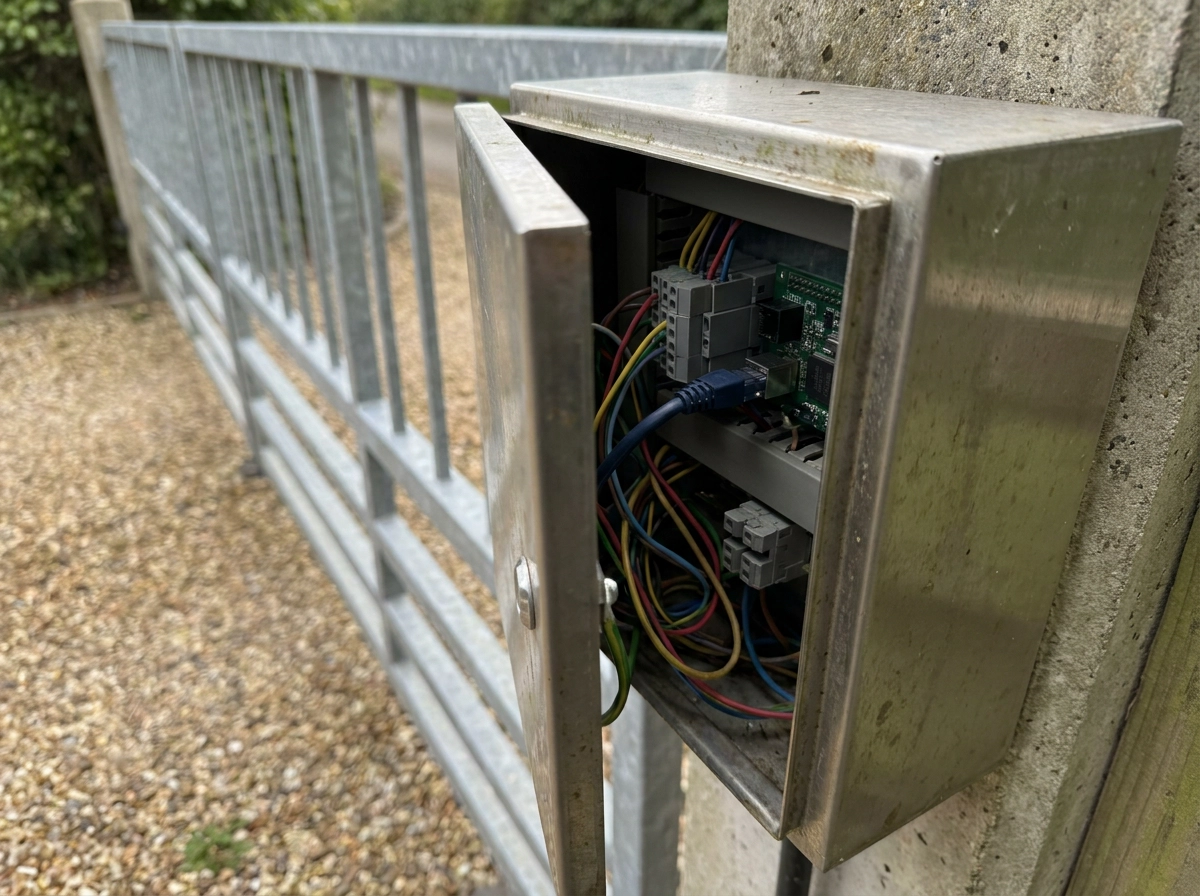
Modern commercial gate automation systems should be specified as nodes within a unified security infrastructure, not as standalone barriers. The access controller needs to communicate with CCTV cameras, intruder alarm panels, and building management systems through open protocol interfaces. Common hardware-level interfaces for credential data include Wiegand and the more recent OSDP standard, which offers bidirectional communication; confirming which protocols your existing systems support is an essential step before selecting a controller. API integration enables communication with cloud-based platforms and site management software. Specifying which protocols your existing systems support before selecting an access controller eliminates compatibility problems that are expensive to resolve after installation.
CCTV convergence is the integration requirement that arises on almost every commercial site. Cameras at gate access points should be configured to trigger recording on credential presentation, capturing a timestamped image or short clip that is linked directly to the access event record. This pairing is what gives audit logs investigative value; a log entry showing a fob number and a timestamp is significantly more useful when a corresponding video clip confirms the vehicle and driver. Planning camera positioning, field of view, and trigger logic at the same time as the gate and access control specification avoids the need for a separate CCTV project later. Guidance on intercom and access control integration covers how these components are coordinated effectively from the outset.
As covered in the credentials section, a unified controller platform ensures every event appears in a single searchable log.
Redundancy planning is non-negotiable at critical commercial access points. The specification must define whether the gate fails safe (defaults open on power loss, appropriate where trapping people is the primary risk) or fails secure (defaults closed, appropriate where perimeter integrity is paramount). A backup power supply with a clearly defined runtime should be included, and the manual override procedure must be documented in a way that does not introduce a gap in the audit trail.
Proprietary systems that cannot communicate with third-party security technology create long-term procurement lock-in. When CCTV platforms, alarm systems, or building management software is upgraded, a proprietary access controller may be incompatible, forcing a full replacement rather than a targeted upgrade. Open-protocol systems protect the initial investment.
Portara Automation designs and installs gate automation systems for commercial and industrial sites across East Sussex, West Sussex, and Kent, specifying access control platforms with confirmed integration capability from the first site assessment.
The Real Cost of Misspecification: Retrofit Versus Right First Time
Integration complexity makes the consequences of underspecification visible quickly, but the root cause almost always traces back to a decision made before the gate was installed.
The most common failure mode in commercial access control is not hardware breakdown; it is a system specified too narrowly for the site it serves. A controller selected for simple fob-only access may lack the firmware architecture, input/output capacity, and credential database structure needed to support vehicle detection, remote management, and audit logging. When that is the case, the entire controller must be replaced.
Retrofit costs accumulate quickly. Replacing a controller means re-cabling to every new peripheral device, reconfiguring any existing integrations with CCTV or intruder alarm panels, and accepting downtime at a critical access point while work is carried out. Site staff require retraining on the new interface, and if credential records were not exported in a transferable format, access rights must be re-entered from scratch. Individually, each of these costs is manageable; collectively, they routinely exceed the incremental investment that would have bought a correctly specified system at installation. If you are already managing retrofitting an existing manual gate, adding a controller replacement to that scope compounds both cost and disruption significantly.
Insurance-triggered retrofits, covered in the audit-trails section above, add urgency to this planning.
The remedy is straightforward: specify a controller with headroom. A unit that supports more credential types and additional access points than the site currently requires adds modest cost at installation, typically a small fraction of total project value, but removes the scenarios that trigger the most expensive retrofits.
The business case is direct. The cost differential between a correctly specified commercial system and a basic alternative is, in most cases, recovered entirely within the first avoided retrofit event. Right-first-time specification is not a premium; it is the lower-cost option measured across the system's operational life.
UK Compliance Standards Relevant to Commercial Gate Access Control
Correct specification avoids the retrofit problem; compliance obligations mean there is no legal option to defer getting the framework right.
BS EN 13241 and the Machinery Directive
BS EN 13241 is the harmonised standard covering industrial, commercial, and garage doors and gates. Meeting it does not, on its own, satisfy every legal requirement. Powered gate installations on commercial sites must also comply with the Supply of Machinery (Safety) Regulations 2008. The installer must produce a Declaration of Conformity before the gate is commissioned, and that declaration must accurately reflect the installed configuration. Any subsequent modification to the automation, including adding a new access credential type or changing the control system, can invalidate the original declaration and require a fresh conformity assessment. Specifying a system that is already future-proofed for anticipated changes limits this exposure.
PUWER and Operational Safety Obligations
The Provision and Use of Work Equipment Regulations 1998 apply to powered gates wherever they constitute work equipment, which covers the vast majority of commercial installations. PUWER requires that gate automation systems are safe to use, maintained in good working order, and that anyone operating or working near them is appropriately trained. Maintenance records must be kept. Where a gate serves a mixed-user environment including contractors, delivery drivers, and shift workers, demonstrating adequate training and instruction becomes a documented obligation, not an assumption.
Risk Assessments and Review Triggers
Risk assessments under PUWER and the Management of Health and Safety at Work Regulations 1999 must be documented before the gate enters service and reviewed when conditions change. A modification to the gate structure, the addition of a new credential type, or the onboarding of a significant new user group each constitutes a material change that should trigger a formal review. Retaining records of each assessment is essential; an undocumented review provides no protection in the event of an incident or enforcement action. For further detail on how safety standards apply to electric gate installations, the guidance on UK Safety Standards and Compliance for Electric Gate Locks sets out the relevant framework.
UK GDPR and Access Log Processing
Sites where access control logs record named credential holders or vehicle registration data are processing personal data. UK GDPR requires a Record of Processing Activities entry covering that data, specifying the lawful basis (typically legitimate interests for commercial security), a defined retention period, and appropriate access restrictions on the logs themselves. This obligation sits with the data controller, meaning the property owner or operator, not the installer.
Installer Accreditation and Planning
The NSI and SSAIB provide accreditation frameworks for commercial access control installers. Specifying an accredited installer is increasingly expected by insurers and is worth confirming with your underwriter.
Finally, planning permission requirements for gate height, siting, and automation vary by local authority and are more restrictive within conservation areas. Permitted development rights should be confirmed before specifications are finalised, not after equipment has been ordered.
A Specification Framework for Commercial Gate Access Control
With compliance obligations confirmed, the next step is translating them into a working specification before any contractor conversation begins.
Start with the user population. Count every credential holder the system will need to support: permanent staff, shift workers, contractors on rolling agreements, and delivery drivers who arrive without prior notice. Identify whether any user group requires time-restricted access, a contractor permitted on site only during daylight hours, for instance, rather than unrestricted entry. That single question frequently determines whether a basic two-credential controller is adequate or whether a full access management platform is required from day one.
Map every access point, not just the main vehicle gate. Pedestrian gates, secondary vehicle exits, loading bay barriers, and internal compound gates all represent access events that belong in the same audit record. If a single controller platform cannot manage all points, establish that requirement before approaching suppliers, because retrofitting networked multi-door capability to a single-door controller is a replacement exercise, not an upgrade.
Establish audit and reporting requirements before speaking to any installer. Consult your insurer, your internal compliance or security team, and any contractual obligations you hold toward tenants or clients. The highest requirement in that group defines your specification floor. Approaching a contractor without this information typically results in a system specified to the lowest convenient standard rather than the one that will satisfy an insurance query or a tenant audit clause twelve months later. For a broader starting point on matching gate specification to site requirements, Making the Right Choice for Your Property sets out the relevant variables.
Confirm integration requirements before selecting hardware. Common hardware-level interfaces for credential data include Wiegand and the more recent OSDP standard, which offers bidirectional communication; confirming which protocols your existing systems support is an essential step before selecting a controller. A controller that cannot communicate with existing infrastructure will create an isolated credential database and a fragmented audit record.
Define performance requirements in measurable terms. Expected daily gate cycles, peak throughput at shift change, the largest vehicle that must pass without delay, and site-specific environmental conditions such as coastal salt exposure or sustained traffic vibration all affect motor, barrier, and controller selection on commercial sites. Specifying these figures removes ambiguity from contractor proposals and makes like-for-like comparison possible.
Finally, test every prospective installer's audit log capability before placing an order. Ask them to demonstrate, concretely, how their proposed system produces, stores, and exports access logs. A contractor who cannot answer that question with precision should not be shortlisted for a commercial installation, regardless of their gate or automation credentials.
Specifying Commercial Gate Access Control: Key Takeaways
Apply the framework above and the answer to what a commercial gate access control system must deliver becomes consistent, regardless of site type or scale.
Specification comes before hardware selection. Credentials, audit logging, compliance documentation, and integration requirements must all be defined before any controller or automation equipment is chosen. Systems selected in the reverse order routinely fail to meet the operational or regulatory standard the site actually requires.
Three elements are non-negotiable for any commercial installation: multi-credential support covering at minimum fobs, PIN entry, and vehicle detection; time-stamped audit trails that are retrievable and exportable; and confirmed interoperability with existing CCTV, intruder detection, and site management infrastructure. The credentials section above explains when and why each credential type is required.
UK compliance obligations are not optional extras. The compliance section above details each obligation and its review triggers.
Right-first-time specification is the lower-cost outcome. As the cost analysis above demonstrates, right-first-time specification is the lower-cost outcome across the system's life.
Portara Automation provides bespoke commercial gate access control design and installation across East Sussex, West Sussex, and Kent. Every project begins with a site assessment that defines credential requirements, audit obligations, integration dependencies, and compliance documentation needs before any hardware is specified. Support continues through to commissioning and the provision of the compliance documentation your insurer, your internal audit process, and UK regulatory obligations require.
If your site needs a gate access control system specified correctly from the outset, contact Portara Automation to arrange an initial assessment.