
Keeping Electric Gates Working on Exposed Sussex Sites
Salt, wind and rain break electric gates differently on Sussex and Kent coasts and farmland. See the failure modes and the servicing that fixes them.
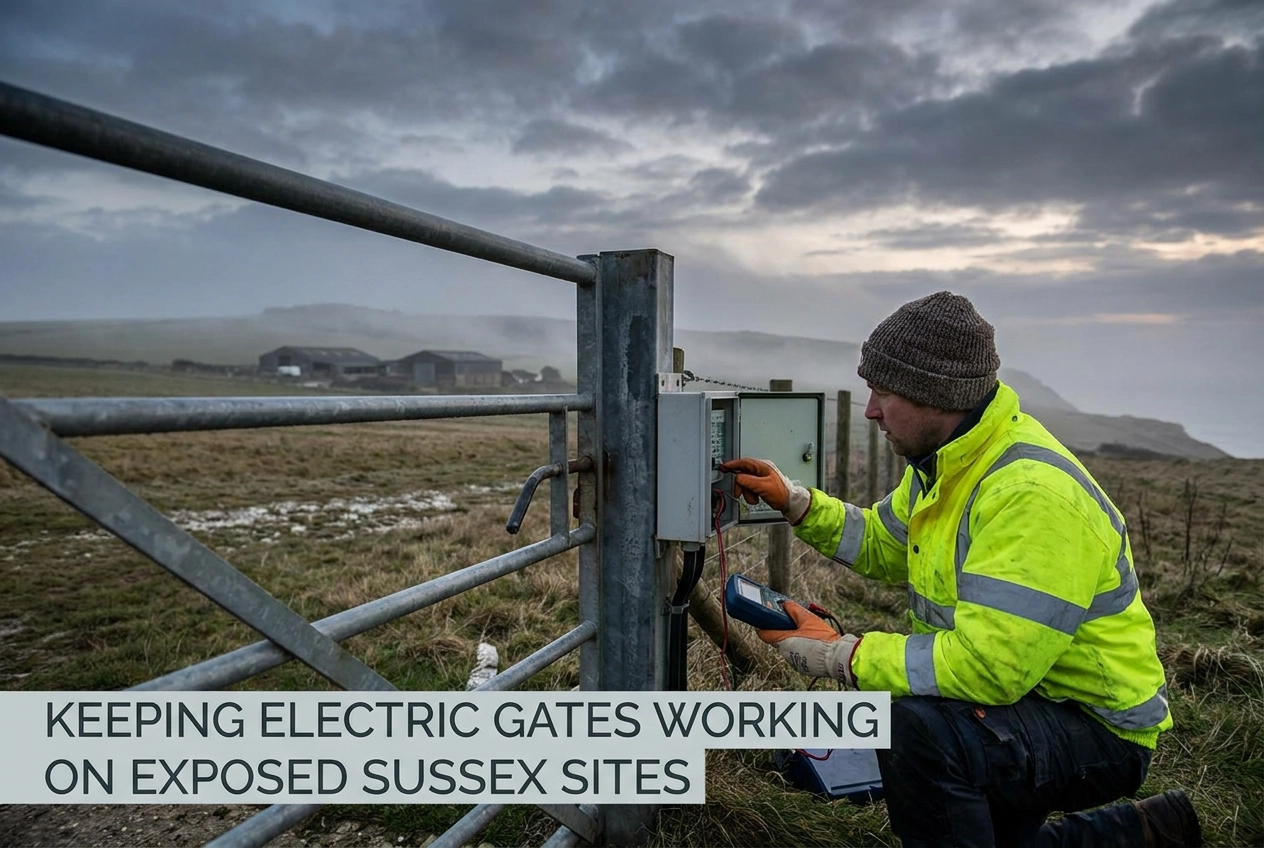
Coastal salt and open farmland do not just make an electric gate look tired. They attack the parts you cannot see: fixings, hinges, ground anchors, control enclosures, safety edges, seals, rollers and tracks. If you manage, maintain or specify gates on exposed Sussex and Kent sites, suburban servicing intervals and assumptions will not keep them safe or reliable. That is why electric gates repairs on this kind of exposure must start with the environment, not just the fault code.
This tutorial explains why exposed Sussex and Kent sites are a different maintenance problem. It compares coastal salt with open farmland, then works through corroded fixings, water ingress into motors and enclosures, UV-perished safety edges, degraded seals, and seized running gear. It covers farm gate automation under stock, mud, wind and heavy duty cycles. It also sets out the safety baseline that applies regardless of setting, including HSE safety alert FOD 7-2010, BS EN 12453:2017 and Gate Safe duties. Finally, you will see how exposure should drive servicing frequency and installation specification, and how to decide whether to inspect, repair or upgrade.
Why Exposed Sussex and Kent Sites Are a Different Maintenance Problem
Gates on the Sussex and Kent coast, and on open downland and farmland, meet salt-laden air, driving rain and uninterrupted wind. A sheltered suburban drive rarely produces the same combination of moisture cycling and wind load. Salt is hygroscopic; it holds moisture against steel long after rain stops.
Routine maintenance reduces the impact of all three, but exposure multiplies their severity at once.
Exposure also changes which component fails first. Fixings, control enclosures, safety edges and running gear each degrade on a different timeline, depending on how much salt, sun and wind the gate sees.
Across Portara's East Sussex, West Sussex and Kent service area, we observe that gates within a short distance of the shoreline, or on open farmland with no natural windbreak, show corrosion and water-related faults sooner than equivalent inland installations. Treat this as practical service experience, not a measured standard. Wind exposure also shapes repair decisions: see what East Sussex conditions mean for tool choice.
The practical consequence is that exposure should drive two decisions at once: the finish and fixings specified at install, and the frequency and content of servicing afterwards. Choosing one without the other leaves a known gap.
How Exposure Changes What Fails: Coastal Salt Versus Open Farmland
Coastal salt. Chloride-rich air settles on metalwork, and coastal environments rank among the most aggressive atmospheric corrosivity categories, equivalent to ISO 12944 C4 to C5. Corrosion advances faster where a coating is scratched or broken, typically at the bracket-to-post joint.
Dissimilar-metal corrosion. Stainless fasteners meeting galvanised or mild steel create a galvanic couple; trapped moisture is the electrolyte, and the joint corrodes first. Fixing specification is therefore an install-stage decision, not a repair-stage fix.
Wind load. Wind load on wide farm gate leaves is addressed in the Farm Gate Automation section below.
Abrasion and mud. Grit and ground-level mud pack into rollers, tracks and hinges, while livestock and vehicles multiply daily cycles. Cleaning and lubrication intervals shorten accordingly. No published interval is confirmed, so treat this as field-based guidance, consistent with how UK weather patterns create recurring electric gate problems.
Water ingress. Driven rain past lid seals and glands, plus condensation from day-night temperature cycling, is a recurring route to intermittent electrical faults.
Coastal salt corrosion of fixings, UV degradation, water ingress and farm-specific patterns are recorded from Portara's own service work, not the published sources reviewed. The sections that follow read each failure by component.
Corroded Fixings, Hinges and Ground Anchors
At the fixings, that salt-laden moisture produces visible symptoms: rust weeping from hinge plates or post brackets, a leaf dropped on the latch side, a gate that sags as it opens, or fasteners that shear rather than tighten.
Coastal sites typically fall within ISO 12944 corrosivity categories C4 to C5, so replace corroded fixings with environment-appropriate ones: marine-grade stainless such as A4/316 or hot-dip galvanised, not standard plated fasteners. Separate dissimilar metals at the joint with isolation washers or sleeves so moisture cannot bridge them and drive galvanic corrosion. Treat and recoat at the first sign of coating breakdown, well before perforation.
Ground anchors, post bases and concealed brackets are easy to miss on a visual check but fail first on exposed sites; remedial groundwork after installation costs far more than specifying correctly at the start.
Make a torque and condition check of fixings, anchors and welded joints part of every exposed gate service, not optional.
Water Ingress Into Control Enclosures and Motors
Corroded fixings fail visibly; water ingress fails intermittently. A gate that stops part way through travel only after heavy rain, suffers repeated fuse or board failures, or works once the panel has dried out points to water ingress. These intermittent faults are common electric gate problems on exposed sites.
Driven rain passes worn lid gaskets, motor seals and cable glands. Water tracks along cable entries into the enclosure. Sealed boxes also form condensation as internal temperature swings between day and night.
Renew enclosure and gland seals. Check the enclosure's IP rating suits the site, and mount it clear of splash and standing water. Cable entries should be made off from below, never from above.
Any work inside a control enclosure carries a duty to leave the gate safe afterwards. The legal framework is discussed in the safety baseline section below.
On exposed coastal or farmland sites, inspecting enclosures and glands after storm events is worth more than waiting for the next calendar service. This is Portara's field-based recommendation, not a published interval.
UV-Perished Safety Edges and Degraded Seals
While enclosure seals fail under driven rain, safety edges and their seals fail from exposure on the outside. On an exposed Sussex or Kent gate, rubber and polymeric edge profiles, end caps and interconnecting seals sit in full sun with salt and grit against them, hardening, cracking or splitting over time. Portara records this degradation from service work rather than from published sources.
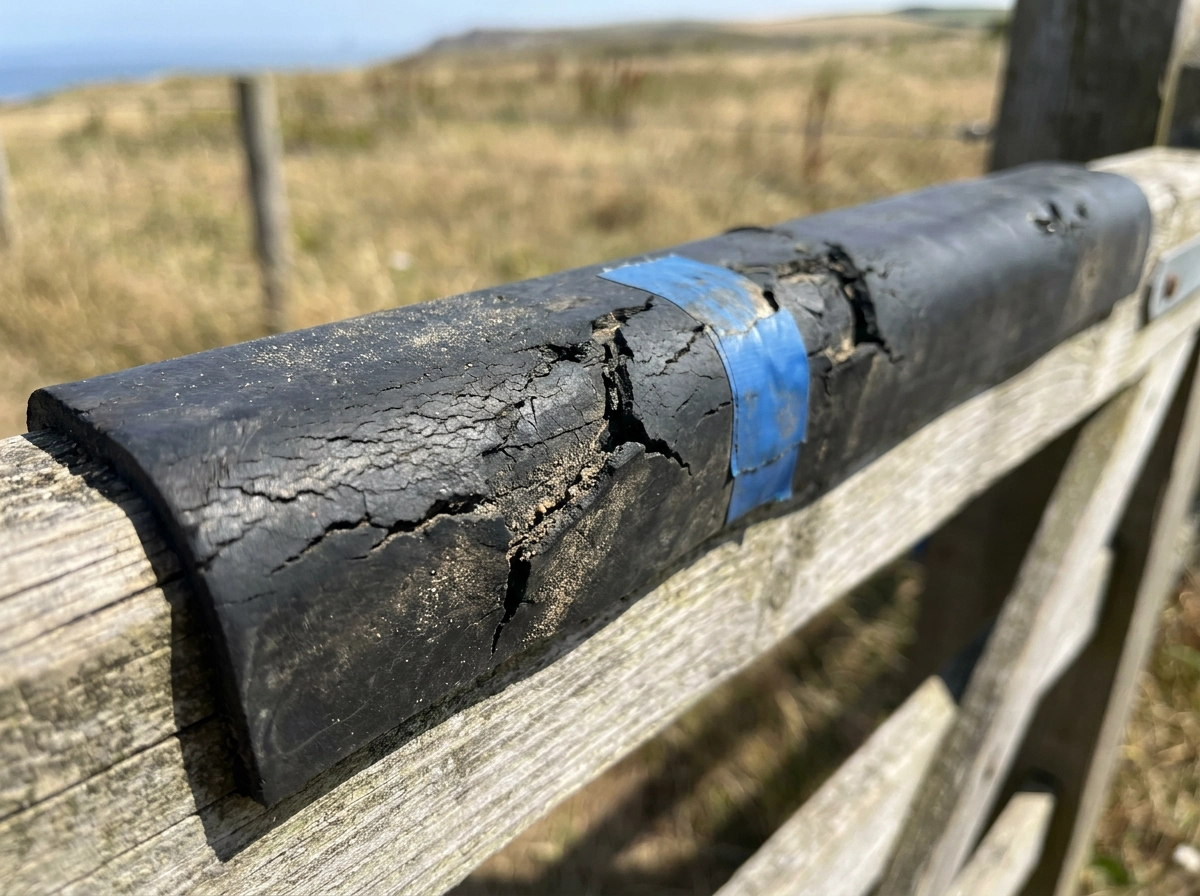
It is not cosmetic. The safety edge is part of the gate's safety function, and the HSE safety bulletin on electric gates expects presence-sensing such as photoelectric beams and protection of trapping points.
At every service, physically deform and function test each edge rather than glancing at it from the drive. A hardened edge that no longer deforms reliably may not trigger a reversal when it matters. Test the wider safety chain at the same time: HSE requires force limitation and reversing on contact, so force testing belongs alongside edge testing, since worn running gear or edges can shift measured forces.
Clean and correctly align weather-exposed photoelectric beams. Salt film, insect debris and storm-blown grit are common causes of nuisance triggering or missed detection on coastal sites, based on Portara's service experience. These are among the components that degrade fastest and why.
Seized Rollers, Tracks and Running Gear
Edges and beams guard the safety chain; running gear carries the load. Seized rollers, tracks or hinges make the operator fight the gate, and mechanical binding can trip the thermal cut out or strain the motor.
Symptoms: sluggish or jerky travel, a leaf dragging at one end, the operator straining or sounding louder than usual, and a motor running warmer than it should.
Mechanisms: grit and mud packing rollers and tracks, rain washing out lubricant, salt corrosion on sliding surfaces, and alignment drift as ground moves or posts settle.
Response: clean and re-lubricate running gear with a product suited to an exposed application, check track alignment and leaf levelling, and replace seized or flat-spotted rollers rather than forcing them back into service.
This cannot wait. A dragging leaf increases operator load, shortening motor and gearbox life, and can push the gate outside its force envelope. HSE states installers without force-measuring equipment cannot be sure a gate meets safety standards. The same applies when running gear changes during a repair.
Seasonal pinch points on Sussex and Kent sites: autumn leaf fall, coastal grit after winter storms and farm mud through the wet months all load running gear at once. Inspect before each period to prevent the seizure that follows.
Farm Gate Automation: Stock, Mud, Wind and Duty Cycles
Rural sites raise the engineering problem further. Agricultural gates have wider openings, heavier leaves and heavier traffic, and often contain livestock; EN 13241's scope excludes gates mainly for the retention of animals. Farm gate automation is a separate engineering problem, not a scaled-up domestic installation, and our agricultural and rural gate automation guidance covers the specifics.
A wide leaf acts as a sail, so operator sizing and hinge specification must be matched to wind load, not leaf weight, the mismatch we see most often on exposed agricultural sites.
Mud and slurry demand a different response. Ground-level running gear, track, rollers and post bases sit in wet, abrasive conditions for much of the year, so cleaning and re-greasing matter more than adjusting settings. Duty cycle should set the schedule, as a gate cycling many times a day reaches its wear limits far sooner than a quiet domestic one.
Safety duties do not lapse in a rural setting. HSE's bulletin on electric gates covers powered gates wherever people have access, and farms carry workers, visitors and often public rights of way. Existing manual farm gates can be automated, and where a gate is unsuitable for motorisation, bespoke fabrication of a replacement leaf is an option.
The Safety Baseline That Applies Whatever the Exposure
Whatever the exposure, one baseline applies. HSE safety bulletin FOD 7-2010, issued 2 September 2010, targets anyone installing or modifying electrically powered gates in areas people can access and may also apply to maintainers. Treat it as the regulator's long-standing position; check its supersession status.
Its requirements, force limits, reversing, presence sensing, trapping point protection and emergency release, are covered in context in the sections above.
As noted for running-gear repairs above, any alteration to forces, hinges or edge profiles triggers the same force-testing obligation.
BS EN 12453:2017 specifies safety-in-use requirements and test methods for power-operated gates within reach of persons, including residential premises, superseding BS EN 12445:2001 and BS EN 12453:2001. Confirm the latest position before quoting it.
Maintainers have a duty to leave the gate safe after any work; consult the relevant HSE guidance and Gate Safe's legal responsibilities page for the applicable statutory framework. On commercial and agricultural sites, records and competent installer checks form part of safety management; Gate Safe maintains guidance on verifying installer credentials.
Letting Exposure Set Servicing Frequency and Install Specification
With that baseline set, exposure should determine both service frequency and original specification. No servicing interval is confirmed in the published guidance reviewed here. The following is Portara's field guidance, not a quoted standard.
A sheltered inland gate normally needs a regular scheduled visit. Catching edge wear, fixing deterioration and running-gear faults early is the core benefit of any regular service visit.
An exposed coastal gate needs a shorter interval plus post-storm checks, prioritising enclosure seals, glands, fixing condition and salt-driven corrosion at joints. Washing salt off metalwork between services reduces what the next visit must repair.
An exposed farmland gate should be scheduled by duty cycle and season, not the calendar, with checks before winter and after the wet, muddy months, plus a look at ground-level running gear and anchors.
Specify at design stage: finish, fixings, enclosure rating and operator sizing settled against exposure, since retrofitting corrosion protection or wind-rated hardware later costs more. On commercial and development sites, pair servicing with written records; documentation and competent checks form part of safety management.
What to Do Next: Inspect, Repair or Upgrade
Three actions follow.
Exposure determines which component fails first, so a coastal or farmland gate needs different attention from a sheltered one. Match fixings, finishes, enclosures and operator sizing to the site, not a catalogue, and schedule by exposure and duty cycle, not the calendar.
If your gate is sluggish, rust-stained, tripping after rain or faulting intermittently, an inspection is the sensible first step. Contact Portara Automation to arrange an inspection.
Conclusion
Exposed sites demand environment-matched specifications and shorter, exposure-driven service cycles, not a suburban calendar. If your gate is showing signs of coastal or farmland wear, contact Portara Automation to arrange an inspection.