
Metal Security Gates: What Every Buyer Needs to Know
Compare gate materials, automation options, and UK planning rules. Your complete guide to choosing metal security gates for residential, commercial, or agricultural use.
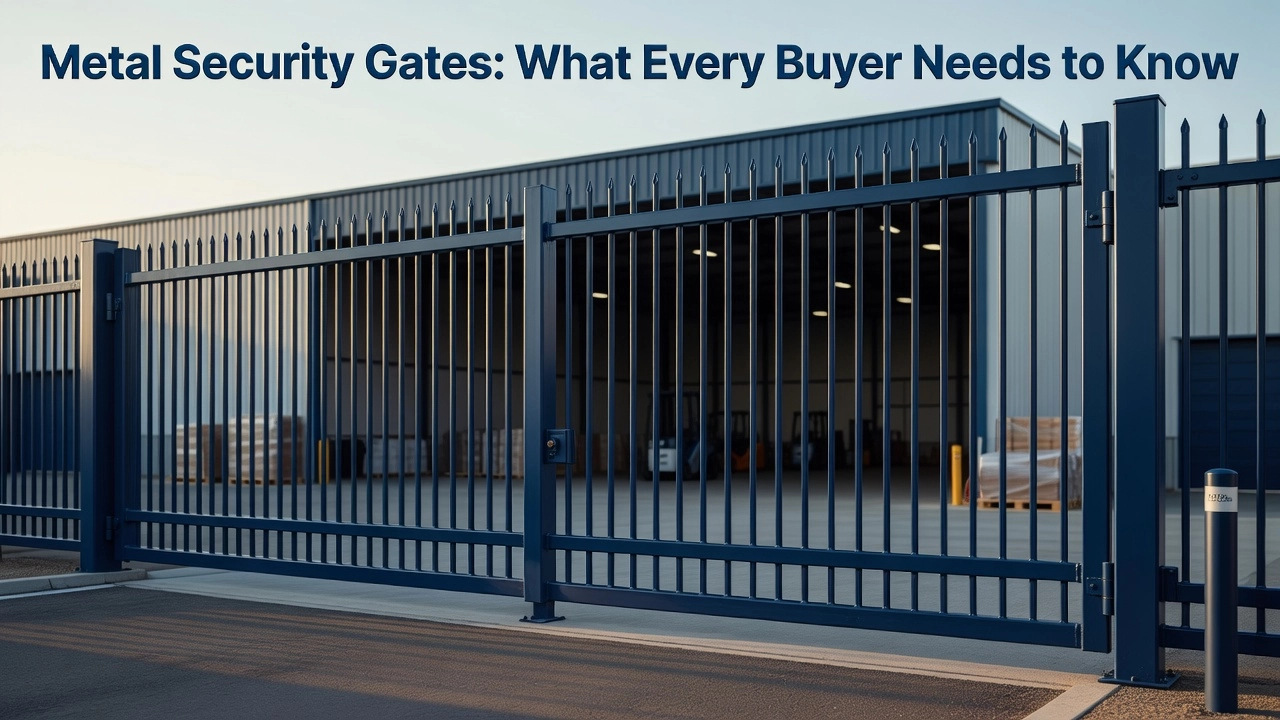
Every year, countless property owners invest in security upgrades only to discover they made costly mistakes that could have been avoided with the right knowledge upfront. When it comes to protecting your home or business, metal security gates stand as one of the most reliable and durable solutions available, but choosing the wrong type can leave you with a product that fails to meet your actual needs.
Whether you are securing a residential driveway, a commercial property, or an industrial facility, understanding the key factors before making a purchase can save you significant time, money, and frustration. Metal security gates come in a wide range of materials, designs, configurations, and price points, and navigating these options without guidance can feel overwhelming.
This guide breaks down everything an informed buyer needs to know before committing to a purchase. From understanding different gate materials and locking mechanisms to evaluating installation requirements and long-term maintenance costs, you will walk away with a clear, confident understanding of what separates a smart investment from an expensive regret. Let's get into it.
Why Demand for Metal Security Gates Is Rising
The market data tells a clear story. The Europe gates market was valued at USD 5.68 billion in 2025 and is projected to reach USD 9.03 billion by 2034, growing at a CAGR of 5.28%. This is not speculative growth driven by a single sector; demand is rising consistently across residential, commercial, and industrial applications, reflecting a structural shift in how property owners think about perimeter security rather than a short-term trend.
Automated metal security gates are growing even faster. The global automated gates market is forecast to expand at a CAGR of 9.9% between 2026 and 2033, with three core forces driving that acceleration: heightened safety concerns, rapid urbanisation creating higher-density and higher-value properties, and increasing investment in smart home and smart city infrastructure. IoT integration, app-controlled operation, and AI-enhanced access control are all actively normalising a level of investment that would previously have been considered purely commercial. The European automatic gate and door opening system market is expected to nearly double between 2025 and 2035, with the UK specifically identified as the fastest-growing country in Europe for this category.
Security concern remains the most direct purchase driver. Theft, trespass, and unauthorised vehicle access are prompting both homeowners and businesses to treat physical perimeter control as a first line of defence rather than an afterthought. Gated residential developments are expanding across the UK, and awareness is spreading; metal security gates are no longer associated exclusively with commercial or industrial sites. Private homeowners are increasingly treating them as a standard property investment.
For properties across East Sussex and the wider South East, these national trends are reinforced by local conditions. Rural isolation, high coastal property values, and the prevalence of mixed residential and agricultural land use create specific vulnerabilities that national statistics underrepresent. Farm vehicle theft, quad bike crime, and opportunistic trespass on agricultural land all drive demand for robust high security gate solutions that go beyond aesthetic kerb appeal, making this region a particularly active market for bespoke metal fabrication and gate automation.
Steel vs Wrought Iron vs Aluminium: Which Metal Is Right for Your Gate?
Choosing the right metal for your security gate is one of the most consequential decisions in any gate project, affecting long-term durability, maintenance costs, automation performance, and ultimately, how well the gate does its job. Here is a clear breakdown of the three primary options.
Mild Steel: The Practical Benchmark
Mild steel accounts for 38.2% of the global metal gate market in 2025, and for good reason. It offers exceptional tensile strength, is highly weldable, and can be fabricated into virtually any configuration, from heavy-duty sliding gates on commercial sites to ornate swing gates for residential driveways. Its cost-effectiveness relative to other metals makes it the default choice for most bespoke fabrication projects in the UK. Steel gates can be finished with powder coating or hot-dip galvanising to significantly extend their lifespan, with galvanising providing a molecular-level barrier against corrosion rather than simply a surface coat. For high-security applications, bespoke steel fabrication allows engineers to specify exact bar diameters, infill spacing, and frame gauge to meet defined security ratings, something off-the-shelf products rarely offer.
Wrought Iron: Traditional Styling at a Premium
True wrought iron fabrication is increasingly rare; most gates marketed as "wrought iron" are actually mild steel with decorative detailing. Genuine wrought iron offers superb aesthetic character and suits period properties, listed buildings, and high-end residential entrances where visual impact matters as much as function. The trade-off is meaningful: wrought iron is heavier, more labour-intensive to fabricate, and noticeably more vulnerable to rust in damp or coastal conditions. In East Sussex, where salt-laden sea air accelerates oxidisation, wrought iron demands a rigorous maintenance programme.
Aluminium: Lightweight, Corrosion-Resistant, Automation-Ready
As noted in driveway gate material comparisons, aluminium does not rust and performs reliably in high-moisture environments, making it well suited to coastal properties across East Sussex and Kent. Critically for automated systems, its lower weight reduces the torque demand on gate motors, extending motor lifespan and improving operational reliability. Marine-grade powder coating applied over aluminium provides further environmental protection.
The Coastal Factor: A Critical, Not Cosmetic, Decision
Salt air accelerates corrosion dramatically compared to inland environments, and properties within several miles of the coast in East Sussex and Kent require more than standard surface treatments. Hot-dip galvanising on steel, combined with marine-grade powder coating, provides genuine long-term protection. For exposed coastal sites, aluminium remains the lower-maintenance default.
Security Is About the Whole Gate, Not Just the Metal
Steel versus aluminium security comparisons consistently show that in a real-world gate breach scenario, hinges, posts, and locking mechanisms typically fail before the gate leaf itself. Gate thickness, infill bar spacing, anti-lift hinge specifications, and post embedment depth all contribute directly to security performance. A bespoke fabricated steel gate, engineered to specific security standards, will outperform a lightweight off-the-shelf alternative regardless of material label.
Gate Types Explained: Sliding, Swing, and Bi-Fold
With your metal type selected, the next critical decision is gate configuration. Each gate type carries distinct engineering requirements, site constraints, and automation implications that should be resolved at the design stage rather than discovered during installation.
Sliding Gates: The Space-Efficient Default
Sliding gates hold 42.3% of the European gates market in 2024, and that dominance is not accidental. Because the gate travels horizontally along the fence line rather than swinging outward, it needs no clearance arc in front of the opening. This makes sliding gates the default solution for properties with short driveways, sloped approaches, or restricted forecourt space. Three sub-variants exist: tracked (running on a ground rail), cantilever (suspended without a ground track, preferred on uneven or soft ground), and telescopic (two interlocking panels that reduce the run-back space required alongside the fence). Selecting the wrong sub-variant for the site conditions is a common and avoidable error; a detailed comparison of fence gate types illustrates how site geometry should drive this choice.
Swing Gates: Visual Impact With Site Requirements
Swing gates, whether single or double leaf, remain the preferred choice for wider entrances with sufficient driveway depth. They are mechanically simpler to automate, generally more cost-effective to specify, and widely favoured for their visual impact on residential and period properties. The trade-off is that they require flat ground and a clear swing arc; a sloped or restricted approach can render an otherwise well-specified swing gate completely unworkable once installed. That correction is expensive. Automated gate buying guides consistently flag this as one of the most frequent retrofit scenarios, where early site assessment would have prevented a costly change of direction.
Bi-Fold Gates: Speed of Access for High-Traffic Sites
Bi-folding gates are engineered for situations where opening speed and traffic throughput matter more than simplicity. The panels fold back on themselves, requiring significantly less lateral run-back space than a full-panel sliding gate while achieving faster cycle times. This makes them well suited to commercial yards, industrial facilities, and agricultural sites where vehicles enter and exit frequently throughout the working day.
The Design-Stage Decision That Protects Your Budget
Gate type selection determines almost everything downstream: motor specification, control board capacity, groundwork requirements, and post sizing. Properties with uneven ground, shared entrances, or non-standard opening widths frequently require bespoke fabricated gate leaves rather than off-the-shelf panel sizes. Attempting to fit standard components to irregular sites is precisely where budgets overrun. Resolving these variables during the design stage, before any groundwork begins, is the most reliable way to keep the project on cost and on programme.
Manual vs Automated Metal Gates: When and How to Upgrade
Many properties across East Sussex and beyond already have manual metal gates that were installed years, or even decades, ago. The good news is that full replacement is rarely necessary. Provided the gate structure remains sound, the hinges show no significant wear or movement, and the gate leaf weight falls within the operational range of a compatible motor, existing metalwork can frequently be automated at a fraction of the cost of a new installation. For swing gates, this typically means leaves weighing up to 300 kg for a linear actuator or up to 500 kg for an underground ram system. Sliding gates with heavier steel construction may require a rack-and-pinion motor rated accordingly, making a professional assessment essential before any components are specified.
The upgrade process follows a clear sequence. A qualified engineer will assess the condition of the existing gate and posts, confirm the frame geometry is compatible with the chosen operator, and identify the most practical cable route from the mains supply to the gate posts. A control board is then fitted, programmed for the chosen entry and exit logic, and the access control device, whether that is a keypad, intercom, RFID reader, or video entry panel, is integrated into the system. According to automatic gate opening system market research, electromechanical drive technology leads the sector precisely because of its reliability, low maintenance requirements, and compatibility with modern access control, making it the dominant choice for retrofit projects.
The security case for automation is straightforward and compelling. A gate that closes automatically behind every vehicle removes the single most common vulnerability in residential and agricultural access: an entrance left open. On farm properties in particular, an open gate can result in livestock loss, equipment theft, or unauthorised access to outbuildings, risks that automated closure with safety photocells and obstacle detection directly mitigates.
Before committing to an upgrade, four practical questions should be addressed. Is the existing metalwork structurally sound, with no cracked welds or corroded sections? Are the posts set in concrete to a depth of at least 600 mm, with no visible movement? Is a mains power supply accessible within a practical cable run distance, typically under 50 metres before voltage drop becomes a consideration? And does the gate configuration, swing or slide, suit the available space? Honest answers to these questions determine whether upgrading the existing installation or investing in a full replacement delivers the better long-term value.
Portara Automation offers manual-to-automated gate upgrades across East Sussex, West Sussex, and Kent, carrying out on-site assessments to evaluate existing gates properly and specify the right automatic gate opening system without defaulting to replacement. The starting point is always what is already in place.
Access Control Options to Pair with Metal Security Gates
A metal security gate provides the physical barrier, but its effectiveness depends entirely on the access control system paired with it. The gate secures the entrance; the access control layer determines who can open it, when that access is granted, and how every interaction is recorded. Choosing the right combination for your property type, traffic volume, and security requirements is just as important as selecting the gate itself.
1. Keypad Entry
Keypad or PIN-based entry remains one of the most practical and cost-effective access control solutions for low-to-medium traffic sites. Users enter a code to trigger the gate, making it straightforward to install and simple to operate. It suits private driveways, small business premises, and farm entrances where the number of authorised users is manageable and the code can be changed whenever personnel or tenants change. While keypads do not provide identity verification or activity logging, they offer a meaningful step up from a manual gate with no access restriction at all. For many residential and agricultural applications, a robust keypad system paired with a quality metal security gate delivers a proportionate level of security without unnecessary complexity.
2. Video and Audio Intercom Systems
Intercoms add a verification layer that a PIN pad alone cannot provide. Gate access control systems pairing keypads with intercoms are an established combination for both residential and commercial metal gates. Video intercom systems allow the gate owner to see and speak with a visitor before granting access, which is particularly valuable for residential properties, offices, and commercial sites that receive regular deliveries or contractors. Audio-only intercoms offer a more affordable alternative where visual confirmation is less critical. Both configurations are available in hardwired and wireless formats, with GSM-based wireless intercoms being the preferred option for remote or rural properties where cabling is impractical.
3. Remote Fobs and Vehicle Loop Detectors
Remote fob systems allow authorised users to open the gate directly from their vehicle, without leaving the car or entering a PIN. This is particularly convenient for daily commuters and commercial vehicle drivers. Vehicle loop detectors take automation a step further; inductive sensors buried beneath the driveway surface detect the presence of a vehicle and trigger the gate to open automatically on exit. This removes the need for any driver action when leaving the site, which significantly improves traffic flow on busier commercial or industrial sites. As detailed in reliable gate control access guides, remote controls are ideally suited to properties where manual gate operation would create delays or safety hazards.
4. App-Controlled and GSM-Based Systems
App-controlled and GSM-based systems represent the most flexible tier of access control currently available, and adoption is growing rapidly alongside broader smart infrastructure investment across Europe. These systems connect gate operation to a smartphone via a dedicated app or the cellular network, enabling the gate owner to grant or deny access remotely from any location. Temporary user permissions can be issued and revoked without a site visit, activity logs provide a verifiable record of every access event, and multiple users or sites can be managed from a single interface. For holiday let owners, landlords managing rental properties, and businesses operating across multiple locations, this level of remote control is a significant practical advantage. GSM intercoms extend this functionality to visitors and delivery drivers, who can request access via an intercom call that the operator answers remotely and resolves with a single button press on their phone.
For properties with the highest security requirements, layering multiple methods, such as combining RFID credentials with video intercom verification and app-based activity logging, provides a multi-factor approach that is increasingly common on commercial and industrial sites. At Portara Automation, we advise on the most appropriate access control combination for every gate installation we undertake, ensuring the system reflects the specific demands of the site rather than applying a one-size-fits-all solution.
UK Planning Rules for Metal Security Gates: What You Need to Know
Before investing in any metal security gate installation, understanding the UK's planning and safety framework is essential. Getting this wrong can result in enforcement action, costly removal orders, or an uninsurable installation. Here are the five key rules every property owner needs to know.
1. Height Limits Under Permitted Development in England
In England, the Town and Country Planning (General Permitted Development) (England) Order 2015 sets the baseline rules. Gates fronting a highway used by vehicles, or the footpath of such a highway, must not exceed 1 metre in height to remain within permitted development rights. For gates positioned elsewhere on the property, the limit rises to 2 metres. Exceeding either threshold requires a formal planning application before work begins. One additional rule applies universally to automated gates: they must be designed to open inward onto the property, not outward onto a road or pavement, as outward-opening gates cannot comply with applicable safety standards.
2. Automated Gates Are Classified as Machinery
Any powered gate system falls under the Supply of Machinery (Safety) Regulations 2008, which implements the Machinery Directive in UK law. Compliance with legal requirements for electric gates is not discretionary. Installers are legally obligated to provide a Declaration of Conformity and a UKCA or CE-marked installation for every powered gate system. Key standards include BS EN 12453:2017, which governs force limitations, and BS EN 12604:2017, covering mechanical requirements. Critically, the HSE has confirmed that adherence to published standards alone does not fully satisfy the mandatory Essential Health and Safety Requirements; a site-specific risk assessment is also required.
3. Conservation Areas, Listed Buildings, and AONBs
Properties within designated areas face considerably tighter restrictions. There are over 5,500 conservation areas in England alone, and within these zones, permitted development rights for boundary treatments are frequently removed entirely. Listed building curtilage, Areas of Outstanding Natural Beauty, and Article 4 Direction areas all require formal consent regardless of gate height. Even a gate that would otherwise fall within permitted development limits may require approval if it would affect the character or appearance of a protected area.
4. Mandatory Safety Devices for Electric Gates
Automated gates present a recognised crush and entrapment hazard, and the safety standards for electric gates in the UK reflect this. Every powered gate installation must incorporate pressure-sensitive edges, photo-electric beams, or equivalent detection devices to halt or reverse gate movement on contact. Force limitation controls governed by BS EN 12453:2017 set maximum operational forces to reduce injury severity, and safety functions must be monitored and checked before each movement cycle. The HSE has also highlighted that inadequate gate support structures create structural failure risks that are entirely preventable with correct installation.
5. Qualified Installers Protect Your Liability Position
An installation carried out without proper compliance documentation creates real legal and financial exposure. A non-compliant automated gate can be subject to enforcement action, required removal at the owner's cost, and complications at the point of property sale. Home insurers increasingly scrutinise automated gate installations when policies are updated, and a missing Declaration of Conformity can affect coverage. Working with a qualified gate automation specialist who conducts a full planning assessment and delivers compliant, documented installations is not simply best practice; it is the foundation of a gate system that is safe, legal, and insurable from day one.
Residential, Commercial, and Agricultural Applications: What Changes and Why
Not all metal security gates are built to the same brief, and understanding how requirements shift across residential, commercial, and agricultural settings is essential before specifying any installation.
Residential installations place equal weight on aesthetics, security, and day-to-day convenience. Homeowners want an entrance that reinforces the character of their property while presenting a credible deterrent to opportunistic intruders. Automation is now considered standard rather than a premium addition, with gate opener systems typically adding between £1,500 and £4,700 to a project depending on gate size and motor specification. The physical design must complement the property's architecture, which is why powder-coated finishes and custom fabrication are increasingly expected rather than optional extras. Site-specific constraints, particularly ground slope, also dictate gate type at the residential level; a swing gate becomes impractical on a sloped driveway, making a sliding or cantilever configuration the only technically sound solution.
Commercial and industrial sites operate under an entirely different set of demands. The primary concerns are throughput, access control logging, integration with existing CCTV and alarm infrastructure, and the ability to manage multiple user credentials simultaneously across a single site. Gate operators for commercial use must carry high cycle ratings, since a gate opening dozens of times per day would degrade a residential-grade motor within months. Heavy-duty fabrication, reinforced hinge points, and robust steel construction are not upgrades in this context; they are baseline requirements. Access control integration, including the ability to record entry and exit events and revoke credentials remotely, is a functional necessity rather than a convenience feature.
Agricultural and rural entrances present a distinct set of engineering challenges. Openings frequently span 5 to 8 metres or more to accommodate farm machinery, and ground conditions are often uneven or subject to seasonal changes. Remote locations with limited or no mains power supply make solar-powered automation a practical necessity; solar systems eliminate the significant cost of cable trenching across large plots. Gate construction must also tolerate repeated contact from vehicles and livestock, demanding heavier section steelwork and robust hardware throughout.
Portara Automation designs across all three sectors throughout East Sussex, West Sussex, and Kent. Every installation is specified to the actual demands of the site rather than selected from a standard catalogue, which matters considerably when a gate that would serve a domestic driveway would be structurally and mechanically inadequate for a working farm entrance or a busy commercial yard.
Bespoke Fabrication vs Off-the-Shelf: Why Custom-Made Gates Deliver More
Off-the-shelf metal gates are manufactured to standardised catalogue dimensions, typically 2.4m, 3m, or 4m widths, with a limited range of stock designs and infill patterns. Where an entrance happens to align with those dimensions, they can perform adequately. The reality is that most residential driveways, commercial entrances, and agricultural access points do not naturally conform to catalogue widths. Gate posts sit at irregular spacings, ground levels vary across the opening, and boundary angles rarely produce a textbook-standard aperture. The result is that buyers either accept a poor fit or invest in costly property modifications to accommodate a gate that was never designed for their specific site.
The Case for Made-to-Measure
Bespoke fabricated metal gates resolve this problem entirely. Every dimension is taken from the actual opening, every structural element is sized to the specific brief, and every design decision reflects the property rather than a manufacturer's catalogue. There is no compromise on fit, finish, or structural performance because nothing has been adapted from a generic template. A gate engineered to purpose carries its load correctly, hangs true from correctly positioned hinges, and integrates with automation hardware without the torque mismatches and alignment issues that can arise when standard products are modified on site.
CNC Plasma Cutting and Design Freedom
CNC plasma cutting has transformed what is achievable in custom gate fabrication. Intricate decorative scrollwork, geometric infill patterns, company logos, and scenic panels can be cut directly into steel or aluminium sheet with precise tolerances, producing results that are both structurally sound and visually distinctive. For commercial premises, a gate can carry brand identity at the entrance itself. For residential properties, it becomes a considered architectural feature rather than a functional afterthought. This level of visual individuality is simply not available from off-the-shelf products.
Structural Specification and Security Performance
Bespoke fabrication also allows full control over the structural variables that determine security performance. Infill bar spacing can be specified to deter intruder access and comply with child safety requirements. Frame tube sizing affects overall gate rigidity and resistance to anti-lift attack. Hinge and latch placement can be designed from the outset with automation compatibility in mind, rather than retrofitted to a catalogue frame not built for that purpose.
Portara Automation designs and manufactures bespoke metal gates from its East Sussex base, combining CNC plasma cutting with precision metalwork to produce installations fitted precisely to the property. The gate is built around the entrance, not the other way around.
Maintenance, Longevity, and the Real Cost of Owning Metal Security Gates
Investing in metal security gates is a long-term capital decision, and understanding the full picture of ownership costs, maintenance requirements, and component lifespans is essential to making that decision well.
1. Service Life and the Long-Term Value Proposition
A well-fabricated steel gate, hot-dip galvanised and powder coated to a professional standard, can realistically deliver 25 to 40 years of service life when maintained correctly. Timber gates, by comparison, typically require replacement every 10 to 15 years due to rot, warping, and structural degradation. When the initial capital cost of a quality metal gate is divided across four decades of use, the per-year figure is considerably lower than many buyers initially assume, and the value differential against cheaper alternatives becomes substantial. The upfront investment looks very different when viewed through the lens of total service life rather than purchase price alone.
2. Annual Maintenance Tasks You Should Never Skip
A structured annual maintenance routine is what protects that service life in practice. For automated metal gate systems, this should cover lubrication of all moving components including hinges, rollers, and rack-and-pinion drives using an appropriate outdoor-grade lubricant. Safety-critical devices, specifically photo-electric beams and safety edges, must be physically tested rather than assumed to be functional. Control board settings, wiring connections, and battery backup systems all warrant inspection, as corrosion and vibration can loosen connections over time. Any paint or powder coat damage, however minor, should be touched up promptly to prevent moisture ingress and the spread of surface corrosion.
3. Coastal Properties Require Elevated Vigilance
Properties across East Sussex, particularly those within a few miles of the coast, face a more aggressive corrosion environment than inland sites. Salt-laden air accelerates the breakdown of surface coatings, especially at welds, cut edges, and fixing points where coatings are thinnest. Twice-yearly inspections are strongly advisable for coastal and semi-coastal locations. Catching early-stage corrosion and applying touch-up treatments costs very little; allowing it to progress to structural deterioration can make remediation significantly more expensive.
4. Automation Components Age Independently of the Gate Structure
The gate leaf and the automation system are separate assets with separate service lives. Gate operators typically carry manufacturer warranties of two to five years and may require overhaul or replacement after 10 to 15 years of regular use. Control boards and safety devices face an additional consideration: as UK safety regulations evolve, older systems may require updating to remain compliant, regardless of whether they are still mechanically functional. Planning for phased component replacement is a smarter approach than expecting the entire installation to perform indefinitely without investment.
5. Calculating the True Total Cost of Ownership
Buyers who focus solely on the fabrication and installation quote consistently underestimate the real cost of ownership. A complete total cost of ownership calculation must incorporate groundworks and civil engineering, automation hardware, access control systems, annual maintenance, and eventual component replacement. Deferred maintenance is a false economy; minor issues left unaddressed compound into major repair bills. A bespoke, quality installation maintained correctly will nearly always outperform a cheaper off-the-shelf system over a 20 to 30-year horizon, both financially and operationally.
How to Choose a Metal Security Gate Supplier in East Sussex and the South East
Selecting the right supplier is as consequential as any material or gate type decision you will make. The following five criteria give you a structured framework for evaluating any provider of metal security gates across East Sussex and the wider South East.
1. Prioritise suppliers who both fabricate and install their own gates. When a company manufactures its own gates and deploys its own installation teams, accountability runs in a single, unbroken line. There is no subcontractor chain to obscure where responsibility sits if a weld fails, a dimension is wrong, or an automation component underperforms. The installing party holds legal accountability under the Supply of Machinery (Safety) Regulations 2008, so choosing a supplier who controls every stage means any issue is addressed directly, without finger-pointing between a remote manufacturer and a separate installer.
2. Verify compliance credentials before committing. Any installer of automated gates must be able to provide a Declaration of Conformity and demonstrate working knowledge of BS EN 12453 and BS EN 12445, the primary standards governing force limitation, safety device requirements, and risk assessment for powered gate installations. Ask directly; industry practitioners have noted that a significant proportion of gate installers are unfamiliar with these obligations. Appropriate public liability and product liability insurance is also a non-negotiable baseline, not an optional extra.
3. Ask to see a portfolio spanning multiple property types. Automated gates are not a one-size-fits-all product. A supplier with demonstrated experience across residential driveways, commercial yards, and agricultural entrances will bring contextually relevant judgment to your project, understanding how ground conditions, traffic volumes, vehicle clearance requirements, and security priorities differ between settings.
4. Local knowledge delivers measurable practical value. A South East-based specialist will understand planning authority norms across East Sussex, West Sussex, and Kent, including conservation area restrictions and permitted development thresholds. Proximity to the coast also shapes material specification directly; suppliers familiar with the marine environment will recommend appropriate surface treatments and alloy grades to counter accelerated corrosion from salt-laden air.
5. Portara Automation provides the complete project journey from a single East Sussex base. Portara Automation covers design, fabrication, groundworks, automation, access control integration, and ongoing servicing across the South East. That single point of contact eliminates coordination risk and ensures every element of your metal security gate installation is engineered, installed, and maintained by the same accountable team.
Making the Right Choice for Your Property
Every successful metal security gate project comes down to four core decisions made in the right order: material selected to suit your property type and local environment, gate style matched to your available footprint, automation specified to your actual usage intensity, and access control chosen to reflect how your property is managed day to day. Getting each of these right from the outset is what separates a gate installation that performs reliably for decades from one that requires costly remedial work within the first few years.
The most common and expensive mistakes in gate projects are predictable and avoidable. Under-specified fabrication, where lightweight construction is used in a high-cycle or exposed environment, leads to premature failure. Incompatible automation, where the operator is mismatched to the gate weight or duty cycle, causes mechanical breakdown and warranty disputes. Failing to check planning requirements before installation begins can result in enforcement notices and removal orders. None of these errors are difficult to avoid with proper specification at the start.
Before contacting any installer, work through this checklist:
Measure your opening width and the available run-back or swing arc on your property side
Note whether your entrance fronts a highway, as this affects both the viable gate style and your planning position
Identify your nearest power supply, including whether mains connection is practical or whether solar or battery backup is needed
Shortlist your access control preferences, whether that is a remote fob, keypad, video intercom, or app-based system
If your property is in East Sussex, West Sussex, or Kent, a site assessment with a local specialist adds particular value. Coastal exposure, conservation area constraints, rural power infrastructure, and highway-fronting rural driveways all present specific challenges that a professional site visit will surface before they become problems. Contact Portara Automation to arrange a consultation and move from research to a fully specified solution.
Conclusion
Choosing the right metal security gate does not have to be an overwhelming process. By understanding your material options, evaluating the appropriate locking mechanisms, and accounting for installation and long-term maintenance requirements, you can make a confident, informed decision that genuinely protects your property.
The right gate delivers more than physical security; it provides lasting peace of mind and adds real value to your investment. Cutting corners or rushing the decision often leads to costly replacements and vulnerabilities you cannot afford.
Now is the time to put this knowledge into action. Assess your specific security needs, set a realistic budget, and consult with a qualified installer before committing to a purchase. Your property deserves protection that works as hard as you do. Take the first step today and invest in a solution built to last.