
One Driveway, Two Entrances: Zoning Vehicle and Pedestrian Access
Why a separate pedestrian gate plus an interlock usually beats one dual-purpose automated gate, on safety and on cost, for most driveways.
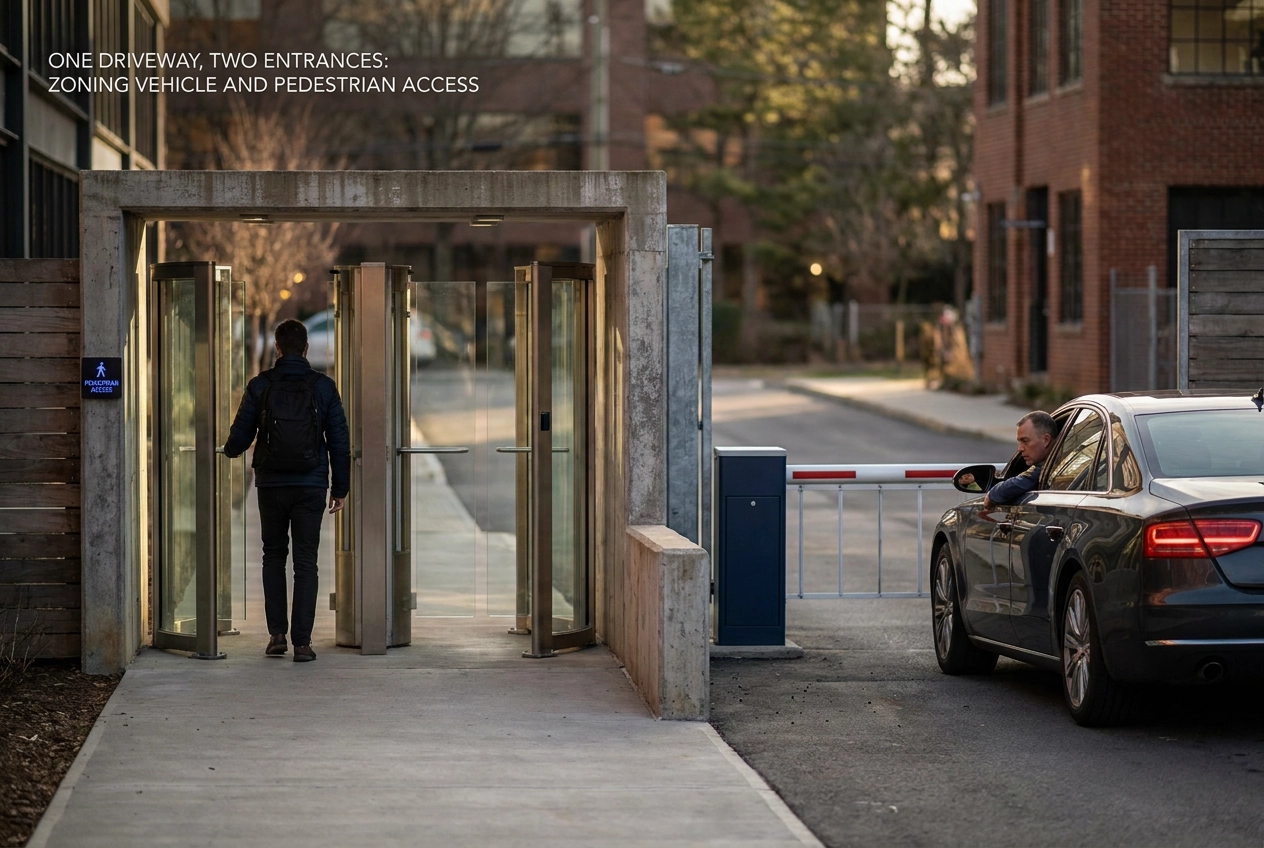
Most driveway gates are asked to do two jobs at once: move vehicles and admit people. That compromise looks efficient on a drawing, but it puts pedestrians into the same operating envelope as cars, hinges, and moving leaves. A single automation gate system can be engineered to mitigate risk, yet the safer and often cheaper answer is a second, dedicated pedestrian entrance interlocked with the vehicle gate. The interlock keeps one gate still while the other is open, removing the daily conflict between foot traffic and vehicle cycles.
This analysis explains why over-working one gate is the wrong starting point. It reviews what powered gate safety rules actually require, where pedestrians get hurt in crush zones, traps, and around the limits of light beams, and why a dedicated pedestrian entrance changes the risk profile. It also examines interlock logic, the cost argument framed honestly, footpath position and latches, small commercial driveways with higher foot traffic, and how to select, maintain, and prove the installation. By the end, the two-entrance rule should look less like a luxury and more like a basic design decision.
Why One Gate Struggling to Do Two Jobs Is the Wrong Starting Point
A vehicle gate is engineered around a wide, heavy leaf with a long travel arc. A pedestrian opening needs a narrow, light, quick-to-pass gap. No single leaf does both without compromise, and that compromise lands in the space people walk through.
Watch for shared-path symptoms: people stepping into the leaf's swing, the gate left parked open all day because someone is on foot, visitors tailgating behind a car, or pedestrians pressing remotes so it never closes behind them. The standard advice, keep clear of moving gates and use remotes only within sight, is hard to follow when the only way in is through the vehicle gate. That is a design problem, not a discipline problem.
A cleverer gate rarely fixes it. Extra detection, dual force profiles and slower travel are devices layered onto one shared path. Separating the flows removes the conflict rather than managing it. The principle: zone access into a vehicle route and a pedestrian route, then control interaction with an interlock. For layout choices that keep each route sized correctly, see Configuration Comparison: Matching Gate Type to Site Constraint.
What Powered Gate Safety Rules Actually Require
HSE's position: a powered gate must respond safely to any interaction, including children playing around it, and stay safe through wear, weather and debris. Crushing points at hinges, and between leaves and fixed parts, are design responsibilities.
The safety alert FOD 7-2010, dated 2 September 2010, names bars passing the gate post as a trapping risk and requires force limits, reversing on contact, sensors that stop the gate before it reaches an obstacle, and an emergency release. Check its currency, as it dates from 2010.
Gate Safe's installer guidance is firmer. Installers must comply with the Supply of Machinery (Safety) Regulations 2008, complete a full risk assessment, and fit at least two types of safety device. Non-contact safety comes first; force limitation alone is not adequate. On standards, dhf cites BS EN 12453:2001; verify the current edition rather than repeating the date. Our guide to UK safety standards and legal compliance for powered gates covers the duties.
Fewer people in the vehicle leaf's operating envelope is itself a safety measure.
Where Pedestrians Get Hurt: Crush Zones, Traps and the Limits of Light Beams
A gate that stops once it touches a person has already touched them; non-contact protection must be the primary layer, not an afterthought. Softer is not the same as safer.
Light beams have a ceiling. A gate that stops once it touches a child has already touched them. A dual-purpose gate is the wrong container for foot traffic. It funnels pedestrians into the leaf's arc and hinge area, the trapping zones HSE names. dhf mentions deaths and serious injuries at hinges but publishes no dates or counts, so attach none.
The pedestrian leaf carries a small risk set general guidance barely covers: finger traps at its hinge, latch and closing edge, and the gap between leaf and post. They are easier to control on a small, light, low-energy leaf, through low-energy or self-closing hardware, shielded or rounded hinge lines, a controlled closing force, and about a metre of clear working zone either side, free of bins, planting and trip hazards.
The Case for a Dedicated Pedestrian Entrance
Crush zones and beam limits point to one conclusion: stop routing people through the vehicle leaf.
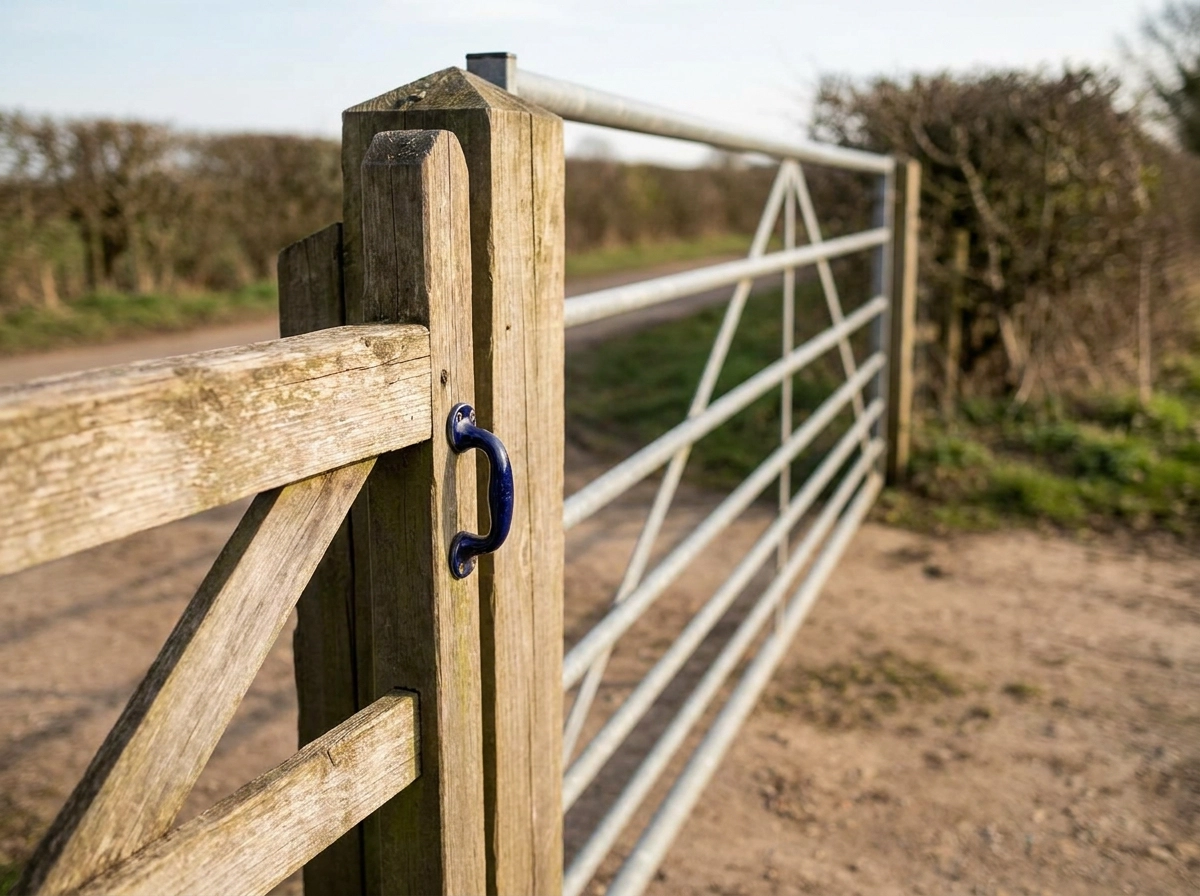
Split the flows at design stage. The vehicle route keeps the automated vehicle gate; the foot route gets its own leaf, sized for comfortable foot traffic and built as one of a matched set of small gates, not a scaled-down copy of the main gate.
Choose a level of automation, not a level of compromise: a manual self-closing leaf, keypad or fob released, or an automated leaf with its own small operator. Staying manual still solves the safety problem, because the point is separation, not gadgetry. A small, light leaf makes low-energy operation realistic: lower-force, quieter hardware than any vehicle leaf can use.
Access control belongs there too: an intercom, keypad or fob on the side gate serves visitors and couriers better than making them drive to the intercom, and access control and smart features sit alongside gate automation and manual-gate upgrades in the specification.
Fabrication ties the two entrances into one scheme: a bespoke frame keeps the pedestrian opening narrow, light and tamper-resistant while matching the main gate's style.
Interlocks: Keeping One Gate Still While the Other Is Open
An interlock links the two entrances: the vehicle gate cannot move while the pedestrian gate is open, often the reverse too. It removes the chance of the vehicle leaf moving through an occupied space, rather than detecting the person afterwards.
Approaches run from simple to fully integrated:
A magnetic or electromechanical lock on the pedestrian leaf, proved closed before the vehicle gate runs.
A monitored contact or limit switch on the pedestrian leaf, wired into the vehicle controller as a hold-off.
Both gates on one gate automation system, with sequencing set centrally through integration with gate automation, intercoms and access control.
Plan pedestrian-side behaviour at the same time: request-to-exit by push button, exit loop or keypad, fail-safe behaviour on power loss, and a documented manual release for the vehicle gate so the interlock never becomes a lock-in.
Treat the interlock as recommended design practice, not a codified product. No research source standardises interlocks for domestic gates, so agree the configuration with an installer who will write the logic down.
Reject weak versions: a pedestrian leaf held shut only by its closer, sequencing that relies on a keyholder remembering the order, or vehicle safety beams used as pedestrian detection.
The Cost Argument, Framed Honestly
With the interlock settled, the cost question needs honesty. No published source we found gives prices for interlocks, dual-purpose gates or separate pedestrian gates. Any claim that two entrances are cheaper is our design judgement, or an installing company's experience on its own jobs, not fact.
A dual-purpose gate spends more on safety: Gate Safe's minimum of two device types, multi-beam curtaining rather than a single beam, a broader risk assessment and longer commissioning, all on a heavier leaf with a wider, faster arc. Two entrances save through a light pedestrian leaf, often manual or low-energy, modest hardware and simple interlock wiring. The vehicle gate's specification need not grow to cover foot traffic it was never designed for.
Costs rise with masonry or fencing changes, groundworks, a surfaced path, or an exact finish match. A gate cut into an existing wall differs from a new opening in a hedge. See gate type and configuration for how that drives price.
The two-entrance layout is better value per pound of risk removed, but "cheaper" depends on your frontage, existing opening and finish. Ask for the pedestrian gate, interlock and vehicle gate as separate quote lines, to see which part drives cost.
Designing the Footpath: Position, Latches and Pedestrian-Specific Risks
Where the pedestrian gate sits decides whether anyone uses it. Put it on the line people already walk: by the letterbox, front door path and visitor parking. Keep it clear of the main gate's swing arc, and never site the two leaves where they could meet.
Handing matters as much as size. Set width, swing direction and latch so the gate opens away from the road, leaves no hand trap between leaf and post, and cannot be opened from outside without access control.
Guidance concentrates on the moving vehicle leaf, so the pedestrian leaf's crush points need specifying deliberately. Shield or round the hinge line, choose a latch that cannot pinch, and control closing force.
Get the ground right too: a firm, drained path, a step-free threshold, and lighting reaching the keypad and the far side of the gate. Trip hazards are as real a risk as the gate. A separate sliding gate for the driveway removes the swing arc entirely, worth weighing early.
Plan for strangers: a secure parcel drop and a route that does not require admitting unknown visitors through the vehicle gate removes the practical reason a side gate gets propped open.
Small Commercial Driveways and Higher Foot Traffic
The principles above hold on any driveway. On a small commercial site they carry more weight. Offices, workshops, clinics and small yards often move more people on foot than by vehicle across a working day, so the risk of a shared path scales with footfall, not with gate size.
Duty sits with the site operator. At a workplace, an automated gate falls within the scope of the Supply of Machinery (Safety) Regulations 2008. Gate Safe's requirements, including compliance, a full risk assessment and at least two types of safety device, scale with use, not with driveway dimensions. Electric Gates for Commercial and Industrial Properties sets out the specification.
Design for unfamiliar users, not just staff: clear signage, a signing-in route that avoids the vehicle gate, and pedestrian access that never depends on someone holding the main gate open.
A complete documentation set, risk assessment, commissioning record and maintenance log, is what a properly run installation looks like to any third party who reviews it.
Where footfall is genuinely high, a separate pedestrian opening with its own lane, and if needed a controlled-release or turnstile-style arrangement, carries the load better than a domestic side gate doing commercial work.
Selecting, Maintaining and Proving the Installation
Buy the specification, not the brand. Insist on at least two types of safety device, non-contact protection where the risk assessment calls for it, multi-beam curtaining rather than a single beam, and an emergency manual release on the vehicle gate.
Check the installer before the price. Ask directly for installer accreditation, evidence of qualified engineers on site, documentation and maintenance records.
Maintenance is a safety function, not an upsell. dhf's position is at least one annual visit, more under heavier use. Have the interlock checked on the same visit as the vehicle gate's safety devices, because the two gates now form one control system.
Owner habits reinforce the separation. Keep clear of moving gates, use remote controls only within sight of the gate, and use qualified specialists for repairs. All three are easier with a footpath that avoids the vehicle leaf.
Match the hardware to the property. A domestic drive, a small commercial yard, an agricultural entrance and a bespoke fabricated gate each need different equipment, so gate automation systems for two entrances are best specified together rather than bought separately.
The Two-Entrance Rule in Practice
Before you commit, count the crossings. If the drive carries more feet than wheels, or if people without the remote use it daily, the shared path is the weak point and a second entrance is the fix.
Then draw both routes on your layout and price them as separate lines: pedestrian gate, interlock logic, vehicle gate. Seeing each cost isolated tells you whether the safety case and the cost case genuinely point the same way on your property.
Specify the interlock in writing, a closer holding a leaf shut is not an interlock.
Book one annual maintenance visit covering both gates, since they now operate as one control system, and request the risk assessment, commissioning record and maintenance log as a set, the documentation that demonstrates a properly run installation.
Finally, have the pedestrian leaf fabricated to match the main gate, so the second entrance reads as deliberate design rather than an afterthought. Planning an automated entrance in East Sussex, West Sussex or Kent? Talk to a specialist who designs, fabricates and automates both gates together.
Conclusion
One driveway with two entrances is not just a layout choice; it is a safety strategy. Draw both routes, price each entrance as a separate line, and have both gates specified as one system. Planning an automated entrance in East Sussex, West Sussex or Kent? Talk to a specialist who designs, fabricates and automates both gates together.