
Power Cuts and Electric Gates: Keeping Access in an Outage
What your electric gate does in a power cut is decided at specification. Compare battery backup, manual release and standby options before you sign.
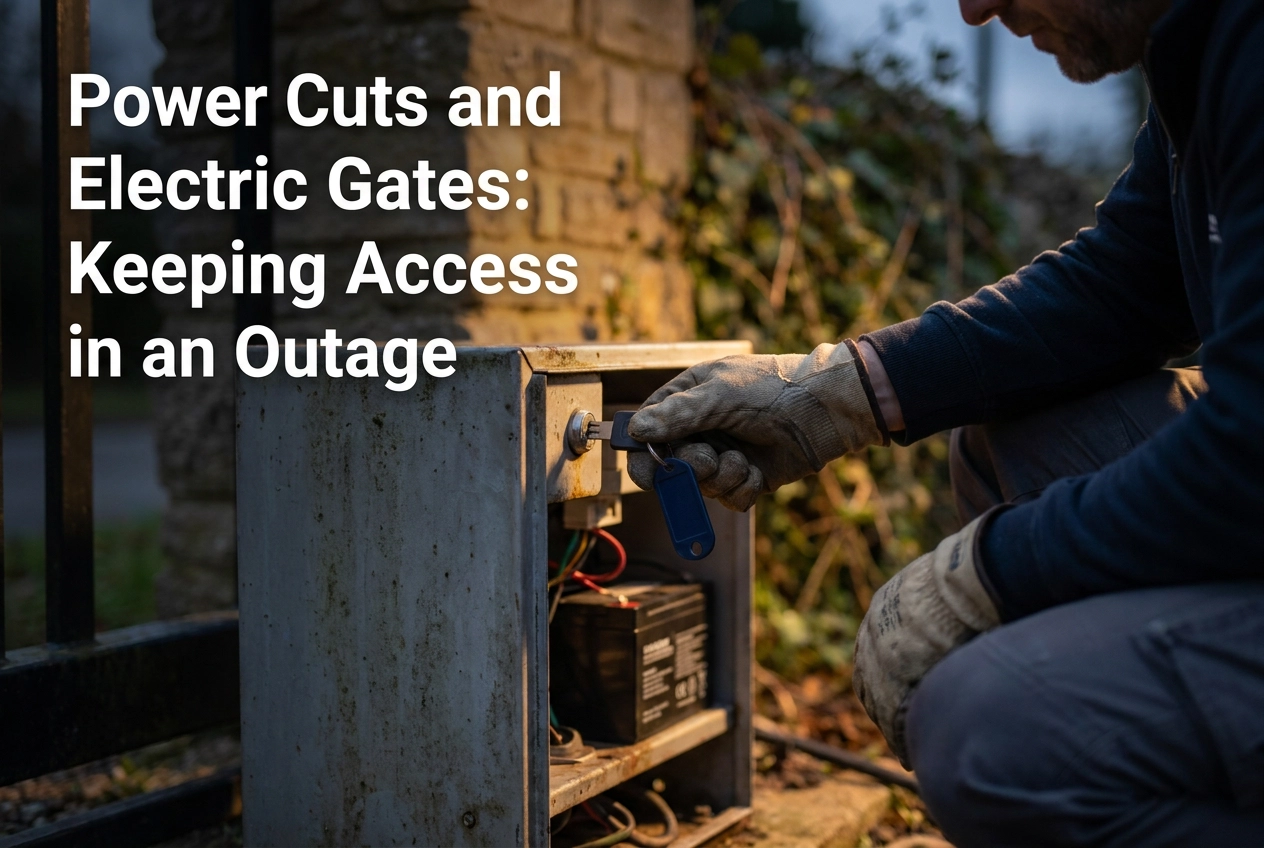
When the mains drops, your gate either keeps working, opens manually, or leaves you stranded outside. That outcome is rarely luck. It is decided long before installation, often in a single line on a quote: the specification of the electric gate mechanism. Battery backup, manual release method and standby duration each trade convenience against security. Get these wrong and a powered gate can become an access problem precisely when reliable entry matters most.
This comparison explains how to turn that invisible specification line into something you can assess across quotes. You will learn why power cut behaviour is a specification decision; how a gate automation system behaves when the mains drops; what battery backup does and does not power; why standby duration should stop being a guess; how manual release can fail in practice; and how security trade-offs affect convenience, access and who gets in. We also separate the needs of residential drives, farms and commercial entrances, then show how to compare systems and quotes and what to ask every installer.
Standards and risk assessments matter, but they do not make the outage decision for you. Specify the outage, not just the gate.
Why Power Cut Behaviour Is a Specification Decision
What an electric gate does when the mains drops is decided at specification: operator type, control panel logic, backup fitted and release method. The weather only triggers the test.
Gate Safe is explicit that automated gates are not one-size-fits-all and that each powered gate should be assessed individually. The same logic applies to power-loss behaviour.
The HSE safety bulletin of 26 November 2018 states that BS EN 12453:2017 and BS EN 12604:2017 do not completely address the risks that may be present, and lists risk assessment for the specific environment and user as the starting point.
A battery backup line on a quote tells a buyer almost nothing until it names the backup type, the cycles it supports and what happens when the battery is flat. Lock behaviour, covered in Fail-Safe vs. Fail-Secure: What Happens During a Power Cut?, shapes that outcome.
Compliance alone settles little: Gate Safe warns that adherence to its listed British Standards will not meet all the mandatory Essential Health and Safety Requirements of the Supply of Machinery (Safety) Regulations 2008. Each choice carries a different cost in security and convenience.
How a Gate Automation System Behaves When the Mains Drops
With that specification settled, the outage itself is easy to read. When mains power is lost, the control panel stops driving the motor, so the gate simply holds its current position. Whether that position is safe, secure or convenient depends on the design, not on chance.
Control panel settings decide whether the gate tries to close, stays put or is released when mains power is lost, ask your installer which behaviour is configured on your system.
HSE bulletin EPD1-2018 recommends that, where the technology permits, the safety function is monitored and checked before each movement, so make Step 2: Inspect the Safety Sensors and Check for Obstructions a routine check, not a repair step.
Force limitation set below the maximum is a design measure the HSE lists, and it matters most when the gate is pushed by hand or runs on a partly charged battery. Finally, assess the environment and users gate by gate.
Battery Backup: What It Powers and What It Does Not
Once the panel's behaviour is settled, the backup's scope is the next decision. It ranges from a battery pack inside the control panel, which may carry the operator only, to an uninterruptible supply that also covers intercoms, keypads, access control readers and gate lighting. Every device added draws on the same cells.
Capacity sets standby duration, but not linearly. A larger pack or a second battery extends standby duration; how many open/close cycles that translates to depends on your site, ask your installer for a calculation based on your operator and load. Ask for the standby figure in cycles and in hours, not a vague promise of backup, and ask what happens when the battery gives out.
Battery type governs service life and replacement cost, so get the make and model in writing before you accept a quote. Have your installer log baseline readings with Power, Backup and Access Control Test Tools.
Backup is not a substitute for safe design. A battery backup does not remove the need for a risk assessment, force limitation and safety function checks; these remain requirements under BS EN 12453 for power-operated gates.
Where mains is absent or unreliable, raise solar and battery only supply with your installer, because it changes what the battery has to carry through a winter.
Standby Duration: The Number Buyers Should Stop Guessing At
Battery capacity alone tells you little. Standby duration is how long the system keeps the gate locked, armed and able to open before the battery is exhausted, and it depends on everything drawing on that battery, not just the operator.
A gate taking frequent intercom calls, holding a lock energised or running sensors continuously drains faster than one sitting idle. The honest figure comes from the load on your site, so ask for a calculation rather than a generic number.
Ask whether the published figure assumes a gate holding position or one still being cycled, and whether any cycles remain once the standby period ends. A figure that holds the gate but cannot open it is not duration you can rely on.
Ask your installer how standby duration was calculated, and whether it accounts for seasonal temperature variation, because battery output can change with ambient conditions.
Write the standby figure into the specification and the servicing and maintenance schedule so it can be tested at each visit rather than discovered during an outage.
Manual Release: The Fallback Everyone Assumes Will Work
Standby duration covers the battery, not the moment the gate will not move at all.
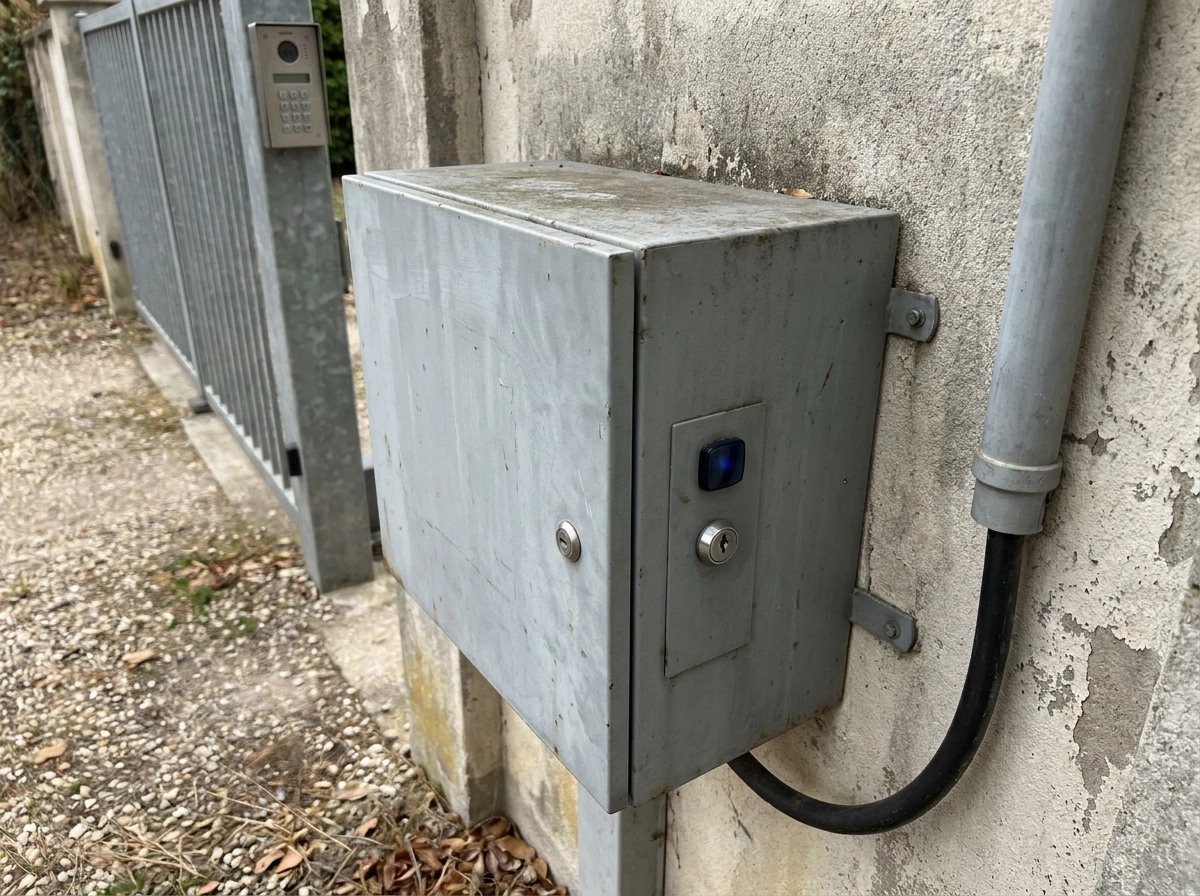
Release mechanisms vary, common arrangements include a key or lever on the operator housing, a cable pull, or a mechanical bypass, and each must be accessible with the gate in its closed position. Ask your installer which type is fitted and where.
Position is a security decision as much as a practical one: a release on the public side is convenience for whoever finds it, while one reachable only from inside suits many residential drives.
Ask your installer whether the operator is self-locking or whether a separate electric lock is fitted, and what must be done before the gate can be moved by hand.
Pushing the gate by hand takes the safety systems out of the equation, so keep in mind that safety devices are bypassed during manual movement.
Test releases and locks at every service visit. A mechanism that has seized since installation is only found at the worst possible moment, and Safety First: What You Must Not Do While Troubleshooting covers what not to attempt meanwhile.
Security Trade-Offs: Convenience, Access and Who Gets In
Testing is only half the release story. Battery backup keeps the gate working and locked, but equally keeps the entrance operable by anyone with a code or an intercom call, so it protects convenience as much as security. Treat backup as an access decision, not just resilience, and confirm safety comes as standard on the installation side too.
Manual release is a convenience for legitimate users and a potential vulnerability if the release point is not sited and secured deliberately.
Generally, fail-secure behaviour keeps the entrance closed on power failure, while fail-safe behaviour opens or releases the gate, confirm with your installer which mode is configured and what it means in practice for your site.
Key control is part of the specification: how many release keys exist, who holds them, whether they are coded, and how the set is recovered after a lost key or a change of occupant.
Pedestrian gates, intercoms and door entry on the same supply belong in the same decision. Keeping the vehicle gate powered while the pedestrian side is stranded is only half a solution.
Residential Drives, Farms and Commercial Entrances: Different Answers
Where the gate sits changes the specification. A suburban driveway is typically one gate, low daily cycle counts and a household home most evenings, so a manual release on the property side is often enough. A farm or agricultural entrance may require a different approach to standby duration and release position, and no realistic alternative route may exist, so these choices carry more weight. Residential, commercial, and agricultural gates are not the same job.
Commercial and shared entrances must keep traffic and people moving. Whoever manages the site owns power failure behaviour, and that includes emergency egress, fire routes and pedestrian access agreed before the release method is chosen. As traffic rises, cycle count and duty rating matter more: an operator sized for a handful of movements a day behaves differently under commercial throughput, and backup sizing must follow the same duty.
The support structure counts as much as the operator. Gate Safe notes that if the pier or post is not fit for purpose, a particular type of accident is inevitable, so automating an existing gate may require structural work in the specification. Match the answer to the site, not to the quote.
Comparing Gate Automation Systems and Quotes
Whichever category your site fits, compare specifications line by line before comparing prices. Ask every installer for four figures and one document: standby duration in hours or days, expected cycles on backup, release method and location, lock behaviour on power failure, and the risk assessment written for your site.
Standards come next. BS EN 12453 and BS EN 12604 were revised in 2017, with further amendments referenced in 2020 and 2022, so check the current applicable version with BSI rather than assuming. Gate Safe's website lists resources for specifiers; check what is currently available on their site and take any applicable guidance to quotes.
Ask for the battery make, model, replacement interval and current replacement cost. A cheap backup that is expensive to renew every couple of years is not the cheaper specification. For why local support matters when a battery or release fails, see why a local gate automation specialist beats a national supplier.
Insist the maintenance schedule tests the backup battery, the manual release and the safety functions, not just greasing hinges and topping up oil.
Questions to Put to Every Gate Installer
With those figures in hand, put five direct questions to every installer. Ask precisely what remains powered on backup: operator only, or intercom, keypad, safety devices and lock as well.
Next, demand the standby figure for your site, in hours and cycles, based on normal use. Confirm what happens at exhaustion: does the gate stop, release, or revert to a set position?
Ask where the manual release sits, how it is secured, and when it was last tested. A release on the public side trades security for convenience; one reachable only from inside may leave someone stranded.
Clarify failure mode: fail secure, fail safe, or simply stop where it is. Each changes who can get in or out.
Without those answers in writing, quotes cannot be meaningfully compared.
Conclusion: Specify the Outage, Not Just the Gate
Those answers reduce power cut behaviour to three linked choices: what gets backed up, how long the battery lasts, and how the gate is released by hand. Treat them as one decision, because a generous battery paired with an unreachable release still strands someone.
Match the answer to the site, the right configuration for a suburban driveway differs from a farm or commercial entrance.
The figures and testing commitments covered above belong in your written specification before installation begins. The outage is the one moment you cannot troubleshoot the specification.