
Replacing an Outdated Gate Intercom: How to Upgrade Without Replacing Your Whole System
Learn how to replace or upgrade your gate intercom system without touching the gate automation. Component guide, costs, and wiring compatibility explained.
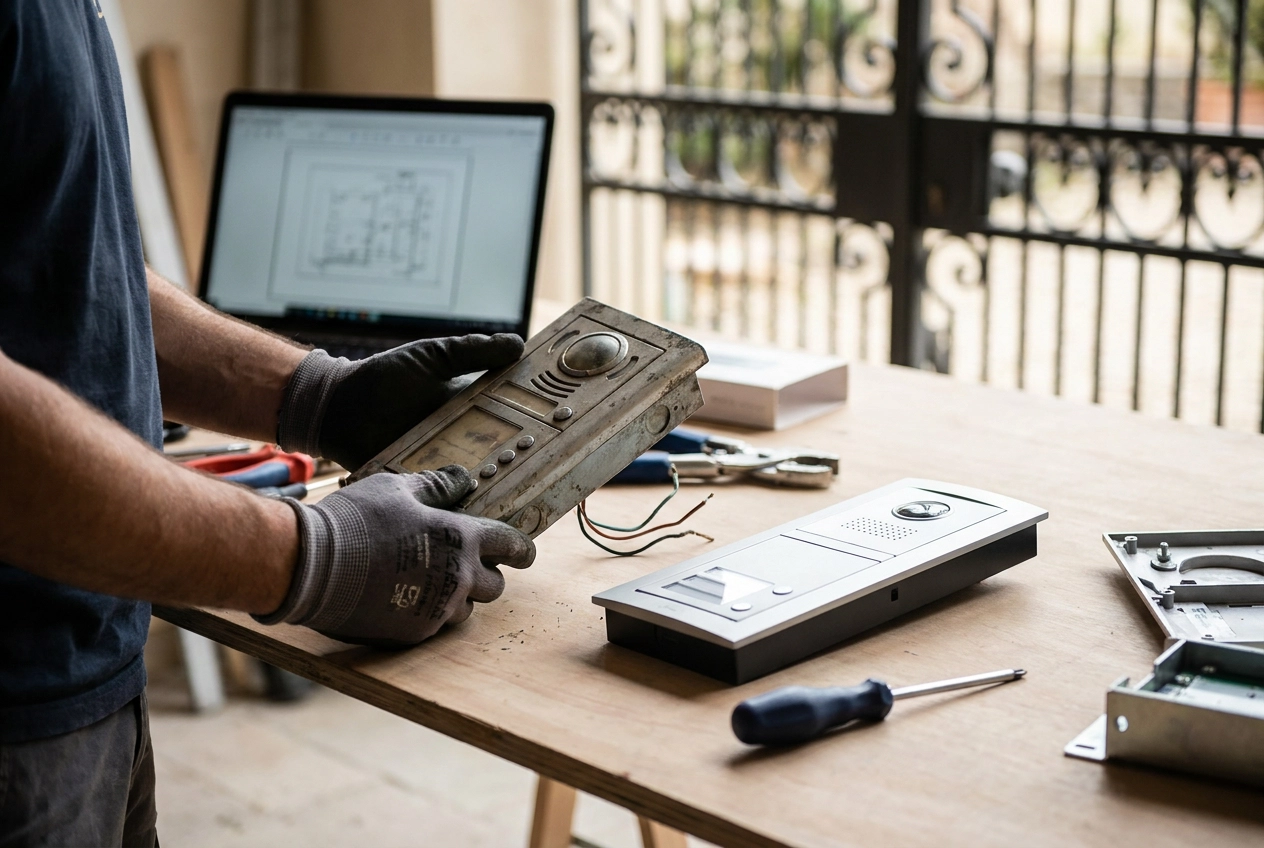
Your gate intercom has started crackling, dropping calls, or simply stopped working altogether. Before you resign yourself to tearing out your entire gate system and starting from scratch, there is something important you should know: the intercom and the gate automation are often two separate, independently serviceable systems. An intercom system replacement does not have to mean a full reinstall.
Gate intercoms frequently reach the end of their useful life long before the gate motor does. The good news is that modern intercom systems are built with modular components, meaning handsets, entry panels, GSM modules, and video cameras can often be swapped out individually without touching the gate automation at all.
In this guide, you will learn exactly how gate intercom systems are structured, how to identify what you have, and which components you can realistically replace on their own. You will also discover how to connect a new intercom to your existing gate motor, what modern features make an upgrade genuinely worthwhile, and when a full replacement is actually the smarter choice. By the end, you will have a clear, confident plan for getting your gate access back up and running.
Why Gate Intercoms Fail Before the Gate Does
Gate motors are built to last. A well-maintained electric gate motor is an electromechanical workhorse, rated for roughly 100,000 open/close cycles and engineered to operate reliably for ten years or more under normal residential load. The intercom system paired with it is a different matter entirely.
Intercom panels, handsets, and GSM modules are consumer-grade electronics. They share more in common with a cordless telephone or a home router than with a motor gearbox, and their design lifespans reflect that. Several specific components account for the majority of failures:
Handset microphones and speakers degrade through moisture ingress, particularly in entry panels exposed to the British climate year-round
Video camera lenses suffer UV degradation over time, producing the blurred or washed-out images that are a common early symptom of an ageing intercom
GSM modules face obsolescence as mobile networks phase out legacy network generations, cutting off remote call functionality regardless of the module's physical condition
Control board capacitors fail gradually with age and heat cycling, causing intermittent faults that are often misdiagnosed as motor problems
Legacy systems illustrate this mismatch clearly. Intercom ranges popular in UK residential installations during the 1990s regularly reach end-of-life while the gate motor they were installed alongside continues to operate without fault. The motor is mechanically sound; the intercom electronics have simply aged out.
The practical consequence is that many owners facing a dead or unreliable gate intercom system assume the entire entry system needs replacing. That assumption is rarely correct. The gate intercom system and the gate automation are separate, independently operating systems. One failing does not condemn the other.
This principle, that components have independent lifespans and independent upgrade paths, is the foundation for making a cost-effective decision. For a broader look at how existing gate systems can be maintained and extended, the guide on maintaining, servicing, and automating existing gates sets useful context before working through the options covered in the sections below.
Understanding the Modular Architecture of a Gate Intercom System
What makes a targeted upgrade possible is the underlying structure of every gate intercom system: it is not a single sealed unit but a collection of discrete, independently functioning modules joined by defined wiring interfaces.
The core modules in any gate intercom system are:
Entry panel (the outdoor call station mounted at the gate)
Handset or monitor (the indoor unit used by the resident)
GSM or IP communication module (handles the call pathway)
Video camera (may be integrated into the entry panel or separate)
Keypad (for PIN or proximity card access)
Control board (manages system logic and gate activation)
Because each module connects to the others through defined signal and power interfaces, a fault in one does not necessarily compromise the rest. A failed component can often be swapped while everything adjacent to it remains untouched. This is the practical basis for a partial access control and intercom upgrade on an existing gate system.
The Entry Panel
The entry panel sits outdoors, exposed to rain, UV, frost, and physical contact from every visitor. It contains the call button, microphone, speaker, and often the camera. That combination of exposure and component density makes it the most failure-prone element in the system, and the most commonly replaced.
Handsets and Monitors
Indoor handsets and monitors are sheltered from the elements and typically outlast the entry panel by several years. Degradation does occur, most often in the speaker and microphone, but the unit itself rarely fails completely. In many systems, the handset can be replaced independently without any changes to the entry panel or gate wiring.
GSM and IP Modules
These modules manage how a call travels from the entry panel to the resident, whether via a dedicated indoor handset, a mobile phone, or a smartphone app. Older 2G GSM modules are a common upgrade target as network compatibility narrows. Swapping a 2G module for a 4G equivalent frequently restores full remote functionality without touching any other part of the system.
Control Boards
The control board routes calls, triggers relay outputs to activate the gate motor, and manages system logic. It is the most complex module to replace. Any swap requires careful assessment of compatibility with the existing gate automation, particularly the relay output mapping. This is covered in detail in a later section.
How to Identify Your Existing Intercom and What That Tells You
Knowing what modules you have is the essential first step before investigating any replacement path.
Start at the entry panel. Remove the front fascia or inspect the rear housing; most manufacturers fix a label here bearing the model number, manufacturer name, and voltage rating. This single label is the most reliable starting point for sourcing compatible replacement parts or locating documentation.
If that label is missing or illegible, work inward. Check the indoor handset or monitor housing next, as these often carry identical branding. If neither yields a result, inspect the control board itself; PCBs frequently carry a printed reference number that specialist suppliers can trace back to a manufacturer's parts catalogue.
Common legacy series to look for include Bell, Videx, Fermax, BPT, and Urmet. All remain in active use across UK residential and commercial properties, and specialist suppliers stock replacement components for each. Aftermarket catalogues for these brands typically list twelve or more variants within a single product family, so a confirmed model number opens up a meaningful range of options. Our broader guide to Access Control Integration: Intercoms, Keypads, and Video Entry covers how these systems connect with other access control components if you need that context alongside identification.
Once you have a confirmed model, search for the manufacturer's installation manual. Many specialist suppliers and manufacturer archives host these as downloadable PDFs. The manual identifies which sub-components are available separately and states the system's power supply voltage and wiring configuration, both of which are critical before ordering anything.
If the system is unbranded or from a discontinued manufacturer, you will need to gather the equivalent information manually. Use a multimeter to measure the supply voltage at the entry panel; common values are 12V DC, 24V DC, and 12V AC. Record the wire count at the terminal block and photograph every connection before disturbing anything. This data forms the specification baseline for identifying a compatible replacement intercom system.
Portara Automation's engineers regularly encounter unidentified legacy systems on properties across East Sussex and Kent. A site visit covers model identification and compatibility assessment, giving you a clear picture of the upgrade options before any commitment is made.
What You Can Replace Independently (And What You Cannot)
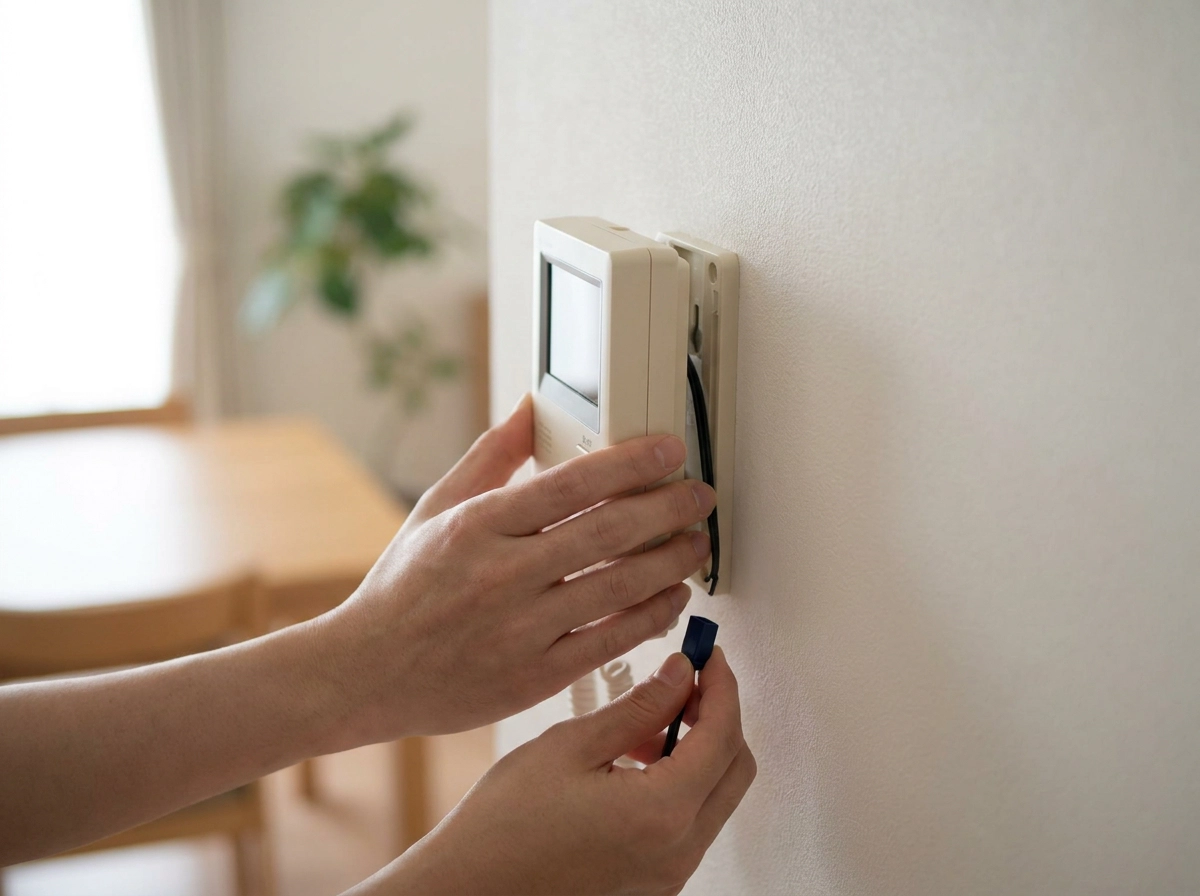
Once you know what components your system contains, the next question is which of them you can realistically swap in isolation.
Video cameras and indoor handsets or monitors sit at the easy end of the spectrum. Both connect to the entry panel via defined signal interfaces, and in most systems a higher-resolution camera or a replacement handset can be fitted without touching the gate motor wiring or control board at all. This is the lowest-cost route to a meaningful improvement in image quality or audio clarity.
GSM modules are similarly straightforward to replace in modular systems. Upgrading from a legacy 2G unit to a 4G or IP-based module restores remote access functionality without disturbing any other component. This is the most common targeted upgrade Portara carries out on existing gate intercom systems, particularly on rural and commercial properties where the 2G switch-off left the intercom unable to connect calls.
Keypads and proximity card readers are almost always independently replaceable, since they function as add-on access control devices connected either to the entry panel or directly to the gate motor controller. The one compatibility check required is output protocol: the replacement unit must use the same signalling standard as the existing receiver, whether that is Wiegand, a relay contact, or RS-485.
Entry panels can be replaced as a complete unit when the existing panel is beyond repair. The critical constraint here is wiring interface compatibility. The new panel must match the existing system's bus type (2-wire, 4-wire, or IP-based) and power supply voltage. If it does not, the indoor handset and control board are pulled into the replacement scope, which changes the cost and complexity significantly. For guidance on assessing whether a repair or a component swap is the more sensible choice, the Repair or Replace? How to Decide guide covers the decision framework in detail.
Control boards are the hardest component to replace independently. They encode the relay logic that triggers gate operation, and substituting a different manufacturer's board requires re-mapping every relay output to the correct motor terminals. This needs wiring diagrams for both systems and is not a task to attempt without them.
The one thing that cannot be done without infrastructure work: upgrading from a 2-wire analogue system to a full IP video intercom. IP-based video requires a suitable data cable run, typically a shielded twisted-pair or equivalent, rather than the simple two- or four-core wire used by analogue systems. Even if the gate motor is untouched, this level of upgrade involves cabling work and should be scoped accordingly from the outset.
Connecting a New Intercom to Your Existing Gate Motor: The Compatibility Question
Replacing a control board forces you to confront the deeper challenge in any intercom system replacement: relay output mapping. Even when the new intercom and the existing gate motor are each fully functional, the intercom cannot trigger the gate unless its relay outputs are correctly matched to the motor controller's input terminals.
Understanding NC, NO, and COM
Modern IP video intercoms typically provide dry-contact relay outputs with terminals labelled NC (Normally Closed), NO (Normally Open), and COM (Common), refer to the specific unit's datasheet for exact labelling. These terms describe the relay's resting state:
NC (Normally Closed): the circuit is complete at rest and breaks when the relay triggers
NO (Normally Open): the circuit is open at rest and closes when the relay triggers
COM: the common terminal shared by both NC and NO
Most gate motor controllers trigger an Open command via a momentary NO contact: the relay closes briefly when the call is answered, then opens again, signalling the motor to run.
A Practical Wiring Example
As a general principle, the intercom's NO terminal connects to the motor controller's trigger/open input, and COM to the controller's common terminal. Always verify against the motor manufacturer's installation manual before wiring.
If the existing system used a dedicated control board with pre-wired relay logic, replacing it with a new intercom's built-in relay requires one additional check: confirm that the new relay's voltage and current ratings are compatible with the motor's trigger input. Most residential controllers accept a clean dry-contact signal and are not voltage-sensitive at the trigger input, but verify this against the motor's installation manual. For a broader overview, see this guide on integration with gate automation, intercoms, and access control.
The Bus-Protocol Complication
Proprietary 2-wire bus systems, including certain BPT and Urmet installations, present a distinct problem. The relay output controlling gate activation may be embedded within the manufacturer's proprietary logic and is inaccessible without specific programming tools. Integration typically requires either remaining within the original manufacturer's product ecosystem or replacing more of the system than initially planned.
Terminal mapping is the most frequent DIY failure point (see also the DIY Limits section). Portara Automation's engineers work across the full range of UK gate motor controllers, including Nice, FAAC, BFT, Came, and Gibidi, and can verify or produce a terminal map for any intercom-to-motor pairing before a single wire is connected.
Cost Comparison: Component Swap, Panel Upgrade, or Full Replacement
Once you know which components need attention, the next question is straightforward: how much should you expect to spend?
There are three realistic cost tiers, and where you land depends entirely on what has failed and what you want the upgraded system to do.
Component-level replacement
Replacing a single failing part, such as a camera, handset, GSM module, or keypad, typically costs a few hundred pounds in parts, with installation taking one to two hours. This is the right approach when the entry panel and control board are working correctly and the fault is isolated. There is no justification for spending more if the rest of the system is functional.
IP intercom panel upgrade
Replacing the full entry panel and indoor monitor with a modern IP video system, while retaining the gate motor and existing cabling where possible, typically falls in the range of several hundred to around £1,500 for parts and installation combined. This tier makes sense when the existing panel is obsolete, video quality has deteriorated, or remote smartphone access is the priority. It delivers a substantial capability improvement without touching the gate automation.
Full system replacement
A complete replacement, covering new gate automation, new cabling, a new intercom system, and new access control, costs several thousand pounds or more. For context on what gate motor costs look like within a full project, see this breakdown of automatic gate motor costs and what to budget. Full replacement is only warranted when the gate motor has also reached end-of-life, wiring has degraded beyond reuse, or access requirements have fundamentally changed.
The cost gap between a targeted intercom system replacement and a full reinstall is considerable. When requesting quotes, ask installers to itemise parts and labour by component separately. A reputable installer will clearly identify which elements are being retained and why, rather than presenting a single undifferentiated total.
Modern Features Worth Upgrading For
Understanding what a modern gate intercom system can actually do is useful context when weighing up whether an upgrade is worth the investment.
Sharper, more reliable video. Current IP-based video door stations deliver 2MP or higher resolution as standard, paired with night vision and wide-angle lenses. If your existing camera produces a blurred or washed-out image, a camera or panel swap alone produces a meaningful improvement to visitor identification and site security, without touching the gate motor.
Mobile call answering without an indoor handset. 4G GSM intercoms route gate calls directly to a standard mobile phone. There is no dedicated indoor unit required, which makes this upgrade particularly practical for agricultural properties, commercial sites, and second homes where someone is rarely stationed at a fixed indoor receiver.
Remote access and multi-user management. App-controlled intercoms and cloud-connected panels allow a gate to be released remotely from a smartphone, maintain a visitor log, and be managed across multiple users. This functionality was not available on most systems installed more than a decade ago. It can be added through a targeted panel or module upgrade rather than a complete system change. For a broader look at how these features sit within a wider access control setup, the guide on intercom and access control integration covers the relevant considerations.
QR code and virtual key access. Newer intercom systems support temporary or single-use gate access via QR codes, removing the need to issue physical fobs or share PIN codes with delivery drivers or contractors. This is an emerging feature rather than universal, but it is increasingly available across current IP platforms and is particularly relevant for commercial and managed residential properties.
Reduced maintenance risk going forward. Current IP and 4G platforms receive active firmware updates and have readily available spare parts. Upgrading now substantially reduces the likelihood of facing the same end-of-life problem again within a few years.
When a Full Replacement Is Actually the Right Call
A targeted upgrade is the right answer for most failing intercoms, but there are genuine scenarios where a full replacement is the more sensible investment.
If the gate motor is also struggling, the calculus changes. Slow operation, unusual grinding or clicking noises, frequent thermal overloads, or repeated control board faults are signs the automation itself is nearing end-of-life. Completing an intercom replacement now, only to return for a full motor replacement within 12 to 24 months, means paying for two separate mobilisations, two sets of access disruption, and potentially two lots of cabling work. A combined replacement in one project is almost always cheaper overall.
Degraded wiring is a stronger trigger than most owners expect. Where the cable run between the entry panel and indoor unit has suffered rodent damage, prolonged UV exposure, waterlogged ducting, or simply a poor original installation, a full recable is unavoidable regardless of what hardware you retain. Once the trenches are open and the ducting is being replaced, the incremental cost of swapping all components at the same time is comparatively small. Retaining an ageing motor or panel to save money on a day when all the disruptive work is already happening rarely makes financial sense. If you are also considering retrofitting an existing manual gate with automation, a wiring renewal is the natural point to do both simultaneously.
Obsolete proprietary bus protocols present a hard technical barrier. Some systems from discontinued manufacturers use communication architectures with no compatible modern equivalent; no replacement handset, no modern entry panel, and no GSM module will interface with them. This is a genuine dead end that requires a full door intercom system replacement rather than a targeted swap.
Significant changes to access requirements such as a property converting to HMO use, a commercial site expanding its access points, or an agricultural holding adding automated barrier access alongside pedestrian entry, typically demand a system redesign. Component-level upgrades assume the original system architecture still fits the use case.
In all these situations, a qualified installer should assess both the gate motor and the existing cabling before recommending a course of action. Be cautious of any quote that jumps straight to full replacement without confirming whether the motor and wiring are serviceable; a thorough assessment costs nothing extra and protects you from unnecessary expenditure.
DIY Limits and When to Call a Specialist
Once you have determined that a targeted upgrade is the right route, the next question is how much of it you can realistically handle yourself.
Like-for-like component swaps are the most DIY-accessible task. Replacing a handset or camera within the same manufacturer's system involves defined interfaces, labelled connectors, and installation guides that are generally available as PDFs from the manufacturer or specialist suppliers. A competent DIYer with basic electrical knowledge and the correct documentation can complete this type of replacement confidently.
Relay wiring and terminal mapping require care: an incorrectly connected relay can damage the motor controller or cause unintended gate movement -- the wiring principles are explained in the motor compatibility section above.
Mains voltage work carries a legal requirement, not just a caution. Any work involving hardwired transformers or mains-fed control panels must be carried out by a qualified electrician in the UK, under the requirements of BS 7671. Low-voltage intercom wiring does not fall under the same obligation, but the supply side always does. If your intercom replacement involves touching the mains feed, a qualified electrician is required regardless of how straightforward the rest of the job appears.
The single most reliable predictor of a failed DIY integration is missing documentation. If you cannot locate a wiring diagram for your existing intercom or your gate motor controller, do not attempt the relay integration. Terminal-mapping errors that appear repeatedly across installer forums almost always trace back to someone proceeding without complete documentation for one or both units.
If any of these situations apply to your project, Portara Automation carries out intercom upgrade assessments across East Sussex, West Sussex, and Kent, covering model identification, compatibility checks, and full installation without unnecessary disruption to your existing gate automation.
Getting the Most from Your Gate Intercom Upgrade
The good news for most gate owners is straightforward: a failing intercom rarely means replacing a fully functional gate system. The cost gap between a targeted upgrade and a full reinstall is substantial, as detailed in the cost comparison section above.
Before spending anything, work through four steps in order:
Identify your existing intercom model using the label on the entry panel housing, indoor handset, or control board PCB.
Determine which component has actually failed rather than assuming the whole system is at fault.
Check parts availability with specialist suppliers, who stock replacement components across all major legacy series.
Verify relay output compatibility with your gate motor controller before purchasing anything, confirming that the new intercom's relay terminals map correctly to the motor's trigger inputs.
If the gate motor is operating reliably, treat it as a fixed point in your planning. Scope the intercom replacement around it rather than treating the entire entry system as a single unit to discard. A motor in good condition is an asset worth preserving.
Where relay wiring, terminal mapping, or mains connections are involved, professional installation is advisable, as set out in the previous section.
Portara Automation works with residential, commercial, and agricultural gate systems across East Sussex, West Sussex, and Kent. Our engineers can identify your existing system, determine the most cost-effective upgrade path, and carry out installation to a professional standard without unnecessary disruption to your existing gate automation. Contact us to arrange a site visit and get a clear assessment of what your system actually needs.
Conclusion
Upgrading a gate intercom does not have to mean starting from scratch. The core principle is straightforward: scope the intercom upgrade around what already works.
Modern intercom features, from smartphone access to video entry, are genuinely worth upgrading for. But the upgrade only makes sense when it is scoped correctly around what already works.
If you are unsure where your system stands, a professional assessment removes the guesswork. Portara Automation serves residential, commercial, and agricultural properties across East Sussex, West Sussex, and Kent. Contact us today to arrange a site visit and find out exactly what your entry system needs, nothing more, nothing less.