Sliding Driveway Gates: A Complete UK Buyer's Guide
Compare sliding gate types, materials, automation systems, costs and planning rules. Expert advice for UK homeowners and commercial buyers from Portara Automation.
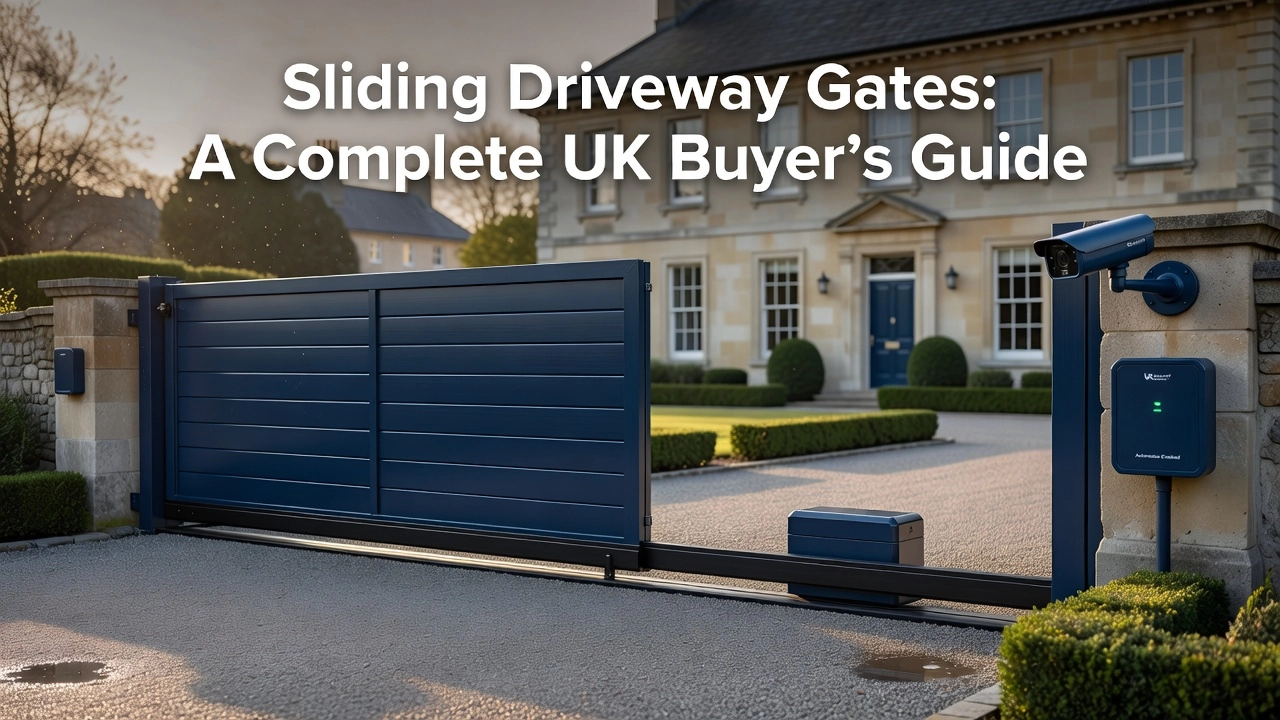
Your driveway entrance says a lot about your property before anyone even reaches the front door. For homeowners across the UK looking to upgrade their security, kerb appeal, and convenience in one move, sliding driveway gates have become the go-to solution. Unlike traditional swing gates, they work beautifully on sloped driveways, tight spaces, and busy households where automation is a priority.
But with so many materials, mechanisms, and price points available, choosing the right gate can feel overwhelming. Should you go for steel or timber? Manual or electric? Single track or cantilever? These are the questions that trip up even the most prepared buyer.
This guide is designed to cut through the noise. Whether you are comparing products for the first time or narrowing down a shortlist, you will find clear, practical information on every key factor that affects your decision. From installation requirements and maintenance considerations to costs and compliance with UK regulations, we cover everything you need to make a confident, informed purchase. By the end, you will know exactly what to look for and what to avoid.
Sliding Gate vs. Swing Gate: Which Is Right for Your Property?
Choosing between a sliding driveway gate and a swing gate is one of the most consequential decisions you will make during a gate installation project. Get it wrong and the cost of retrospective correction can easily exceed the original installation budget.
Run-Back Clearance: The Constraint That Catches People Out
A sliding gate travels horizontally along the fence line, which means it demands a completely unobstructed run-back equal to 100 to 110% of the gate leaf width. On top of that, you need an additional 300 to 500mm beyond the leaf to accommodate motor hardware, end stops, and limit switches. For a 4-metre opening, you are realistically looking at 4.7 to 4.9 metres of clear, level space running parallel to your boundary. Swing gates carry no equivalent lateral requirement; they only need a clear arc in front of or behind the opening. This single constraint disqualifies sliding gates from a meaningful proportion of urban and suburban plots where boundary walls, outbuildings, or utility boxes encroach on the fence line.
Why Sloped Driveways Favour Sliding Gates
On any gradient, a swing gate must fight gravity on every cycle. The bottom edge drags, hinges bind prematurely, and automation motors work harder than their design load intends. A sliding driveway gate, travelling parallel to the boundary rather than swinging through an arc, is completely unaffected by driveway gradient. This makes sliding the practical default across much of hilly East Sussex, where level entrances are the exception rather than the rule. Understanding the full comparison of cost and features reinforces this point: sliding gates are significantly more adaptable to uneven terrain than their swing counterparts.
When Swing Gates Are the Smarter Choice
Swing gates remain the right solution in several common scenarios. Where lateral run-back is simply unavailable, a swing gate is often the only viable option regardless of other variables. On level ground with generous turning space, swing gates open elegantly and pair well with traditional or estate-style aesthetics. They also carry a lower installation cost, as the mechanism is inherently simpler and labour time is reduced.
Decision Matrix: Four Variables That Determine the Right Gate
Matching the correct gate type to your specific site comes down to four measurable property variables:
Property Variable
Favours Sliding Gate
Favours Swing Gate
Driveway gradient
Sloped or uneven
Level or near-level
Run-back clearance
Sufficient lateral space along boundary
Insufficient side clearance
Opening width
Moderate widths where track is feasible
Very wide openings with no side space
Surface condition
Uneven surfaces suit cantilever sliding
Clean, flat surfaces suit either type
Site Survey Mistakes That Lead to Costly Corrections
The most common and expensive error is committing to a gate type before measuring the site properly. Failing to assess gradient before ordering a swing gate, overlooking a buried service or gatepost that blocks the run-back, or underestimating the width required for an angled driveway approach are all mistakes that surface only once installation begins. A professional site assessment resolves these questions before any fabrication takes place, ensuring the gate type, automation spec, and structural groundwork are all matched to the actual conditions on your property.
Cantilever Sliding Gates vs. Tracked Sliding Gates
Once you move past the swing-versus-slide decision, a second specification choice becomes equally important: whether your sliding driveway gate should use a cantilever system or a tracked system. These are mechanically distinct solutions, and selecting the wrong one for your site conditions can create persistent operational problems that no amount of maintenance will fully resolve.
How Each System Works
A cantilever sliding gate is supported entirely by a roller carriage assembly fixed to a post alongside the fence line. The gate leaf extends across the opening without making any contact with the ground, counterbalancing its own weight through a rearward extension of approximately 1.5 times the opening width behind the post. Because no component touches the ground beneath the gate, there is no bottom track whatsoever. This makes the structural post and carriage the sole support mechanism, which in turn places significant load demands on the post foundation; properly engineered cantilever installations require deep, reinforced concrete footings to handle the moment forces involved.
A tracked sliding gate, sometimes called a V-track or roller gate, operates on a steel ground rail set into or laid on the driveway surface. A bottom roller guides the gate leaf along that rail as the gate opens and closes. The system is mechanically simpler, uses lighter-duty hardware, and carries a lower fabrication and installation cost, making it a common choice for residential driveways where ground conditions are stable and traffic volumes are modest.
Choosing Based on Site Conditions
The site conditions at your property should drive this decision more than budget alone. Cantilever systems are the correct specification for gravel driveways, compacted stone surfaces, and any site with a gradient, because the absence of a ground rail eliminates debris obstruction, frost heave damage, and interference from ground movement over time. Tracked systems perform reliably on stable, hard surfaces such as tarmac or block paving, but ground rails are vulnerable to blockage by leaves and grit, and seasonal movement can gradually misalign the running surface. For a detailed comparison of cantilever and roller gate systems, the performance gap between the two widens considerably in high-traffic or adverse-weather scenarios. Properties with heavy vehicle access, such as agricultural or commercial sites, should default to cantilever regardless of surface type, as tracked systems are generally suited to limited residential cycle counts.
Maintenance Obligations for Each Type
Both systems are manageable under a scheduled service plan, but their maintenance requirements differ in character. Cantilever systems require periodic inspection and lubrication of the roller carriages, adjustment of the upper guide, and verification of counterbalance alignment; there is no ground-level component to clear, but the carriage hardware must be checked for wear on a regular basis. Tracked systems require consistent rail cleaning to remove accumulated debris, plus inspection of the rail for frost damage or surface settlement that could affect the running line. As explored in this practical guide to sliding gate system types, long-term reliability for either type depends more heavily on installation quality and material specification than on the system type itself. At Portara Automation, our site surveys assess surface type, gradient, debris exposure, and intended use before recommending a system, ensuring the specification matches the conditions your gate will actually face.
Sliding Gate Materials: Steel, Aluminium, Wrought Iron, and Timber Infill
Steel: Strong, Versatile, and Widely Specified
Steel remains the default material for sliding driveway gates across residential, commercial, and agricultural installations. Its strength, weldability, and design flexibility make it compatible with virtually any infill configuration, from plain flat bar infills to intricate CNC plasma-cut decorative panels. For property owners seeking a bespoke gate that reflects a specific aesthetic, steel fabrication offers the widest creative range of any gate material. The critical consideration is corrosion protection. Untreated or inadequately protected mild steel will oxidise when exposed to moisture, and standard powder coating alone is not sufficient for outdoor installations in exposed locations. The correct specification is hot-dip galvanising followed by powder coating: the galvanising process immerses the fabricated gate in molten zinc, forming a metallurgically bonded barrier against moisture and oxygen, and the powder coat is then applied over the top as a second protective and decorative layer. This dual-treatment process, governed in the UK by BS EN ISO 1461, delivers significantly superior long-term corrosion resistance compared to powder coat alone, and is the minimum appropriate standard for any steel sliding gate installed in an outdoor environment. Steel gates do require periodic inspection and maintenance, with retreatment typically recommended every three to five years depending on exposure conditions.
Aluminium: The Recommended Choice for Coastal Locations
For properties on or near the East Sussex coast, or in estuarine settings such as the Ouse and Cuckmere valleys, aluminium is frequently the most sensible specification. Aluminium does not rust; its natural oxide layer makes it inherently resistant to salt-air corrosion without the ongoing maintenance burden that steel demands in marine environments. Aluminium sliding gates are also typically 40 to 50 percent lighter than equivalent steel gates, and this weight reduction has a meaningful practical benefit: lighter gates place less load on automation motors and drive components, reducing wear and extending the operational lifespan of the automation system. The trade-off is upfront cost, with aluminium gates generally priced approximately 40 to 60 percent higher than comparable mild steel options. However, when assessed over a ten to fifteen year ownership horizon, the reduced maintenance expenditure and lower risk of structural corrosion often make aluminium the more economical choice for coastal and estuarine properties. Powder-coated or anodised aluminium requires little more than occasional cleaning to maintain its appearance.
Wrought Iron: Heritage Aesthetics with Maintenance Commitment
Wrought iron is specified primarily for its distinctive ornamental appearance rather than its practical properties. It is a well-established choice for period properties, listed buildings, and properties within conservation areas across East Sussex where planning officers or heritage guidance may require a traditional gate aesthetic. The visual character of wrought iron, its hand-worked appearance and traditional profiles, is difficult to replicate in other materials. However, wrought iron carries a higher ongoing maintenance commitment than either steel or aluminium, requiring regular treatment to prevent rust and preserve its appearance. It is also considerably heavier than equivalent steel or aluminium gates, which creates challenges for automation: higher gate mass demands more powerful and expensive motor systems, and increases wear on rollers, guides, and drive components over time. For property owners prioritising automation reliability and low maintenance, wrought iron is generally not the most practical choice.
Timber-Infill Steel Frames: Privacy and Visual Warmth
A structural steel frame with hardwood or softwood infill panels offers a popular middle ground for property owners who want the privacy and visual warmth of timber without sacrificing structural integrity. The steel frame carries the load and interfaces with the automation system, while the timber infill delivers a natural aesthetic that suits rural and semi-rural properties across East Sussex particularly well. The important management consideration is timber movement: in the wet conditions typical of the South East, timber infill sections can absorb moisture and swell, altering gate geometry and placing stress on automation components if the installation is not properly engineered. Softwood infill requires regular treatment with a quality preservative or stain, while hardwood offers better natural durability but at higher material cost. Periodic inspection of timber sections is advisable, and any swelling or warping should be addressed promptly to maintain smooth automated operation.
Coastal Properties: A Clear Specification Recommendation
For East Sussex coastal and estuarine properties, the material specification decision is straightforward. Industry guidance on steel gate finishes is clear that hot-dip galvanisation, not powder coat alone, is the correct standard for steel gates in salt-air environments. Where budget allows, aluminium with a quality powder coat finish eliminates the corrosion risk entirely and is strongly recommended for sites with direct coastal exposure. Standard mild steel with powder coat only should not be specified for these locations; salt-air penetrates standard coatings progressively over time, leading to corrosion that undermines both the structural integrity and the appearance of the gate.
Automation Systems for Sliding Gates
Rack-and-pinion drive is the universal automation method for sliding driveway gates, and understanding why helps you make better decisions when specifying a system. A toothed steel rack is welded along the bottom of the gate leaf; the motor unit, mounted at the base of the gate post, houses a driven pinion gear that engages this rack directly. As the motor turns, the pinion walks along the rack, converting rotary motion into smooth, linear gate travel. All major manufacturers, including FAAC, BFT, Nice, and Came, build their sliding gate product ranges around this principle. It is reliable, low-maintenance, and mechanically straightforward to service. Rack specification matters in practice: standard residential installations use M4 (Module 4) rack, while heavier industrial or agricultural gates typically require M6. Steel rack is strongly preferred over nylon for any gate above around 300kg, where the forces involved would accelerate nylon wear significantly.
Choosing the Right Motor
Selecting the correct motor requires matching four variables to your specific installation. Gate leaf weight is the primary factor; residential sliding gates commonly fall between 300kg and 800kg, while commercial farm or estate gates can exceed 1,500kg, requiring heavy-duty motors rated accordingly. Daily cycle frequency is equally important: residential installations typically run fewer than 20 cycles per day, while commercial sites with delivery vehicles or staff access can exceed 40 cycles, which demands motors rated for intensive or continuous duty. Power supply availability then shapes the product shortlist, with 240V mains-fed motors being the standard choice where a cable run to the motor post is practical. Where that run is lengthy or expensive, 12V or 24V DC motors become relevant. Gate travel speed, although often overlooked, affects convenience and safety compliance and should be specified rather than left as a default.
Solar Automation for Rural and Agricultural Sites
Solar-powered automation has become a genuinely practical option for properties across East Sussex, West Sussex, and Kent where trenching a mains cable to a remote gate post would cost more than the gate itself. Low-consumption DC motors, paired with a battery-backed solar panel kit, can operate reliably year-round in southern England. The South East benefits from above-average UK sunshine hours, and modern solar kits are engineered with sufficient battery reserve to sustain operation through overcast winter periods. For rural agricultural and equestrian properties, this approach removes the single largest installation cost barrier entirely.
Retrofitting Automation to an Existing Gate
A significant number of sliding gates installed across the South East a decade or more ago are still being operated manually. Provided the gate structure remains sound and square, the correct rack specification can be fitted to the bottom rail, and the required safety devices can be installed, retrofitting automation is straightforward and cost-effective. This is a popular upgrade path and avoids the full cost of gate replacement.
Safety Device Requirements Under BS EN 12453
Every automated sliding gate installation in the UK must comply with BS EN 12453, which governs the use of powered gates and doors. The standard requires at least one active means of obstacle detection, most commonly a combination of photocells positioned across the gate opening and safety edges fitted to the leading face of the gate leaf. These devices must limit dynamic closing force to a maximum of 400N, with impact energy not exceeding 4J. Compliance applies equally to new installations and retrofit automation projects; FAAC's own installation documentation explicitly requires conformance to both EN 12453 and EN 12445 on every installation, and this obligation sits with the installing company. Portara Automation designs every automated sliding gate system to meet these standards as a baseline, not an afterthought.
Access Control Options: From Key Fobs to ANPR
Remote key fobs represent the entry point for virtually every automated sliding gate installation. Supplied as standard with most gate motor packages, they offer simple, push-button operation with no infrastructure requirements beyond the receiver unit already built into the automation system. Rolling-code technology ensures each transmission generates a unique signal, making fob-based access considerably more secure than older fixed-code systems. For households with a small number of regular users, fobs remain entirely adequate, but they scale poorly; managing a large pool of fobs across a busy site becomes impractical, and a lost fob requires reprogramming or receiver reset rather than a simple credential revocation.
Keypads and Proximity Card Readers
Where multiple users need access without a handheld transmitter, surface-mounted weatherproof keypads and proximity card readers offer a practical step up. Keypads suit delivery drivers and contractors where issuing a temporary PIN is more efficient than distributing hardware. The limitation is PIN security; once a code is shared, controlling who holds it becomes difficult. Proximity card and RFID fob readers resolve this directly by assigning unique credentials per user, meaning individual access can be revoked instantly without affecting other authorised users. Both formats are straightforward to integrate alongside an existing gate motor and control board.
GSM and Video Intercoms
GSM intercoms allow gate entry to be triggered via an inbound mobile call to the property owner, requiring no broadband connection whatsoever. This makes them particularly well suited to rural properties across East Sussex and similar areas where reliable internet cannot be guaranteed. The owner can release the gate remotely from any location simply by accepting the call and pressing a DTMF tone. Video intercoms build directly on this capability by adding a camera, allowing visual identity verification before release. As noted in guidance on the best intercom systems for electric driveway gates, video intercoms have become the default residential specification in 2026, with fitted costs ranging from approximately £250 for basic colour-display units to £700 or more for HD systems with night vision and motion detection.
ANPR and Smartphone App Control
Automatic Number Plate Recognition eliminates driver interaction entirely by triggering gate opening when a pre-registered vehicle plate is detected. This is the access method of choice for high-frequency commercial, agricultural, and industrial sites; farms, logistics yards, and school entrances all benefit from removing the intercom bottleneck during peak arrival periods. Specialist gate intercom and ANPR systems are now offered as a standard product category by professional gate installers, reflecting how far ANPR has moved beyond car park barriers into mainstream gate automation.
Smartphone app control via Wi-Fi and GSM modules, including FAAC Connect, Nice BusT4, and Came Connect, rounds out the access control landscape. These modules allow remote gate monitoring and operation from any location with a data connection and offer integration with Amazon Alexa, Google Home, and Apple HomeKit on compatible systems. For new residential buyers in 2026, app-based control is frequently a primary purchase criterion rather than an optional add-on, and the ability to layer multiple access methods, such as ANPR for known vehicles paired with a video intercom fallback for visitors, delivers a genuinely complete access ecosystem rather than a single-device solution.
Planning Permission for Sliding Driveway Gates in England
Planning compliance for sliding driveway gates in England is governed by Schedule 2, Part 2 of the Town and Country Planning Act 1990, and the thresholds are specific. Where a gate sits on a boundary adjacent to a highway used by vehicles, permitted development rights only apply if the gate does not exceed 1 metre in height. For all other boundary positions, the permitted development limit rises to 2 metres. These thresholds apply equally to manual and automated gates; the presence of a motor and control system does not affect how the height rules are applied. Any gate exceeding the relevant limit without formal consent is technically unlawful and may be subject to enforcement action, not simply a retrospective paperwork exercise.
Conservation Areas and Listed Building Constraints
Permitted development rights are not guaranteed, even where your gate would otherwise fall within the height thresholds. Across East Sussex, Kent, and West Sussex, Article 4 Directions regularly withdraw standard permitted development rights in designated conservation areas. Lewes, Rye, and Battle in East Sussex; Tunbridge Wells and Cranbrook in Kent; and Arundel and Midhurst in West Sussex all contain conservation areas where gate installation may require consent regardless of height. For listed buildings, the position is stricter still. Where any part of a site is a listed building or falls within its curtilage, or where the boundary adjoins a neighbouring listed building, no permitted development rights apply at all. Planning guidance confirms that listed buildings and properties within their curtilage need particular care and may require both planning permission and listed building consent, even where a comparable gate would be permitted elsewhere. Verifying your property's designation status with the local planning authority before committing to a design is essential, not optional.
Formal Applications and the Role of Local Knowledge
Where permitted development rights are removed or the proposed gate exceeds the statutory height limits, a householder planning application must be submitted to the relevant Local Planning Authority. In East Sussex, this means engaging with Lewes District Council, Rother District Council, or Wealden District Council depending on location. Portara's experience working across the South East means we are familiar with local planning officers, precedent decisions, and the design sensitivities that influence application outcomes in conservation-designated areas, which can meaningfully reduce the risk of refusal or delay. GOV.UK guidance on when permission is required provides the overarching framework within which these local decisions operate.
Confirm Compliance Before Fabrication Begins
The practical implication for anyone planning a sliding gate installation is straightforward: planning compliance must be confirmed before fabrication starts, not after. A bespoke steel or aluminium gate is manufactured to specific dimensions and cannot easily be resized once cut and welded. Retrospective planning applications are possible if consent was overlooked, but they introduce additional cost, delay of typically eight weeks or more for determination, and genuine uncertainty about outcome. Where a design is close to a height threshold or the property sits within a sensitive designation, taking pre-application advice from the LPA adds a small amount of time upfront and avoids a much larger problem later.
UK Safety Standards and Your Post-Installation Obligations
Automated sliding driveway gates are classified as machinery under the Supply of Machinery (Safety) Regulations 2008, and that classification carries real legal weight. Understanding the standards that govern your installation is not a box-ticking exercise; it is a legal requirement, an insurance obligation, and a duty of care to everyone who uses your entrance.
BS EN 12453:2017: The Standard That Governs Every Powered Gate
BS EN 12453:2017 is the primary UK standard covering safety in use of power-operated doors and gates, published by BSI on 31 July 2018. In practical terms, it sets the maximum permissible closing force at 400N dynamic force, with impact energy limited to 4J or less when safety devices such as photocells and safety edges are active. These thresholds exist to prevent crushing, shearing, and impact injuries, and compliance is not discretionary. A key update in the 2017 revision is that it absorbed the former companion standard BS EN 12445, which previously existed as a separate document specifying force measurement methodology. Force and energy testing procedures are now consolidated within BS EN 12453:2017 itself, under Annex C and Annex D. Some older documentation still references BS EN 12445 independently, but that standard has been withdrawn; compliance is now assessed entirely under the current unified document. As the HSE's Safety Bulletin EPD1-2018 confirms, meeting the standard at commissioning is necessary but not sufficient; site-specific risk assessments are also required, and risks must be reassessed whenever conditions change.
Documentation, UKCA Marking, and What You Should Receive at Handover
Following Brexit, automated gate products placed on the UK market must carry UKCA marking. CE marking was accepted for legacy stock during a transitional period, but UKCA is now the applicable UK conformity mark for new installations. At handover, your installer is required to provide a Declaration of Conformity confirming that the completed installation meets essential health and safety requirements. A technical file must also be retained by the responsible person for a minimum of ten years, covering force testing results, risk assessments, technical drawings, and copies of all supplier declarations. Retain this documentation carefully; it is the evidence your insurer will expect to see in the event of a claim, and the document a health and safety inspector will request if an incident occurs.
Your Ongoing Obligations as a Gate Owner
Installation is the starting point, not the endpoint. Residential gate owners have an ongoing duty to ensure their gate remains safe in use. This means conducting regular visual checks for mechanical wear or damage, functionally testing photocells and safety edges to confirm they are operating correctly, and keeping records of those checks. Annual servicing by a competent installer is the widely recommended interval, allowing force and energy levels to be verified with calibrated equipment and safety devices to be inspected systematically.
Additional Obligations at Commercial and Agricultural Sites
If your sliding gate serves a workplace, farm, or commercial property, the Provision and Use of Work Equipment Regulations 1998 (PUWER) applies in addition to the machinery regulations. Under PUWER, employers must ensure automated gates are maintained in a safe condition, inspected at suitable intervals, operated only by trained persons, and that inspection records are kept. These are formal, documented obligations that go significantly beyond the duties placed on residential owners, and the HSE holds enforcement responsibility.
Why Installer Accreditation Matters
The competence of the installer who commissions your gate directly determines whether your installation is compliant. AGAD (Automated Gate and Door Association) is the UK's primary trade body for gate automation specialists, and choosing an AGAD-registered installer provides genuine assurance that your gate will be designed, risk-assessed, and commissioned in accordance with current UK safety standards. Accreditation is not a marketing badge; it reflects a documented commitment to the technical and legal standards that protect both you and the people who use your gate.
How Much Does an Automated Sliding Gate Cost in the South East?
Residential automated sliding gate installations in the UK typically carry an installed cost of £3,000 to £8,000 or more, with specialist sliding gate packages frequently reaching £4,000 to £10,000 once automation, access control, and groundworks are factored in. South East England pricing consistently sits toward the upper end of this range. Higher regional labour rates, material logistics into East Sussex, West Sussex, and Kent, and the premium property contexts in which these systems are typically specified all contribute to that upward pressure. Labour alone commonly accounts for £2,000 to £3,000 of a total project cost, before any materials or automation hardware are included.
The Five Cost Drivers That Determine Your Final Figure
Five variables account for the majority of cost variation between projects. Gate leaf size is the most significant: a wider gate requires a heavier gate leaf, heavier-duty motor, more rack, and longer groundwork runs. Material choice creates a cost split that plays out differently over time; aluminium carries a higher fabrication cost than mild steel at the point of manufacture, but eliminates the ongoing expense of repainting and rust treatment, making it frequently the better whole-life value. Automation grade represents another meaningful step-change; residential-duty motors are engineered for moderate daily cycles, while commercial-duty systems designed for high-frequency operation carry a substantially higher price. Access control specification adds incrementally, with a basic fob system contributing relatively little to overall cost, while a video intercom paired with ANPR camera integration adds considerably more. Finally, site-specific work including groundworks, cable runs from the nearest power supply, new post installation, and any planning application fees can shift costs significantly, particularly on plots with uneven ground or remote power supplies.
New Installation vs. Retrofit Automation
If your property already has a structurally sound manual sliding gate with compatible racking, retrofitting a motor and safety devices is typically more cost-effective than commissioning a full replacement. Retrofit automation packages start considerably below the cost of a new bespoke gate, and where the existing gate is in good condition, the result is functionally equivalent. The right path depends on an honest assessment of the existing gate's structural integrity and specification.
Why the Investment Makes Practical Sense
With UK residential burglary running at approximately 5.7 incidents per 1,000 households per year (ONS 2023/24), a physical perimeter gate represents a meaningful deterrent. Beyond security, estate agents consistently cite automated driveway gates as contributing to kerb appeal and buyer confidence, particularly across premium South East property markets where first impressions carry real weight during viewings.
Getting an Accurate Quote for Your Property
Because installed costs vary so considerably based on site-specific factors, a detailed quote requires a proper site survey. Gate width, post conditions, ground type, power supply proximity, and any applicable planning requirements all affect the final figure in ways that no online calculator can reliably account for. A no-obligation site visit from Portara's team is the most reliable way to establish a realistic budget tailored to your specific property and requirements.
Bespoke Design: CNC Plasma-Cut Infill Panels
Computer-controlled plasma cutting allows a fabricator to reproduce virtually any flat design directly from a digital file, cutting through steel or aluminium plate with a precision that hand fabrication cannot match. Geometric patterns, botanical motifs, heraldic crests, architectural references, custom lettering, and property-specific artwork can all be incorporated into a gate's infill panels as structural elements rather than surface decoration. The design is cut into the material itself, meaning the visual detail and the gate's structural form are one and the same. This makes CNC plasma cutting fundamentally different from applying decorative grilles or welding ornamental ironwork on top of a standard frame.
Why Most Installers Cannot Match This
The majority of gate automation companies in the UK operate without any in-house fabrication capability. They source infill panels from third-party catalogue manufacturers, which means customers are limited to whatever pattern options those manufacturers stock. With over 46,000 plasma-cut gate products available globally from commodity suppliers, the catalogue model is widespread and price-competitive, but it produces identical results across thousands of properties. Portara's in-house CNC plasma facility removes that constraint entirely. Because design and fabrication happen under one roof in East Sussex, the infill panel is genuinely bespoke from the first consultation rather than selected from a pre-existing range.
From Brief to Finished Panel
Customers can supply their own artwork or develop a design with Portara's fabrication team, drawing on the property's architecture, its location, or personal preference. Once a concept is agreed, the artwork is digitised into CNC-compatible file format, a test cut is produced for approval, and full production follows only when the customer is satisfied. This structured process eliminates surprises and ensures the finished gate reflects the brief accurately.
Balancing Aesthetics with Automation Requirements
Infill panel design has direct engineering consequences for automated sliding gates. A solid panel increases wind loading and places greater torque demand on the rack-and-pinion motor. An open plasma-cut pattern, where material is selectively removed to form the design, reduces panel weight and wind resistance while retaining visual impact and a meaningful degree of privacy. Portara's fabrication team addresses these trade-offs during the design phase, advising on pattern density relative to the chosen motor specification and the gate's exposed site conditions.
Completed projects across East Sussex, West Sussex, and Kent illustrate the full range of achievable outcomes, from crisp geometric designs on contemporary new-build properties to traditional botanical and heraldic motifs on period rural homes. Each installation reflects a brief that no catalogue could have fulfilled.
Commercial and Agricultural Sliding Gates: Specification Considerations
Residential-specification sliding gates and motors are simply not engineered for the demands of commercial and agricultural environments, and specifying them in these contexts is a false economy. Across Portara's service area in East Sussex, West Sussex, and Kent, the applications that expose this gap most clearly include farm and equestrian yard entrances in the Wealden and High Weald areas, industrial estate and warehouse vehicle barriers, developer plot security on new residential and mixed-use sites, and access control at schools or healthcare facilities. Each of these settings imposes structural, mechanical, and regulatory demands that domestic-grade equipment cannot meet consistently or safely.
Duty Cycle: The Specification Factor Most Often Overlooked
Motor duty cycle is the most commonly underspecified element when commercial operators purchase gate automation. A residential gate motor is typically rated for 15 to 30 operations per day, reflecting the modest demands of a family driveway. A commercial site receiving delivery vehicles, shift-change staff, and regular visitors may require 100 to 200 operations daily, sometimes more. Running a domestic-rated motor at that frequency causes accelerated wear, thermal overload, and ultimately premature failure, and in most cases voids the manufacturer warranty entirely. Commercial-duty motors from FAAC, BFT, and Nice are rated for continuous or near-continuous use and are the correct specification for any high-traffic gate installation.
PUWER, ANPR, and Agricultural Requirements
Any automated gate installed at a workplace falls under the Provision and Use of Work Equipment Regulations 1998. PUWER requires documented risk assessments, regular maintenance records, and evidence of operator training. These are legal obligations, not optional best practice, and they begin at the point of installation. Portara's commercial installation service addresses all three requirements from the outset, ensuring clients are compliant from day one rather than retrospectively.
For high-traffic commercial sites, ANPR camera systems represent the most practical access control solution. By recognising pre-registered number plates and triggering the gate automatically, ANPR eliminates intercom queues, reduces individual gate cycle time, and removes a common bottleneck during peak arrival periods.
Farm and equestrian entrances carry their own specific demands. Gates at these locations must withstand impacts from large agricultural vehicles and sustained pressure from livestock, requiring heavier-gauge steel construction and commercial-duty hardware throughout. Where mains power is unavailable or impractical to run to a remote field entrance, solar-powered automation using battery-backed DC motor kits is a well-established and reliable solution that Portara regularly specifies across rural properties in the region.
Key Takeaways: Choosing the Right Sliding Driveway Gate
Four decisions determine the outcome of most sliding driveway gate projects, and getting any one of them wrong creates problems that are expensive to correct after fabrication begins.
Confirm site suitability before anything else. Run-back clearance and driveway gradient are the two variables that disqualify more sites than any other factor. A sliding gate requires a clear run-back space equal to at least the full gate leaf width plus 300 to 500mm for motor and end-stop hardware. Where that space is not available, or where a significant cross-slope makes a ground track impractical, a cantilever system may resolve the constraint. Neither solution works on every site, which is why a physical survey precedes any specification.
Match your material to the environment. For coastal and estuarine East Sussex locations, aluminium or hot-dip galvanised steel are the appropriate starting points. Standard powder-coated mild steel will not perform reliably in salt-air conditions over the long term.
Verify planning and safety compliance early. Gates exceeding 1 metre on a highway boundary, or 2 metres elsewhere, require planning permission. Your installer must provide a Declaration of Conformity alongside UKCA or CE marking documentation.
Portara Automation delivers site surveys, bespoke CNC plasma fabrication, full automation installation, and ongoing support across East Sussex, West Sussex, and Kent. Contact the team to arrange a no-obligation visit.
Conclusion
Choosing the right sliding driveway gate comes down to four essentials: selecting a material that suits your climate and aesthetic, deciding between manual and automated operation, understanding your installation requirements, and budgeting realistically for both purchase and long-term maintenance.
A well-chosen gate does more than secure your property. It adds lasting kerb appeal, increases your home's value, and makes daily life noticeably more convenient. With the right information, the decision becomes far less daunting than it first appears.
Now that you have a clear framework for evaluating your options, the next step is simple. Measure your entrance, set your budget, and request quotes from at least two or three reputable UK suppliers. Your ideal gate is closer than you think, and the upgrade to your home begins the moment you take that first step.