Sliding Gates: The Complete Guide for UK Homeowners
Learn how sliding gates work, what they cost in the UK, automation options, planning rules, and how to choose the right system for your property.
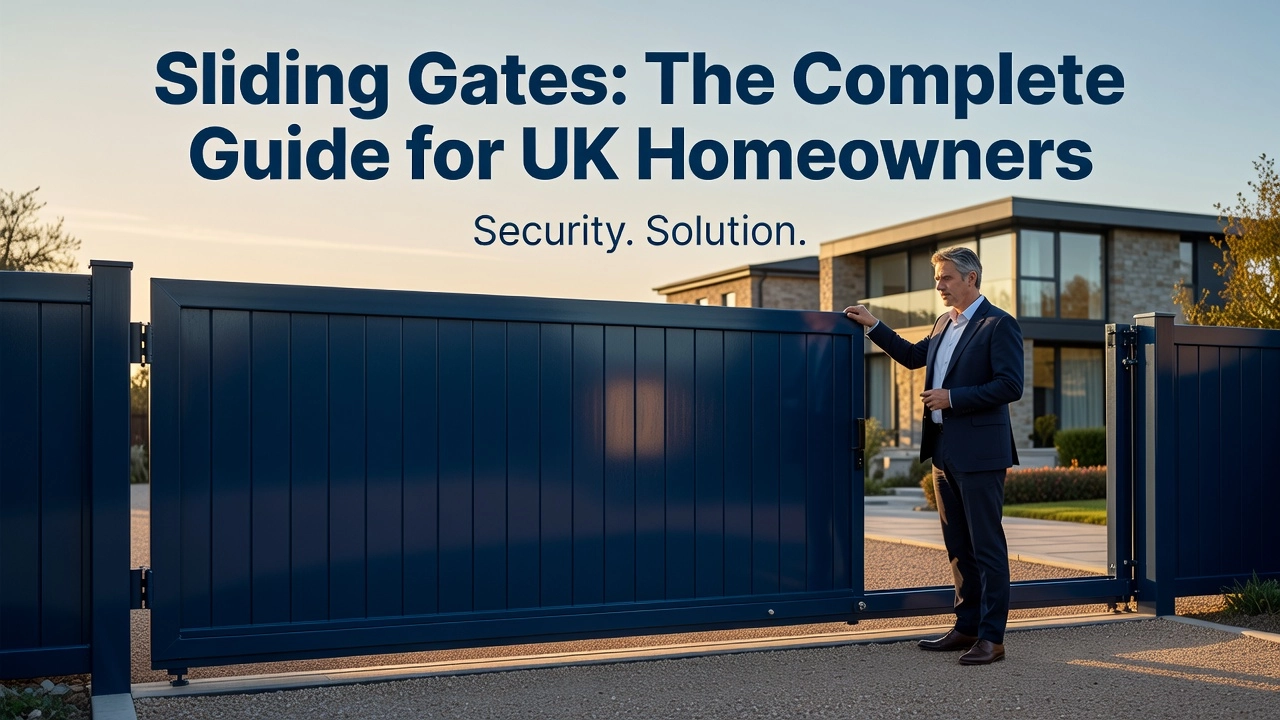
Your home's entrance makes a powerful first impression, and choosing the right gate can transform both the security and appearance of your property. If you've been considering a sliding gate for your home, you're already thinking in the right direction. These sleek, space-saving solutions have become increasingly popular across the UK, and it's easy to see why.
Unlike traditional swing gates, a sliding gate moves horizontally along a track, making it the perfect choice for driveways with limited space or sloped ground. Whether you're looking to boost your home's kerb appeal, improve security, or simply add a touch of modern style, sliding gates offer a practical and attractive solution for homeowners at every budget.
In this complete guide, we'll walk you through everything you need to know as a UK homeowner. From the different types of sliding gates available to installation requirements, costs, and maintenance tips, this guide covers it all. By the end, you'll have the confidence and knowledge to make the right decision for your property.
How Does a Sliding Gate Work?
Understanding how a sliding gate operates gives you a solid foundation for making the right choice for your property. At the heart of every automated sliding gate is a rack-and-pinion drive system. A toothed steel rack is welded or bolted along the underside of the gate leaf, and a motor-driven pinion gear meshes directly with it. As the pinion rotates, its teeth push against the rack, converting the motor's rotational force into smooth, controlled horizontal movement. Reversing the motor's rotation direction reverses the gate's travel, giving you precise, reliable open and close cycles every time.
Tracked vs. Cantilever Configurations
There are two principal ways to support a sliding gate during travel. Tracked systems use a steel ground rail running the full length of the gate's path, with the gate panel rolling along it on support wheels. These work well on sealed, level driveways but the ground rail is vulnerable to debris accumulation and damage from heavy vehicles. Cantilever systems take a fundamentally different approach, suspending the gate entirely above the ground from roller carriages mounted to posts on the non-opening side. No track crosses the driveway opening at all, making cantilever the preferred configuration for gravel surfaces and sites with heavy vehicle traffic. You can explore the key components of cantilever sliding gate hardware in detail to understand what each part contributes to the overall system.
The Electromechanical Operator
The automation system brings together a motor, gearbox, control board, and limit switches working in sequence. A trigger command, whether from a remote, keypad, or intercom, instructs the control board to power the motor. The gearbox reduces motor speed and increases torque to move the gate panel reliably. Limit switches detect when the gate reaches its fully open or closed position and stop the motor precisely. Electromechanical technology dominates the market because of its durability, low maintenance requirements, and compatibility with modern access control systems.
Run-Back Space and Safety
Before specifying any sliding gate, a thorough site assessment is essential. The gate leaf must retract parallel to a boundary wall or fence, requiring clear run-back equal to the opening width plus approximately 20% to accommodate the operator housing. Cantilever systems need roughly 1.5 times the gate width in run-back for the counterbalance extension.
Modern systems also incorporate multiple safety layers. Photocell beams detect any person or vehicle in the gate's path, pressure-sensitive edges on the leading edge trigger an immediate stop if contact occurs, and auto-reverse functions prevent entrapment. These features ensure compliance with UK machinery safety standards. For a comprehensive overview, the Auto Sliding Gates Explained guide covers how these components work together in practice.
Sliding Gate vs. Swing Gate: Which Is Right for Your Property?
Choosing between a sliding gate and a swing gate is one of the most important decisions you will make for your entrance. Each type suits different property conditions, and selecting the wrong one can create practical problems that are expensive to fix later. Here are the five key factors to weigh before you decide.
1. Space and Gradient
Swing gates require a clear arc of ground equal to the full width of the gate, either sweeping inward toward the house or outward toward the road. If your driveway slopes, rises steeply, or sits close to a public highway, that arc becomes obstructed and the gate simply cannot function correctly. A sliding gate travels parallel to the boundary fence or wall, meaning gradient is irrelevant to its operation. For properties across East Sussex and Kent where driveways frequently slope or front boundaries sit tight to the road, this distinction alone often settles the debate. As this detailed comparison of sliding and swing gate features confirms, sliding gates are generally more adaptable to uneven terrain than their swing counterparts.
2. Security Performance
Sliding gates are widely regarded as the more secure option. Because the gate travels along a fixed track rather than pivoting on hinges, there is no central join that can be forced under pressure and no hinge point that can be lifted or compromised. This makes them the preferred choice for high-security residential properties, commercial sites, and agricultural holdings where perimeter integrity is a priority. According to gate security specialists, robust construction and reliable locking mechanisms make sliding gates a strong deterrent against unauthorised entry.
3. Wind Load and Structural Demands
On exposed coastal sites in Sussex and Kent, wind loading is a genuine engineering consideration. Wide swing gates act like sails, transferring enormous lateral force through the hinge columns with every gust. This stresses the supporting posts and can accelerate wear on both the gate structure and the automation hardware. Sliding gates avoid this lever-arm problem entirely, though they still require well-engineered posts and proper counterbalancing on exposed sites to perform reliably long-term.
4. Aesthetic and Planning Considerations
Swing gates carry a traditional, architectural quality that suits period properties, listed buildings, and rural settings where wrought iron or timber designs complement the surroundings. Sliding gates offer cleaner, more contemporary lines that work well on modern homes and commercial premises. Material selection, whether powder-coated steel, aluminium, or timber, affects both the visual outcome and any planning authority assessment, particularly in conservation areas. It is always worth checking with your local planning department before installation if your property falls within a designated area.
5. Quick Decision Summary
A sliding gate is generally the stronger choice where driveway space is limited, the ground slopes, security is a priority, or the entrance handles regular traffic. A swing gate suits wide, flat, low-traffic residential driveways with ample forecourt depth and a preference for a more traditional aesthetic. As this practical space and cost comparison notes, evaluating both gate types together across space, cost, and maintenance gives you the clearest picture before committing.
Types of Sliding Gate Available
Not all sliding gates are built the same way, and understanding the key variations will help you choose the right system for your property from the outset.
1. Cantilever Sliding Gates
A cantilever sliding gate is suspended on rollers fixed to vertical support posts, with no bottom track crossing the driveway surface at any point. The gate incorporates a counterbalance tail, an extension roughly half the width of the opening, which keeps the structure stable as it travels. Because the gate operates several inches above the ground, it continues to function reliably on uneven surfaces, sloped driveways, and sites where a ground rail would create a trip hazard or obstruct vehicle clearance. These qualities make cantilever systems the preferred choice on high-traffic commercial and industrial sites. The trade-off is that the counterbalance tail requires additional run-back space alongside the opening, typically around 50% more than the gate width itself.
2. Tracked Sliding Gates
Tracked sliding gates use a steel or nylon bottom rail, either embedded into the driveway or laid across it, along which wheeled carriers guide the gate. They generally carry a lower upfront cost than cantilever systems and perform well on flat, clean, well-maintained surfaces. However, the track is exposed to the environment and can collect debris, suffer water pooling, or ice over in colder conditions, all of which affect reliable operation. Regular track maintenance is therefore essential. A telescopic variant is also available, using two overlapping panels to serve wider openings where run-back space is restricted.
3. Materials and Finishes
Material choice has a direct effect on gate weight, maintenance requirements, and long-term cost. Mild steel, either powder-coated to a RAL colour of your choice or hot-dip galvanised, is the most common choice for commercial and residential installations, offering strength and rigidity. Aluminium is lighter and inherently corrosion-resistant, reducing load on post foundations and automation hardware. Timber-clad steel frames combine a warm domestic aesthetic with underlying structural integrity, while wrought iron suits period and heritage properties requiring decorative metalwork.
4. Bespoke Fabrication vs. Standard Infill Panels
Off-the-shelf gate kits offer a lower entry price but impose fixed dimensions, limited material options, and standardised designs that rarely match the property precisely. Bespoke fabricated gates are sized exactly to the opening, designed to complement the boundary treatment, and built to tolerances that support long-term, reliable automation.
5. The Portara Approach
Portara Automation designs and manufactures bespoke sliding gates in-house using CNC plasma cutting and precision metalwork, treating the gate and its automation as a unified engineered system. This means every component, from the structural frame to the drive interface, is specified and built to work together rather than assembled from mismatched parts.
Sliding Gate Automation: Operators, Brands, and Technology
Selecting the right automation operator is where getting the specification right truly matters. Four primary variables should guide every decision: gate weight, leaf width, cycle frequency, and power supply availability. A residential single-leaf gate weighing under 400 kg requires a relatively modest electromechanical motor, designed for moderate daily use and straightforward installation. A heavy commercial or agricultural double-leaf system cycling hundreds of times per day demands an entirely different class of operator, one built for continuous duty with robust thermal protection and higher torque output. Getting these variables wrong leads to premature motor failure, safety risks, and costly replacements, which is why working with an experienced installer matters from the very first conversation.
Leading Automation Brands
The four dominant European manufacturers supplying electromechanical sliding gate operators are FAAC, Nice, BFT, and CAME. Each brand offers product ranges that span from light residential installations through to heavy industrial-duty applications, meaning the right choice depends entirely on the specification, not brand preference. In the solar gate opener sub-market alone, FAAC held a 21.81% share and Nice followed closely at 21.47%, reflecting the depth and breadth of their respective product portfolios. A competent installer will assess your gate's weight class, cycle requirements, and site conditions before selecting the appropriate model, rather than defaulting to a single brand regardless of suitability.
Smart Home and App Integration
Modern sliding gate control boards have moved well beyond basic remote operation. Current systems support Wi-Fi and GSM modules that enable smartphone app control, event logging, remote diagnostics, and integration with smart home platforms. This aligns directly with the growing consumer expectation for IoT-connected home systems, and it is a key driver converting homeowners from manual to automated gates. According to Fact.MR's automatic gate opening system market research, smart home ecosystem integration is an explicitly cited demand driver, and the sliding gate market forecast through 2033 projects continued growth at a CAGR of 7.4%, partly fuelled by this technology convergence.
Solar-Powered Operators
For rural properties and agricultural sites without convenient mains supply, battery-backed solar kits offer a genuinely practical alternative to grid-connected operators. Lithium battery storage maintains reliable operation through extended low-sunlight periods, making solar viable across most of the UK year-round. The global solar gate opener market reached $174.67 million in 2023 and is forecast to reach $388.6 million by 2033, with its CAGR accelerating from 6.3% to over 10% as adoption builds. Beyond access convenience, solar systems reduce ongoing running costs and support broader sustainability goals, making them an increasingly attractive option for environmentally conscious property owners.
Taken together, these technology layers explain why sliding gate automation holds 51% of product share in the global automatic gate opening market in 2026, as reported by Fact.MR. The maturity of the hardware ecosystem, the breadth of available operators, and the expanding software intelligence built into modern control systems make sliding gate automation the most comprehensively developed segment in the industry.
Access Control Options for Sliding Gates
Choosing the right access control system is just as important as selecting the gate itself. A well-specified sliding gate deserves an equally well-specified access solution, and the options available today range from simple keypad entry through to biometric authentication.
1. Remote Fobs and Keypads
For most residential installations, rolling-code radio fobs are the starting point. Unlike older fixed-code transmitters, rolling-code technology generates a new encrypted signal with every button press, making it extremely difficult for unauthorised devices to intercept and replay the signal. Keypads offer a practical PIN-based alternative for visitors, delivery drivers, or tradespeople who need occasional access without being issued a permanent fob. The two methods are frequently combined on the same installation, giving homeowners flexibility without significant added cost.
2. Intercom and Video Intercom Systems
An audio or video intercom allows you to identify and speak with any visitor before releasing the gate, all without stepping outside. Modern video intercom systems support app-based answering via smartphone, meaning the gate can be released remotely from anywhere in the world. Wired systems offer the most reliable connection and are typically recommended for new installations, while wireless intercoms provide a practical solution when retrofitting access control to an existing sliding gate where cable runs would be disruptive.
3. Smart App Control and IoT Integration
Dedicated gate control apps paired with Wi-Fi or GSM modules take remote access a step further. Beyond simple open and close commands, these systems support open-time scheduling, real-time notifications, and access event logs that record every gate operation. According to 2025 access control trends, smartphone-based access is now mainstream rather than a premium addition, reflecting how far consumer expectations have shifted.
4. Card, Fob, and Proximity Readers
RFID and proximity readers are well suited to shared residential developments, business premises, and agricultural sites where multiple users need independent access. Each user is assigned an individual credential, and any single credential can be revoked instantly through the system controller without affecting other users. This makes RFID readers considerably more manageable than shared PIN codes at higher-traffic entrances.
5. Biometric Access Control
For commercial and high-security sites, fingerprint and facial recognition systems provide the highest level of individual accountability. Biometric systems currently represent the largest segment of the door entry systems market, reflecting strong demand from industrial and corporate clients. Portara's team can advise on pairing biometric readers with your sliding gate installation to meet specific security requirements.
How Much Does a Sliding Gate Cost in the UK?
Cost is one of the most common questions homeowners ask before committing to a sliding gate project, and the honest answer is that several variables work together to determine the final figure.
What Drives the Price
Six factors have the greatest influence on what you will pay. Gate size is the most obvious starting point; a wider or taller opening requires more material and a more powerful operator. Material choice plays an equally significant role, with steel, aluminium, and hardwood timber each carrying different fabrication costs, weight profiles, and long-term maintenance implications. Automation system specification covers the operator type, duty cycle, and technology tier you select. Access control requirements such as intercoms, keypads, GSM diallers, or vehicle loop detectors add to the total, as does groundwork complexity, including track laying, drainage channels, cable runs, and any concrete foundation work. Finally, whether this is a brand-new installation or a retrofit onto an existing manual gate will materially affect the labour component.
Indicative Price Ranges
For a standard residential driveway with a 3 to 4 metre opening, a supply-and-install automated sliding gate typically costs between £3,000 and £8,000, according to current UK cost data from Checkatrade. Labour alone generally accounts for £2,000 to £3,000 of that figure. It is worth noting that sliding gates tend to cost more than swing gates at equivalent specification because the track installation, drainage management, and groundwork are inherently more involved. For fully bespoke fabricated sliding gates in metal or hardwood, budgets can start from £10,000 plus VAT when full civil works are included.
New Installation Versus Retrofitting
If you already have a manual sliding gate in reasonable condition, adding automation is often more cost-effective than starting from scratch. The key requirement is that the existing gate leaf and posts are structurally sound and that the leaf weight falls within the duty rating of a compatible operator. A professional site survey is essential before any retrofit work begins, as no two existing installations are identical.
Why Bespoke Is Worth the Investment
A bespoke fabricated gate is engineered precisely to your opening dimensions, weight-matched to the chosen operator, and finished to complement your property's appearance. This precision reduces wear on the drive system, lowers long-term maintenance costs, and removes the compromises that come with standard kit gates. The automatic sliding gate opener market is valued at over USD 2 billion globally in 2025, reflecting a mature and competitive hardware supply chain. That competition keeps component costs accessible, meaning the primary value in any quality installation comes from professional specification, skilled fabrication, and expert installation rather than the hardware alone.
Do You Need Planning Permission for a Sliding Gate in the UK?
Planning permission is one of the most frequently misunderstood aspects of installing a sliding gate, and getting it wrong can result in costly enforcement action. The good news is that most residential gate installations fall within permitted development rights under the Town and Country Planning (General Permitted Development) Order 2015, meaning no formal application is needed. However, the height thresholds are lower than many homeowners expect.
Under permitted development, a gate adjacent to a vehicular highway must not exceed 1 metre in height. Gates positioned elsewhere on the property boundary, away from a highway, may reach 2 metres without requiring consent. These limits apply regardless of whether the gate is manual or automated; the mechanism of operation has no bearing on the planning position.
Several circumstances take a gate installation outside of permitted development entirely. These include:
Gates exceeding the height thresholds outlined above
Properties where permitted development rights have been removed, which is common on new-build estates where planning conditions attached to the original development consent restrict future alterations
Any gate on or adjacent to a listed building, which requires Listed Building Consent and potentially full planning permission
Article 4 Directions, which are formal designations that remove permitted development rights in a defined area
Parts of East Sussex and Kent contain conservation areas and Article 4 Directions where standard permitted development rules do not apply. Installing a gate in one of these areas without first checking with your Local Planning Authority can result in an enforcement notice requiring removal at your own expense. Consulting your local authority's planning portal before purchase is a straightforward step that avoids significant problems later.
For listed buildings, the local authority's conservation officer will scrutinise the gate's design, materials, and finish. Traditional materials such as wrought iron tend to receive more favourable consideration than modern alternatives in these settings.
The planning process is entirely manageable when addressed early. A specialist installer with direct knowledge of East Sussex, West Sussex, and Kent planning contexts, such as Portara Automation, can advise on likely outcomes, flag potential constraints, and help prepare supporting documentation where a formal application is required.
Maintaining Your Sliding Gate: What You Need to Know
A well-maintained sliding gate will serve your property reliably for well over a decade. Neglect the basics, and you will be dealing with costly breakdowns far sooner than necessary. Knowing what to check, and when, is the most effective way to protect your investment.
Routine maintenance follows a straightforward schedule. The gate track on a tracked system, or the carriage wheels on a cantilever setup, should be inspected and lubricated every six months. The rack-and-pinion drive deserves the same attention at the same interval: clean away accumulated grime, then re-grease the rack teeth to prevent accelerated wear on both the rack and the motor pinion. Limit switches and safety photocells should be tested and realigned quarterly, since even minor movement can cause the gate to stop short of its fully open or closed position, or fail to detect an obstruction in its path.
Three fault points cause the majority of sliding gate problems. In tracked systems, debris accumulating in the bottom track is the single most common reason a gate slows down or stalls completely. Worn carriage wheels are the second culprit, creating excessive vibration that accelerates rack wear and places unnecessary strain on the motor. Third, if a motor on a high-cycle commercial or agricultural gate is running hot, it almost always means the original operator was undersized for the workload and needs upgrading before it fails entirely.
Certain warning signs should prompt an immediate service call. Unusual grinding or clicking during travel, slower-than-normal movement, the gate stopping before completing its cycle, and the motor running while the gate stays stationary are all clear indicators that something requires attention. The last symptom, in particular, typically points to a slipping pinion or a failed rack section.
Not every task requires a specialist. Track cleaning, basic lubrication, and checking photocell alignment are all reasonable for a confident homeowner to handle. However, replacing control boards, reterminating motor wiring, adjusting limit switches, or diagnosing intermittent faults should always be passed to a qualified automation engineer. Attempting these tasks without the necessary expertise risks voiding the manufacturer warranty and, more seriously, creating a safety hazard for anyone using the entrance.
A planned maintenance agreement offers the most complete protection. Working with a local specialist such as Portara Automation provides scheduled annual servicing, priority response when a breakdown occurs, and a documented inspection record. Those records carry real practical value: insurers may request evidence of maintained safety systems, and a complete service history is a tangible asset when selling your property.
Agricultural and Commercial Sliding Gates
Residential properties represent the majority of sliding gate installations, but agricultural and commercial environments present a substantially different engineering challenge that demands a higher specification at every level.
Heavy-Duty Specifications for Farm Sites
Agricultural sliding gates routinely span openings of 5 to 8 metres or more to accommodate wide farm machinery, HGVs, and livestock handling equipment. At these widths, gate weights increase significantly, placing far greater demands on the carriage system and foundation. Galvanised steel construction is the standard choice for farm environments, offering reliable corrosion resistance against mud, moisture, and chemical washdown that would quickly degrade powder-coated finishes alone. Cantilever systems are strongly preferred on agricultural sites because they eliminate the ground track entirely, removing the risk of debris, gravel, and ground movement causing misalignment or operational failure. The operator must be rated for continuous-duty use rather than the light residential cycles typical of a home entrance.
Duty-Cycle Specification for Commercial Sites
A residential sliding gate operator is typically rated for around 10 to 20 cycles per day. A commercial gate serving a busy distribution centre, car park, or industrial estate may need to handle 200 or more cycles per day, in all weather, without interruption. Under-specifying the motor at the outset is a costly mistake; premature failure on a commercial gate means unplanned downtime, security exposure, and expensive emergency callouts. Selecting a high-duty-cycle operator with thermal protection, battery backup, and integrated diagnostics is not optional on a busy commercial site; it is a baseline requirement.
Integrated Access Management and Safety Compliance
Commercial installations increasingly combine sliding gates with ANPR, CCTV, video intercoms, and multi-user access control to create a fully managed entry point with audit trails and remote operation capability. Alongside this, safety compliance carries real legal weight on commercial sites. BS EN 12453 governs automated gate force limits and safety device requirements, and installers must deliver a full risk assessment alongside a Declaration of Conformity under the UK Machinery Regulations. Photocell placement, warning signage, and force limitation are all subject to scrutiny on commercial premises in a way that is less consistently enforced in residential settings.
Portara supplies and installs heavy-duty sliding gates for commercial, industrial, and agricultural clients across East Sussex, West Sussex, and Kent, combining correct engineering specification with full compliance documentation on every project.
Why Choose a Local Specialist for Your Sliding Gate Installation?
Every decision made before a sliding gate reaches your driveway affects how well it performs for the next decade. Selecting a local specialist rather than a national kit supplier or uncoordinated trades is one of the most consequential choices you can make. Here are five reasons why a regional expert delivers a fundamentally better outcome.
1. Bespoke fabrication means your gate is built for your property, not the nearest standard size. A specialist that designs and manufactures its own gates, like Portara Automation, measures your exact opening, accounts for the structural reveal, and matches materials to your property's architectural character. Steel finish, infill pattern, post height, and overall proportions can all be specified to complement what already exists. A national supplier dispatching a catalogue product cannot do this; you receive a gate that fits approximately, not precisely.
2. One team, one point of accountability, zero finger-pointing. Groundworks, fabrication, electrical installation, automation, and access control integration are all interdependent. When separate contractors handle each discipline, responsibility for delays and cost overruns becomes genuinely difficult to pin down. A single provider managing the whole project carries full accountability from the initial survey through to commissioning and ongoing servicing.
3. Local knowledge shapes the specification before a single post is installed. Ground conditions across East Sussex and Kent vary considerably, drainage requirements differ between sites, and coastal proximity demands specific material choices to resist salt-air corrosion. A locally based specialist understands these factors and specifies accordingly, rather than applying a generic national template.
4. New installations and retrofits are both within scope. Market data consistently identifies manual-to-automated conversion as one of the fastest-growing demand segments. A specialist capable of automating your existing manual gate, rather than insisting on full replacement, gives you a materially broader set of options and often a more cost-effective route to automation.
5. The market is growing fast, and proven installers are in rising demand. The UK is among the fastest-growing markets in Europe for automated gate systems, with global automatic sliding gate opener revenues forecast to climb from USD 2,056.5 million in 2025 to USD 3,500 million by 2035. As residential and commercial demand accelerates, access to established regional specialists with verified installation records becomes increasingly competitive. Engaging a proven local team now is the straightforward way to avoid capacity constraints later.
Making the Right Choice for Your Property
Every sliding gate project follows the same logical sequence: confirm run-back space and site gradient first, choose between cantilever and tracked configuration based on what the site allows, then specify the automation operator and access control system to match how frequently the gate will cycle and how much security the property requires. Skipping any of these steps in order leads to costly corrections later.
Planning and compliance checks must happen before groundwork begins, not after. Permitted development thresholds for gates are lower than most homeowners anticipate, and local designations across East Sussex and Kent, including conservation areas and Areas of Outstanding Natural Beauty, can restrict what is permitted without formal consent.
Correct specification from day one delivers the strongest long-term value. An undersized motor, a misaligned track, or a gate leaf exceeding its operator's rated capacity will generate repair and replacement costs over five years that far exceed the modest saving made at the point of purchase.
Portara Automation offers a free site survey across East Sussex, West Sussex, and Kent. A site visit is the only reliable way to produce an accurate specification and quotation. With specialist design expertise, in-house fabrication, trusted automation brands including FAAC, Nice, BFT, and CAME, and a full aftercare offering, Portara provides a single point of accountability from initial survey through to long-term maintenance. Contact the team today to arrange your survey.
Conclusion
Choosing the right sliding gate is one of the smartest investments you can make as a UK homeowner. To recap the key takeaways: sliding gates save space and suit sloped driveways perfectly; they come in a range of styles and materials to match any property; professional installation ensures long-term safety and reliability; and regular maintenance keeps them performing at their best for years to come.
Now that you have a complete picture of what sliding gates involve, you are ready to take the next step. Start by assessing your driveway space, setting a realistic budget, and requesting quotes from at least three reputable local installers.
Your home deserves an entrance that makes a statement. With the right sliding gate in place, you can enjoy enhanced security, improved kerb appeal, and genuine peace of mind every single day.