
Vetting an Electric Gate Installer: Questions That Separate Specialists from Generalists
Electric gate installers: use this 8-question checklist to verify qualifications, safety compliance, insurance, and legal documentation before hiring.

Most people searching for electric gate installers near me assume the hard part is finding someone local who can do the job. It is not. The hard part is knowing whether the person who shows up actually has the qualifications, documentation, and legal compliance to install a gate that is safe, warrantied, and built to last.
Electric gate installations in the UK are governed by strict legal requirements. The wrong installer does not just leave you with a gate that underperforms. They can expose you to unsafe machinery, voided manufacturer warranties, and personal legal liability if something goes wrong.
This guide gives you a concrete checklist of questions to ask before you sign anything. You will learn which registers and certifications separate genuine specialists from generalists, which safety documents must be produced before work begins, and what warranty and aftercare commitments a qualified installer should be willing to put in writing. Each question is designed to put you in control of a decision that directly determines the long-term safety and compliance of your gate. By the end, you will know exactly what a qualified answer looks like and which responses should make you walk away.
Why Your Choice of Installer Determines Long-Term Gate Safety and Compliance
Electric gate installation in the UK is governed by the Supply of Machinery (Safety) Regulations 2008, and non-compliance is not a quality issue, it is a statutory breach. Legal liability for an unsafe installation does not rest with the installer alone; it transfers directly to the property owner once the gate is in use. The HSE has publicly endorsed Gate Safe's work since 2010, signalling that regulatory scrutiny of UK safety standards and legal compliance for electric gates is sustained, not theoretical.
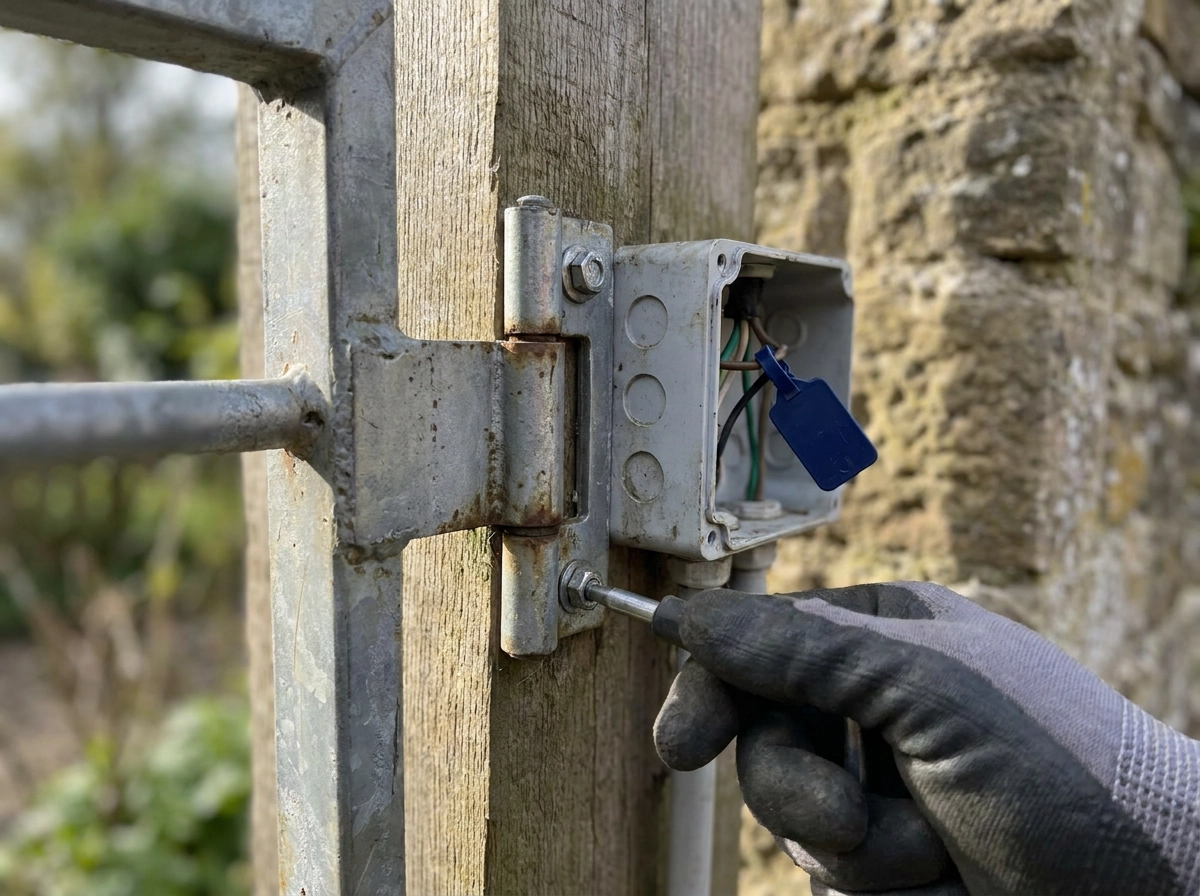
When a generalist installs a gate without proper documentation, the liability chain does not stop at their invoice. If an incident occurs and no risk assessment, Declaration of Conformity, or safety device record exists, the homeowner bears the consequences.
Correcting a poor installation is also far more disruptive than replacing a faulty appliance. Buried cable runs, set concrete foundations, and integrated safety systems must be excavated or dismantled, at significant cost and disruption.
Every question in this checklist maps to a specific, documented risk that unqualified installers routinely overlook. They are not formalities; they are your practical protection.
Question 1: Are You Listed on the Gate Safe Approved Installer Register?
Gate Safe operates the UK's national register of approved installers and delivers accredited training specifically for powered gate and barrier installation. The register is publicly searchable by company name, so you can independently verify any accreditation claim an installer makes rather than taking their word for it.
Ask the installer directly: "What is your Gate Safe registration number?" A genuine electric gate specialist will answer immediately. Hesitation, a vague reference to "industry training," or a promise to "send that over later" are red flags.
Gate Safe Aware status goes a step further, signalling a more advanced engagement with gate safety standards and protocols beyond basic registration. This distinction matters when choosing between electric gate specialists and generalists who fit automated gates alongside other trades.
For a broader look at what competent accreditation looks like in practice, the guide on how to choose an electric sliding gate installer covers what separates a qualified specialist from a generalist before a single quote is requested.
Question 2: Will You Provide a Documented BS-Based Risk Assessment Before Installation?
A Gate Safe-registered installer knows the British Standards. The next question confirms they are actually applying them to your specific site. As established above, this is a statutory obligation, what matters here is confirming the installer will apply it to your specific site.
A formal risk assessment under the UK safety standards and compliance framework for electric gate openers is a legal requirement imposed by the Supply of Machinery (Safety) Regulations 2008, not an optional service tier. Every compliant installation requires one. There is no legitimate shortcut.
The assessment must address site-specific hazards: crushing points, gate runaway risk, track failure scenarios, and foreseeable interactions beyond normal use, including children playing near the gate. It must also account for ground conditions, adverse weather exposure, and how speed and force settings will be limited for your particular environment.
Ask for the assessment in writing before any work begins, and ask directly which British Standards have been applied. A qualified installer names them immediately. Vagueness or a promise to "sort the paperwork afterwards" is a disqualifier.
If an installer proposes skipping or abbreviating the risk assessment to cut costs or speed up the job, decline regardless of their price. This is not a documentation oversight; it is a breach of the regulations.
Question 3: What Safety Devices Will Be Installed, and Why That Combination?
The risk assessment directly determines which safety devices your gate must have.
HSE guidance confirms that every powered gate installation requires a minimum of two different types of safety device. Photocells and pressure-sensitive edges are the standard pairing: photocells detect obstacles before contact; pressure edges trigger reversal if contact occurs. Both are required because neither covers every failure scenario alone.
The correct combination is not fixed in advance. It depends on your site's risk assessment, the operating environment, and foreseeable user interactions, including children, elderly visitors, or delivery personnel. A specification adequate for a remote agricultural entrance may be wholly insufficient for a residential driveway with regular pedestrian traffic.
Ask the installer to explain, in plain language, why each device is specified for your site. A specialist can connect every component choice back to specific risk assessment findings. Vague references to "standard safety kit" indicate the specification has not been tailored to your installation. You can also review key features to look for in an electric gate system to familiarise yourself with the components before that conversation.
Finally, confirm that all safety devices will be physically demonstrated during commissioning and recorded in your handover pack.
Question 4: Can You Show Proof of Public Liability Insurance That Covers Gate Installation?
Once safety device specification is agreed, insurance is the next non-negotiable check.
Public liability insurance is essential for any electric gate or barrier installation. Without it, injury or property damage occurring during or after installation can expose both the installer and the homeowner to uncapped legal costs.
Crucially, the policy must specifically cover automated gate and barrier installation work. A general construction or fencing policy frequently excludes powered machinery installation entirely, meaning an apparently insured installer may carry no meaningful cover for your job. Do not accept verbal reassurance; ask to see the actual certificate of insurance and verify three things: the expiry date, the named activities covered, and the indemnity limit.
For residential installations, a minimum indemnity limit of £2 million is the recognised industry standard. Commercial and agricultural gate projects warrant higher limits, typically £5 million to £10 million, given the greater scale of potential liability.
An installer who hesitates to share this documentation, or who cannot produce it promptly, should not be appointed regardless of how competitive their quote is. You can find a broader overview of what qualified installers must be able to demonstrate in this guide to UK safety compliance for electric gate installations.
Question 5: Will the Installation Include a Declaration of Conformity?
Insurance confirms financial accountability; this question confirms the installer understands their handover obligations under the same regulations.
The HSE is explicit: the Declaration of Conformity must be in writing, in English, and must accompany the product. It is not a marketing certificate or a quality badge; it is a formal legal document identifying the specific standards applied, the machinery covered, and the person or company responsible for compliance.
Most homeowners have never heard of it. That is precisely why knowing to ask for it separates informed buyers from those who discover problems later.
Keep it with your property documents so any future owner or insurer can confirm the system was legally installed.
Ask the installer directly: "Will you provide a Declaration of Conformity at handover, and can you explain what it will cover?"
A specialist answers immediately. A generalist who is unfamiliar with the declaration, or who cannot describe its contents, has a material gap in their regulatory knowledge and should not be appointed.
Question 6: What Pre-Installation Documentation Will You Provide?
The Declaration of Conformity confirms your system was built to specification; pre-installation drawings confirm it was designed to specification for your specific site.
Before groundwork begins, request drawings covering gate dimensions, post positions, foundation specifications, and cable routing. These should reflect your property's actual layout, not generic templates.
Foundation and post specifications deserve particular scrutiny. Undersized or poorly positioned foundations can contribute to gate drift, alignment failure, and premature motor wear over time. A specialist will calculate foundation depth and concrete volume based on gate weight and operating forces, not guesswork.
Ask how environmental factors are addressed: sun exposure affects control panel placement, wind loading influences structural requirements for larger gates, and drainage around underground motor housings must be planned before concrete is poured, not after.
Signed-off drawings also protect you legally. If the finished installation deviates from specification, documented drawings make any deviation traceable and attributable. Without them, disputes become your word against the installer's.
Portara Automation designs and manufactures bespoke gate systems in-house, so pre-installation drawings are produced as a natural part of the process. If you want to understand what that looks like before committing, Making the Right Choice for Your Property outlines key considerations worth reviewing alongside this checklist.
Question 7: What Do Your Warranty Terms Actually Cover, and for How Long?
Pre-installation drawings confirm what will be built. Warranty terms confirm what happens when something goes wrong. Both matter; neither replaces the other.
Ask for all warranty terms in writing before signing, verbal commitments are difficult to enforce. Confirm what is covered for mechanical components, electrical components, motors, and safety devices separately, as each may carry a different duration.
Ask whether the warranty covers parts and labour. A parts-only warranty leaves you paying for fault diagnosis and remedial work every time something fails. For automatic gate installation, that cost can be substantial if the fault involves buried cabling or a ground-mounted motor housing.
Ask what would void the warranty, some policies are affected by third-party servicing or exclude wear-related failures. Knowing these conditions lets you plan maintenance accordingly, rather than discovering an exclusion after a claim is refused. Our guide to Repair or Replace? How to Decide covers what those fault scenarios typically involve.
Demand a defined response time for warranty call-outs. "Within a reasonable timeframe" is meaningless if your gate fails open or closed in a security-critical position.
For bespoke or custom-fabricated systems, confirm that the warranty covers the fabricated metalwork separately from the automation components. These are manufactured and supplied independently and may carry different guarantees from different parties.
Question 8: What Aftercare and Maintenance Commitments Come With the Installation?
Automated gates are subject to ongoing duties under the Health and Safety at Work etc Act 1974, and failure to maintain them can result in prosecution if an incident occurs. Ask the installer for a written maintenance schedule and whether they offer a formal service agreement, not just a verbal assurance of availability.
Ask for a written service schedule; at minimum it should address safety device function checks, fixings and mountings, lubrication of mechanical components, and force and speed settings, the HSE confirms these parameters must be maintained throughout a gate's operating life.
Ask directly whether the installer will still be reachable for repairs in two to five years. A sole trader with no service infrastructure carries genuine continuity risk. A dedicated specialist installer with an established local presence offers a structure that supports long-term availability.
Confirm whether emergency call-out is offered and what the expected response time is for your area.
Finally, treat this conversation as a diagnostic. A generalist installing gates alongside other trades is unlikely to have a dedicated maintenance team or service scheduling system. A specialist will answer these questions without hesitation.
Red Flags That Reveal a Generalist Before You Sign
Beyond the aftercare conversation, certain responses during initial enquiries will reveal a generalist immediately. Treat these as automatic disqualifiers.
Cannot name the British Standards unprompted. A competent specialist knows BS EN 12453:2017, BS EN 12604:2017, and BS EN 12978:2003 without consulting notes. Hesitation or a vague reference to "industry guidelines" signals the risk assessment will be conducted without proper grounding.
Quote omits line items for safety devices, commissioning, or documentation. If these do not appear as separate line items, they will either be skipped entirely or added as extras once work has begun.
Reluctance to produce written documentation. Any installer who cannot promptly provide an insurance certificate, warranty terms, or risk assessment findings is either unaware of their legal obligations or is avoiding them. Neither is acceptable.
Offers to automate your existing manual gate without a full site risk assessment. This shortcut is a direct regulatory breach, as safety requirements are determined by the entire system within its specific environment.
Ask specifically for a system-level Declaration of Conformity, component CE marking alone does not cover the complete installation. Confusion between the two indicates a material gap in regulatory knowledge.
The Checklist in Practice: What a Qualified Answer Looks Like
Once you know what red flags to avoid, the final step is knowing what confidence looks like from the other side.
A qualified electric gate specialist answers every question on this checklist without hesitation, produces documentation on request, and treats your questions as evidence of an informed buyer. Friction, vagueness, or impatience are disqualifying signals in themselves.
Use this checklist before requesting final quotes, not after. The answers determine whether a quote is worth evaluating. Comparing prices from an unqualified installer against a compliant one is not a meaningful comparison.
The right installer makes compliance feel straightforward. If the process feels opaque or bureaucratic, that reflects the installer's competence, not the subject matter.
Portara Automation offers site consultations that cover risk assessment, safety device specification, and pre-installation design as a matter of course. Standards-compliant installation is the baseline, not an upgrade.
Save this checklist and share it with anyone else involved in the decision. The eight questions cost nothing to ask; the answers protect your safety, your property, and your legal position for the entire life of the installation.
Conclusion
Choosing an electric gate installer is not a price decision. It is a safety, legal, and long-term liability decision. The eight questions in this checklist expose the difference between a specialist who understands compliance and a generalist who is guessing at it.
The eight questions cost nothing to ask; the answers protect your safety, your property, and your legal position for the entire life of the installation.