
When Bi-Folding Driveway Gates Beat Swing and Sliding Gates
Bi-folding driveway gates solve the tight, sloped or obstructed drive, but they are oversold elsewhere. See when they beat swing and sliding gates.
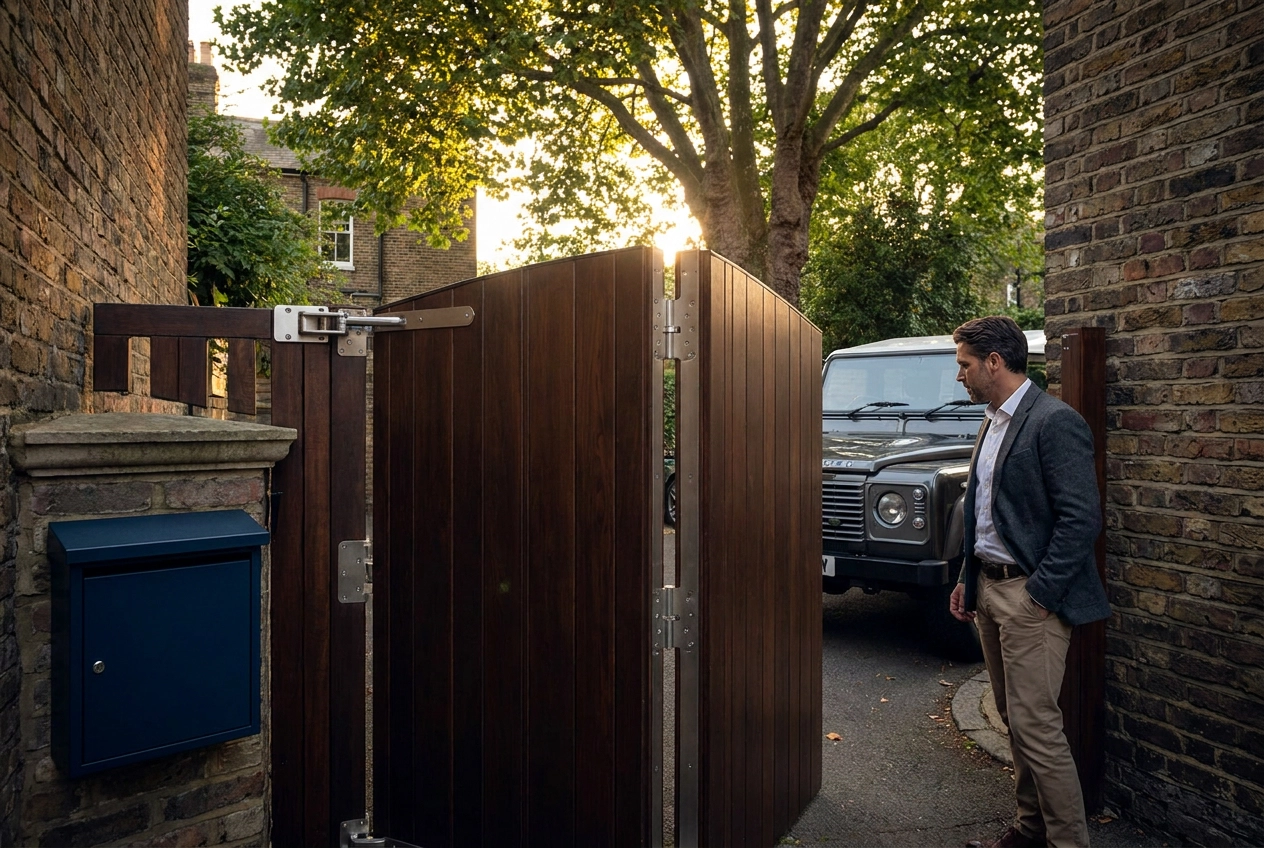
Most driveway gate advice quietly assumes you have space to spare. A swing gate needs a clear arc to open into; a sliding gate needs a straight track run and somewhere for the leaf to park. On a short, sloped or obstructed frontage, neither option fits, and no amount of clever automation will change the geometry. This is the narrow but genuine territory where bi-fold driveway gates win.
This guide explains what bi-fold driveway gates are and how their leaves fold and stack, then examines why swing and sliding gates fail on certain driveways. A side-by-side comparison sets out the trade-offs in clearance, track, hinge load, ground conditions and operator demand, before we look at where bi-fold driveway gates win: small driveways and short frontages, sloped sites where a folding leaf removes the track problem, and obstructed or angled approaches. Just as important, we cover where they are oversold, what electric bi-fold gates demand of the operator, foundations and hinge line requirements, safety standards and risk assessment, and the questions to ask before you buy.
What Bi-Folding Driveway Gates Are and How They Move
Bi-folding driveway gates use two or more gate leaves hinged together in pairs. As the gate opens, each pair folds back on itself and gathers into a shallow stack at the side of the opening, so no leaf ever sweeps across the driveway. How Bifold Driveway Gates Work explains the mechanics in detail. That single behaviour is the reason this gate type exists.
As a general arrangement, two configurations dominate. In a single stack, every leaf gathers to one side of the opening. In a double arrangement, leaves gather to both sides, which halves the depth of stack on each side but doubles the hinge-line hardware involved, and with it the number of components that need adjusting over time.
The mechanism does not change when the gate is automated. An electric bi folding gate is the same folding leaf arrangement under power, not a separate type of gate. Hand-operated and powered versions share the fold geometry; only the drive and control hardware differ.
The visual trade-off is real. In our experience, a bi-fold stack typically remains visible whenever the gate is open, unlike a sliding gate that can disappear behind a wall. The open-state appearance of the entrance therefore matters more with a bi-fold than with other gate types.
Because leaf size and fold count follow the driveway's shape, bi-folds are typically made to order rather than selected from a standard catalogue. A specialist that designs, manufactures, installs and automates bespoke gates can carry the whole job as one.
Whether that trade-off is worth making depends entirely on your driveway's geometry, which is where the comparison begins.
Why Swing and Sliding Gates Fail on Some Driveways
A swing gate only works if its arc stays clear for the full travel of the leaf. Not just at rest: for every inch of the sweep, the path must be free of parked cars, planting, kerbs, wheelie bins and passing traffic. That is a safety requirement rather than a convenience, because anyone who contacts a moving leaf is at risk, and pedestrians should be kept clear of the gate's entire travel path. On a short or narrow frontage, that arc often cannot be kept free at all, which is where standard swing gates start to fail on small driveways.
Sliding gates fail differently. They need a substantial straight run to retract into. On a short drive, that run ends up in the road, crosses a neighbour's boundary, or occupies exactly the space you wanted for the car.
Slope attacks both. A swing leaf must clear ground rising or falling across its arc; a sliding gate needs a track that stays level and true, so a gradient forces either a cantilever design or a track permanently fighting the drive.
Obstruction is cumulative. A pier here, a low wall there, a mature tree, a meter cabinet, a shallow setback, an angled approach: each takes a little of the space, and together they take all of it.
The point of a bi-fold is not superior engineering. It trades a wide, low mechanical footprint for a deeper, more demanding installation. That is an exchange, not a free upgrade.
Bi-Folding vs Swing vs Sliding: A Side-by-Side Comparison
Swing Gates: Simple, But Only Where Nothing Is in the Way
Swing gates remain the default for good reason: they are typically the most cost-effective option for narrow-to-medium entrances, with straightforward operators. The price of that simplicity is the arc, so they suit wide, level, unobstructed openings best.
Sliding Gates: Where Nothing Can Swing and a Straight Run Exists
Sliding gates need no arc and preserve full opening height. Retracted, a cantilevered gate disappears behind a wall or pier, and the type suits large openings. Track-based designs demand ground that stays level and true across the run; cantilevered versions tolerate gradient better, but all sliding gates are unforgiving of soft or settling ground.
Bi-Folding Gates: Where Space Is the Binding Constraint
A bi-fold needs neither arc nor track. Its leaves gather into a stack no deeper than one or two folded leaves, held against a pier or wall. On tight, sloped or obstructed driveways, that is often the only geometry that fits. See how the three compare in Gate Types Explained: Sliding, Swing, and Bi-Fold.
The Comparison Brochures Leave Out: Load Distribution
A bi-fold places significant load at its hinge posts and along the fold line. Gate Safe's warning that an unfit pier makes an accident inevitable applies with particular force here. Foundation suitability matters for every gate type, as the section on the hinge line explains.
None of the three is best in the abstract. Each answers a different question, and your driveway decides which question you are answering.
Where Bi-Fold Driveway Gates Win
That question resolves to one test: can your driveway take a swing arc or a slide run at all? If neither can be made to work, a bi-fold earns its place. The blocking constraint is width, gradient, obstruction, or a blend of all three. Read across types of electric driveway gates and you will see each one answers a different version of that question.
More often than not, the constraints arrive together. A narrow frontage on a slope, with a wall along one side, is the classic case, and it is also the case where a swing or sliding gate quotation quietly stops making sense. A wall beside a sliding gate creates a shearing hazard at the fixed support, which makes guarding the run harder rather than simpler.
As covered above, price a swing or sliding gate first if either can be made to fit.
Bi Folding Gates for Small Driveways and Short Frontages
Short driveways are where a swing gate fails first. A leaf that opens into the only parking space, or out over the pavement, is not a gate that works; it is a gate that works only when nothing else is happening. Outward-opening gates onto a street are also restricted without consent, so the swing option can disappear on legal grounds as well as practical ones.
Small frontages with narrow openings between piers leave no room for both a vehicle gate and the pedestrian access beside it. A folding leaf that gathers into the pier line is often the only way to keep both, and Electric Gate Options for Small Driveways: Which Configuration Fits? works through how each configuration behaves when the opening is tight.
Terraced and semi-detached properties with shallow setbacks are a common fit. The frontage is measured in centimetres rather than metres, and every parked car counts against the gate's clearance.
If you are searching for bi folding gates for small driveways, or for electric gates for small driveways generally, the real question underneath is whether an automated gate is realistic on a frontage this tight at all. It can be, but only with a type chosen for the geometry rather than for the look. Sloping ground and angled approaches squeeze the choice further, and both are covered next.
Sloped Driveways: Where Folding Leaves Remove the Track Problem
As the earlier section notes, both swing and sliding gates fight the driveway on a gradient, a dynamic we cover further in Sliding Gate vs. Swing Gate: Which Is Right for Your Property?.
A bi-fold takes the long level track run out of the equation and shrinks the horizontal space the gate needs. That matters most where the drive climbs steeply from the road or falls away behind the entrance, because the leaves gather into a shallow stack at the pier line rather than tracking along or sweeping over the surface.
Slope also changes more than geometry. It affects the ground the gate is fixed into, drainage across the opening, and how the finished entrance reads from the road, so the survey carries more weight here than on flat ground. The Health and Safety Executive names a gate running away down a slope among the hazards safe design must eliminate.
The practical consequence is that a generic quotation is worth very little. Fold count and leaf size that work on a level opening may not suit a sloping one, so the price has to come from the site rather than the screen.
Obstructed Driveways: Walls, Piers, Trees and Angled Approaches
Slope is one constraint; obstruction is another. It rarely means a single object. A wall on one side, a pier on the other, planting in the middle and a road that will not accept a gate swinging into it combine to remove the space a conventional gate needs. On a tight entrance, that combination is normal rather than exceptional.
A bi-fold answers this because its leaves gather back against the obstruction instead of sweeping across the front of it. The fold line retreats along the pier or wall, so the gate opens within the entrance rather than through the space beside it. That is why a folding gate can fit an entrance where a swing gate cannot, even when both are quoted for the same opening.
Angled approaches, corner plots and driveways meeting the road diagonally are poor candidates for swing and sliding gates alike. The usable straight run for a slider, or the clear arc for a swing leaf, is smaller than it looks from the pavement. If you are still weighing those two designs, our guide to swing gates and sliding gates explains why clearance is usually the deciding factor.
Where an existing wall or pier is doing useful work, the installation must be designed around it. Bespoke fabrication is generally the only realistic way to make the fold geometry fit what is already standing, rather than replacing sound masonry to suit a standard gate.
Where Bi-Folding Gates Are Oversold
Where none of those constraints exists, however, the case for a bi-fold collapses. On a wide, level driveway with clear space either side, a conventional swing gate does everything a bi-fold does with less hardware, fewer hinges and far less to service.
Where a straight level run already exists, a sliding gate is typically the simpler answer and hides itself better when open. If you are weighing those two against each other, the sliding gate versus swing gate comparison sets out the trade-offs in detail. A bi-fold there would be solving a space problem the driveway does not have.
Bi-folds show their mechanism
The stack and the fold line stay visible whenever the gate is open. That is not a defect, it is the nature of the type. But an entrance with no genuine space constraint ends up paying for visible complexity it gains nothing from, and the open-state appearance becomes a permanent feature of the property rather than a temporary compromise.
Paid for twice
That complexity is paid for once at purchase, where extra leaves, hinge sets and bearings sit inside the quotation, and again across the life of the gate through adjustment, servicing and the occasional replacement of moving parts. Fewer hinges means fewer things to check, grease, align and eventually renew.
The marketing problem
Space-saving gets sold as a universal benefit rather than a specific remedy. It is not a universal benefit. It is the answer to a geometry problem, and if width, gradient or obstruction is not your problem, you are buying a harder gate than you need, one that asks more of its operator, its hinge line and its foundations for no return the driveway will ever call on.
What Electric Bi-Folding Gates Demand of the Operator
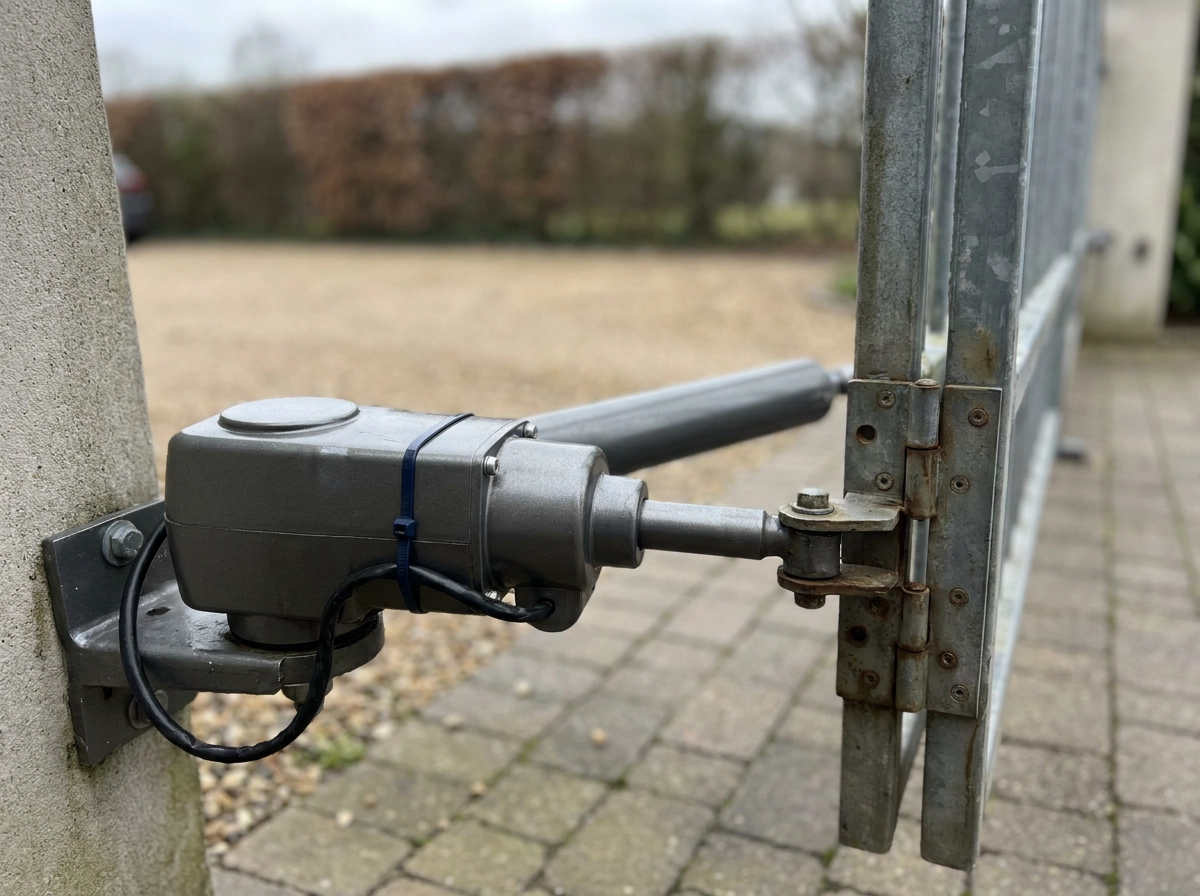
If a bi-fold genuinely suits your driveway, the leaves are only half the specification. The operator must be matched to the gate it will actually move.
More leaves mean more travel per cycle, so the operator's duty rating must be matched to the actual gate specification, not a generic size bracket.
Load does not sit evenly, either. The leaves closest to the hinge post carry the fold, so momentum builds towards the end of travel. Soft start, soft stop and force limiting therefore matter far more than on a single swing leaf, and force limitation is a core requirement of BS EN 12453:2017 rather than a factory default.
In practice, the sequence in which leaves open and close, hold-open time, obstruction sensing and safe reversal should all be configured for the installed gate rather than left at factory defaults. Where the technology permits, the safety function should be monitored before each movement.
Access control belongs in the same system. Intercoms and access control can be integrated with the automation, so the entrance works as a single system. Portara Automation designs, manufactures, installs and automates bespoke gate systems, so that can be handled as one job.
Servicing is not optional. More hinges, bearings and moving parts mean more to inspect, and the interval should come from the installer's schedule rather than a general rule of thumb.
The operator is only as good as what it is fixed to, which is where the hinge line and the ground come in.
Ground, Foundations and the Hinge Line
However well the operator is matched, it can only work with the structure it is bolted to. A bi-fold puts the gate's mass into the hinge posts and along the line the gate runs on. Suitability of the pier or post stops being a detail and becomes the thing that decides whether the gate lasts.
Gate Safe is blunt: where the pier or post is not fit for purpose, the resulting accident is described as inevitable. A powered folding gate places dynamic loads on the hinge post that a previously manual gate was not designed to absorb. Reusing an old pier or post built for a hand-operated gate is a false economy. The HSE's position supports this: mountings and foundations must resist the dynamic forces arising from the weight of the gate as it moves, plus wind loadings.
Practically speaking, the drive surface and sub-base carry the stack and, on some designs, a guide or track; drainage and ground behaviour after rain are therefore worth discussing with your installer. HSE also names rain, snow and debris among the environmental factors that can impair function, which is why puddles and run-off are not cosmetic problems on a folding gate.
Fold count, leaf size and post positions should follow a site survey, not a catalogue page. That is why bespoke fabrication is the norm, with design, manufacture and installation handled by one supplier. Get the structure right and the rest of the installation has a sound basis.
Safety, Standards and Per-Installation Risk Assessment
The current reference set for powered gates comprises BS EN 13241-1:2003 (doors, gates and barriers), BS EN 12453:2017 (safety in use), BS EN 12604:2017+A1:2020 (mechanical aspects), BS EN 12978:2003+A1:2009 (safety devices), ISO 13857:2019 (safety distances) and BS EN ISO 13854:2019 (crushing gaps).
Gate Safe adds the caveat that matters most: adherence to those standards will not meet all the mandatory Essential Health and Safety Requirements (EHSRs) of the Supply of Machinery (Safety) Regulations 2008. They set a floor, not a full compliance route. Its position is that every powered gate must be approached on an individual basis, with a risk-by-risk assessment rather than a checklist. Knowing a gate type meets a standard is not the same as knowing the installation is safe.
That distinction bites hardest on bi-folds. A bi-fold's multiple leaves introduce additional fold-line gaps and reversing points, which means safety distances and crushing-gap limits need to be applied to the actual fold geometry, not assumed from another gate type. That is the author's interpretation of how the general guidance applies; no published standard addresses bi-folds specifically in the research available.
For a bi-fold, then, the answer is not a product claim but a document: a documented, site-specific risk assessment carried out by the installer and applied to the fold geometry in front of them.
What to Ask Before You Buy a Bi-Folding Gate
If the risk assessment is the installer's job, these five questions are yours. Put them all before anyone quotes.
1. Can anything else work? Ask directly whether a workable swing arc or slide run exists on your driveway. If either can, price both properly before a bi-fold is priced at all. A bi-fold is the fallback, not the default.
2. Is the hinge line sound? This is the cost that surprises homeowners most often. Ask whether existing piers and posts are adequate as they stand, or whether new foundations and new posts are needed. Gate Safe's warning about unfit piers is particularly relevant here, as covered in the foundations section.
3. What does the automation include? Get the duty rating, soft start and stop, and obstruction sensing confirmed, not implied. Ask whether intercom or access control forms part of the same system or arrives as an add-on later.
4. What does upkeep involve? More leaves means more hinges, bearings and adjustment points. Ask for the servicing schedule in writing rather than a general reassurance over the phone.
5. How is safety handled? You want a site survey and a specific, documented risk assessment, not a one-line statement about complying with standards.
A specialist that designs, manufactures, installs and automates its own bespoke gates can carry fabrication, automation and access control as a single job, keeping all five answers in one place.
Conclusion: The Decision Threshold in One Page
Before you request a bi-fold quotation, answer one question: which constraint does your driveway actually have? Width, gradient, obstruction, or none at all. That answer decides more than any side-by-side specification table. On a wide, level, unobstructed driveway, a swing or sliding gate remains the simpler and cheaper answer, the earlier comparison covers why.
If the constraint is real, price a bi-fold through a proper site survey. Expect the quotation to include operator specification matched to the gate's duty cycle, ground preparation, and hinge-post or foundation work. These are core costs, not optional extras bolted on later. Be wary of any figure built from dimensions alone.
The standards section explains why a documented, site-specific risk assessment is non-negotiable, insist on one before work starts.