
Which Electric Gate Parts Fail First and What They Cost
See which electric gate parts fail first, what causes the wear, and how replacement and repair costs work for safety edges, hinges, rams and locks.
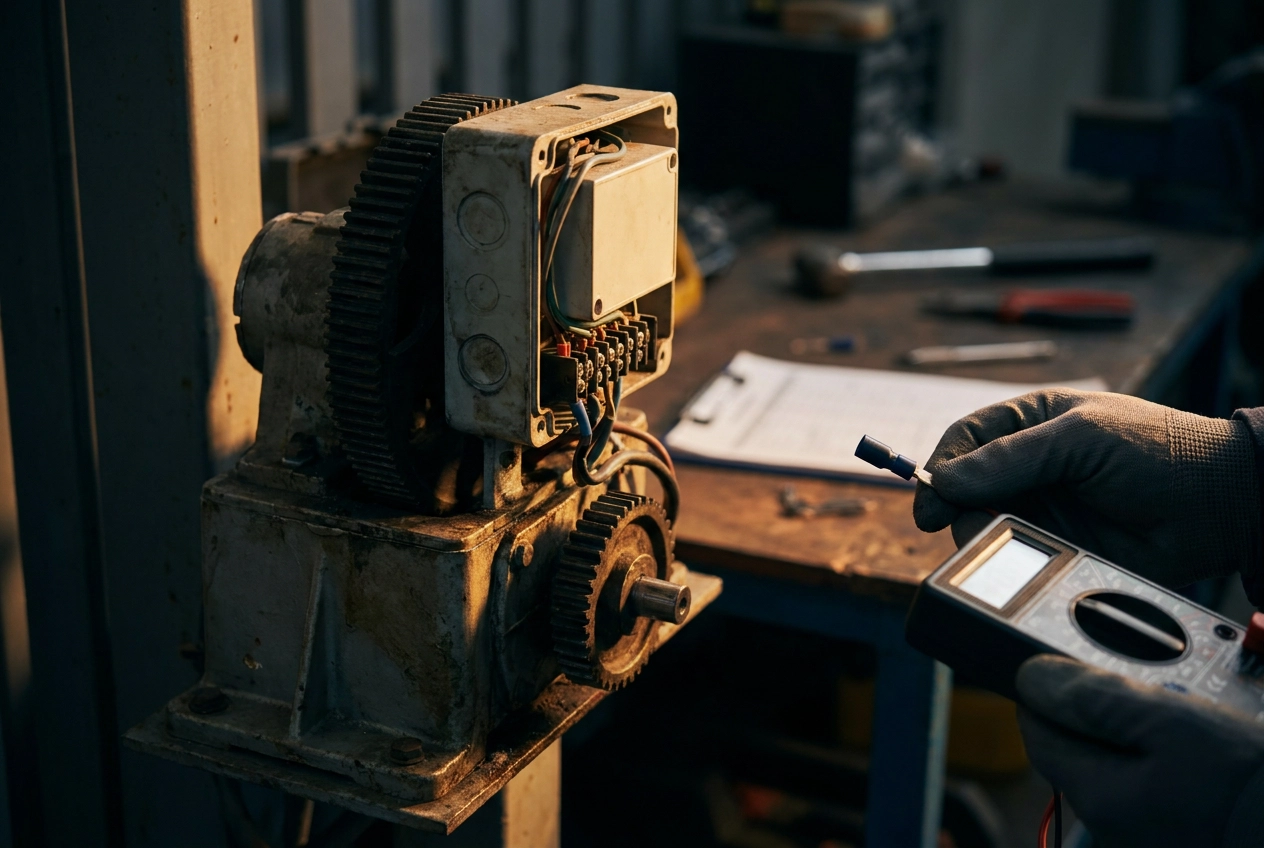
An electric gate rarely fails all at once. More often, a safety edge cracks, a hinge stiffens, a ram loses force, a lock jams, or a control-panel battery fades, and the first symptom looks like a motor problem. Here, electric gate repair becomes urgent: a failed component can alter safety status as well as function. Powered gates are assemblies, and HSE guidance stresses that switches, sensors, safety devices, controllers and motors must be considered together against normal wear, wind, rain, snow and debris. Gate Safe adds that fully automatic gates need at least two safety-device types, with photocells and pressure edges on every gate or barrier.
This listicle maps the parts that fail first, from why components fail before the motor does to how planned repair compares with emergency call-out and how to turn repairs into a schedule. You will read how to interpret failure order, lifespan and cost factors; why safety edge failure cannot be treated as a consumable; how hinges and rollers change gate geometry; when rams, locks and drop bolts wear out; why control-panel batteries and electronics cause expensive call-outs; and what drives repair costs. The aim is simple: turn unavoidable wear into a scheduled, budgeted repair.
Why Electric Gate Parts Fail Before the Motor Does
The motor is rarely the first thing to go. HSE guidance on powered gates is clear that safety depends on how components are combined, and that design must account for normal wear and tear plus adverse environmental influences such as wind, rain, snow and debris.
In practice, failures cluster around a short list of consumables: safety edges, hinges and rollers, electric gate rams, locks and drop bolts, and control-panel batteries. The drive motor usually outlasts all of them.
A failed part does not simply stop the gate. It can change the gate's safety status. A tired hinge or an unresponsive safety edge matters far more than a noisy motor, because crushing and trapping risks sit with geometry and detection, not with the drive.
Exposed and coastal sites across East Sussex, West Sussex and Kent see more wind-driven debris and salt-laden air, so two identical gates on the same road can wear at different rates. Our Common Electric Gate Faults We Repair page covers the failures we see most often.
This piece sets out which parts go first, what replacement involves, and how the cost of an electric gate repair is really built up.
How to Read This List: Failure Order, Lifespan and Cost Factors
The order below reflects how often each component appears in repair work, not how dangerous it is. Safety edges are the deliberate exception: they sit outside the routine wear sequence because a failed edge is a compliance problem rather than a consumable to run down.
No two gates share a lifespan. Cycle count matters most, followed by leaf weight and leaf length, drive type, siting, and whether the gate is serviced at all. The same drivers behind the components that degrade fastest and why apply here.
Cost follows similar logic. Component type sets the baseline, but a like-for-like swap and a re-design price very differently. Access adds labour, and a failure that has already damaged the frame, post or control panel adds parts nobody planned for.
Treat any lifespan or price figure you find online as a starting point to check against your own gate's service history, never as a promise about your installation. Where a number cannot be traced to manufacturer data or named trade guidance, this article explains what drives it instead of quoting one.
Gate Safety Edge Failure: The Component You Cannot Treat as a Consumable
Safety edges earn their own entry because they are not a wear item you can postpone. A gate safety edge, also called a pressure edge, is a contact safety device that detects an obstruction and stops or reverses the gate before it can crush.
Gate Safe guidance states that anyone installing a powered gate must comply with the Supply of Machinery (Safety) Regulations 2008. A fully automatic gate should have at least two types of safety device, and photocells and pressure edges should be fitted to every gate or barrier. That guidance is explicit that force limitation alone is not acceptable where safety edges are not relied upon, and that non-contact safety should always be prioritised. It also makes what safety devices will be installed, and why that combination matters a fair question for any installer.
EN 12453 caps force at 1400N for reducing gaps over 500mm and 400N at 500mm or less, with force required to fall to 150N within 0.75 seconds and 25N within five seconds. A dead edge can take a gate outside those limits. Treat it as a compliance matter to diagnose and resolve, never as a budget swap.
Hinges and Rollers: The Wear Points That Change Gate Geometry
Wear here is slower than an edge failure but harder to spot. Hinges and rollers carry the full weight of the leaf, so the first signs are sag, drop and dragging. By the time anything looks broken, the geometry has usually been shifting for months.
The consequences are regulatory, not cosmetic. HSE prosecutions following the 2010 Bridgend and Manchester child deaths cited reducing gaps at hinges, untested operating force and structural integrity, and maintenance companies were among those prosecuted in the trade coverage of those cases. Reducing gaps at hinges are a named crush-risk area under EN 12453, so a leaf that has dropped slightly is a compliance issue.
The DHF code of practice TS 013-1:2021, second edition published August 2022 and incorporating EN 12453:2017+A1:2021, lists hazard controls including safety distances, guards and enclosures, and structural integrity. Every one of them depends on hinges and rollers holding geometry.
Replacement cost varies with hinge type (adjustable, bolt-on or weld-on), gate weight, and whether the frame or post has been damaged by months of misalignment. Repairs to the gate itself rarely end at the hinge.
Electric Gate Rams: When the Drive Itself Wears Out
Electric gate rams are linear actuators that push and pull the leaf. On most residential swing gates, linear ram actuators do the work. They usually fail at the seals and glands, or at the end of stroke, rather than stopping dead one morning.
Early signs worth acting on: sluggish movement, oil weeping from the ram body, uneven travel, and a gate needing a hand to get moving.
Wear is driven by cycle count, leaf weight against the ram's rated duty, and continuous rain and wind loading, the environmental influences HSE guidance expects a gate design to account for.
Cost depends on stroke length, force rating, whether rams are replaced as a matched pair, and whether the control panel needs re-commissioning. Underground and articulated operators are a different job again.
Replace before total failure. A seized ram can overload the control panel and turn a single-component repair into a system-wide one, which is exactly what the smaller locking parts below can do as well.
Locks and Gate Drop Bolts: Small Parts, Big Security Consequences
Unlike a ram, which moves the leaf, a drop bolt simply holds it. A gate drop bolt is a ground-engaging locking pin that secures a leaf in the closed position. Electric and solenoid versions release automatically when the drive starts, so the gate never fights its own lock. You can compare types of electric gate lock for how these fit alongside other locking options.
Watch for the pin sticking in its ground socket, misalignment after the gate has dropped, a buzzing solenoid, or the gate trying to run while still locked. Wear comes from ground movement, grit and debris in the socket, and repeated impact when the leaf does not land squarely.
Parts are rarely the expensive element. The real cost sits in re-aligning the leaf and re-integrating the release with the intercom or access control so the timing is correct. A lock failed open is a security failure; failed closed, it can trap a vehicle and force a manual release. Both need prompt attention.
Control-Panel Batteries and Electronics: The Cheap Part Behind Expensive Call-Outs
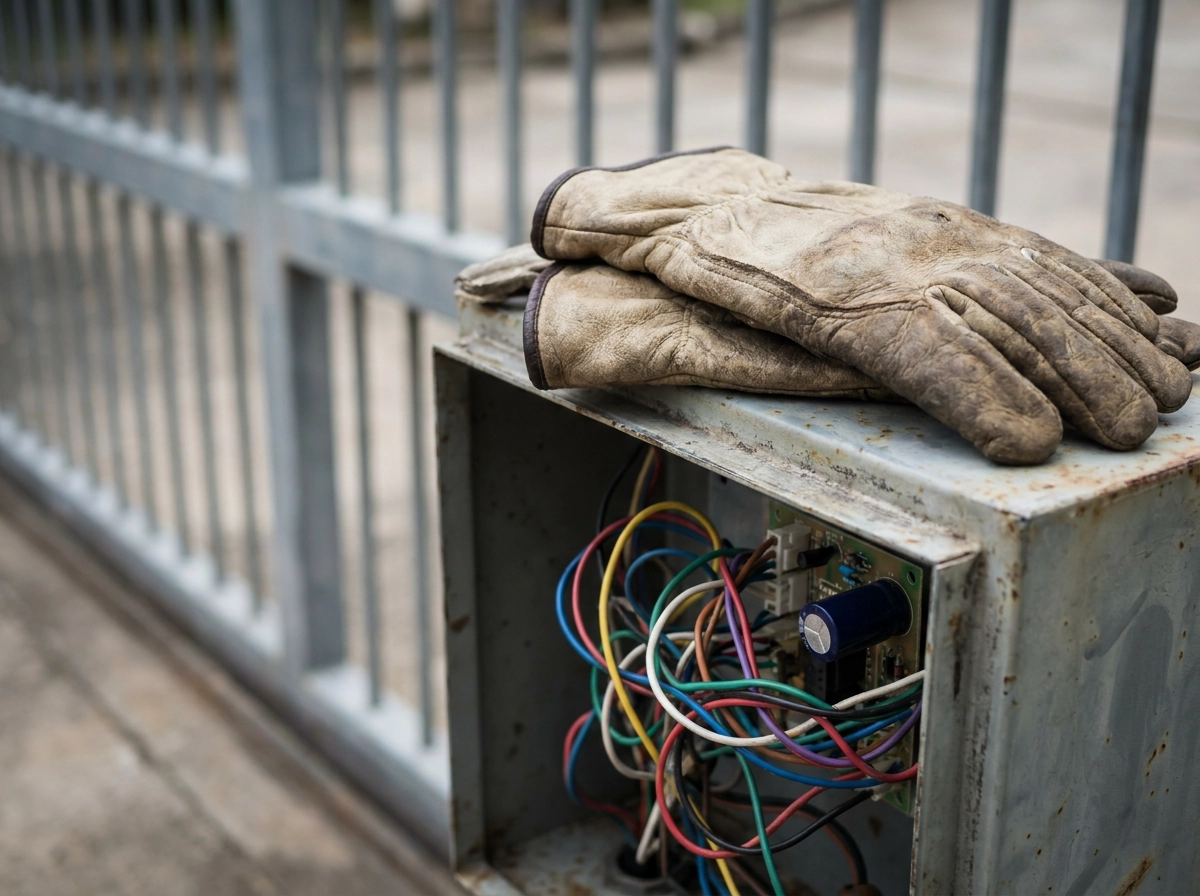
Unlike a stuck drop bolt, a control-panel backup battery fails quietly. It keeps settings, clock and safety logic alive through power cuts. When it goes flat, the gate may forget its limits, open erratically, report phantom safety-device faults, or beep from the panel. Those symptoms look expensive, but the battery itself is inexpensive. Cold weather and frequent short power interruptions shorten its life. A flat battery can also mask a genuine safety edge or photocell fault, so replacing it without testing what it hides is false economy. Receivers, photocells and transformers routinely get blamed for battery faults. Diagnosis must come before parts are ordered. On a service visit, the real value is testing safety devices, re-checking force settings against commissioning figures, and confirming the gate still meets its original safety setup. A systematic check of control panels and electrical faults turns a panic call-out into a planned repair. If the panel is beeping, book a diagnostic visit rather than ordering a receiver.
What Really Drives the Cost of an Electric Gate Repair
Battery faults often look dramatic, yet the part rarely accounts for the bill, and that pattern holds across every component above.
Parts are usually the smaller half of an electric gate repair bill. Labour, site access and re-commissioning dominate, which is why two identical-looking faults can price very differently.
Access matters. A gate behind planting, on a slope or over block paving takes longer to reach and work on than a clear roadside gate with space to swing the leaf. Electric Gate Costs: What Affects the Price? explains how site factors shape a wider gate budget.
Like-for-like replacement is cheaper than a re-design. Re-design becomes common where a part has gone obsolete or a gate has been modified repeatedly over the years.
Re-commissioning is not optional. Any change to a safety-related part means operating force should be re-tested against EN 12453 limits rather than assumed. That testing is part of the repair, not an extra.
This article quotes cost drivers rather than prices. Until figures are verified against manufacturer data or named trade guidance, a number would be a guess, not advice.
So the real question for any electric gate repair is less about the part and more about when you book it.
Planned Repair vs Emergency Call-Out: The Servicing Argument
Cost drivers explain why prices vary. Timing is the variable you control. A gate that is still running when it is serviced can be repaired on a planned visit, with parts ordered ahead and access booked in advance. Hinges, safety edges, rams, drop bolts and control-panel batteries get caught at that point rather than at the point of failure.
The regulatory record makes the case. After the 2010 child deaths in Bridgend and Manchester, HSE prosecutions extended to manufacturers, installers and maintenance companies, with failures including reducing gaps at hinges, untested operating force and structural integrity. Documented, scheduled inspection is therefore a risk control, not an upsell.
Gate Safe promotes training and accredited installers. A proper service tests safety devices, checks operating force and inspects structure, rather than simply lubricating moving parts.
Portara Automation designs, manufactures, installs, repairs and services electric gate systems across East Sussex, West Sussex and Kent, so the specialist who knows the installation can carry out the repair. Planning the work is what keeps an electric gate repair compliant and the budget predictable.
Conclusion: Turn Gate Repairs Into a Schedule
A schedule only pays off if it is consistent. Book one annual inspection where hinges, rollers, safety edges, the drop bolt and the control-panel battery are all checked in the same visit, and record what each check found.
Test the safety edge and photocells deliberately rather than waiting for a fault to announce itself. Any change in gate speed, sag or stopping position is reason to book an inspection, not to watch and wait another week.
Keep a written history of parts replaced and the dates they were fitted. After two or three years, general lifespan guidance becomes specific to your gate, and you can order the next ram or battery before it fails rather than after.
That is the shift this article has argued for: planned replacement instead of emergency repair. Choose a specialist who can service and repair the whole system, not one who can only swap what has already broken.
Set the date, record the findings, and let your gate's own history decide what comes next.