
Wireless Gate Intercom or Wired? Long Driveway Cable Runs
Wireless or wired gate intercom? How trenching, cable distance, power and listed building consent decide the right choice for a long driveway.
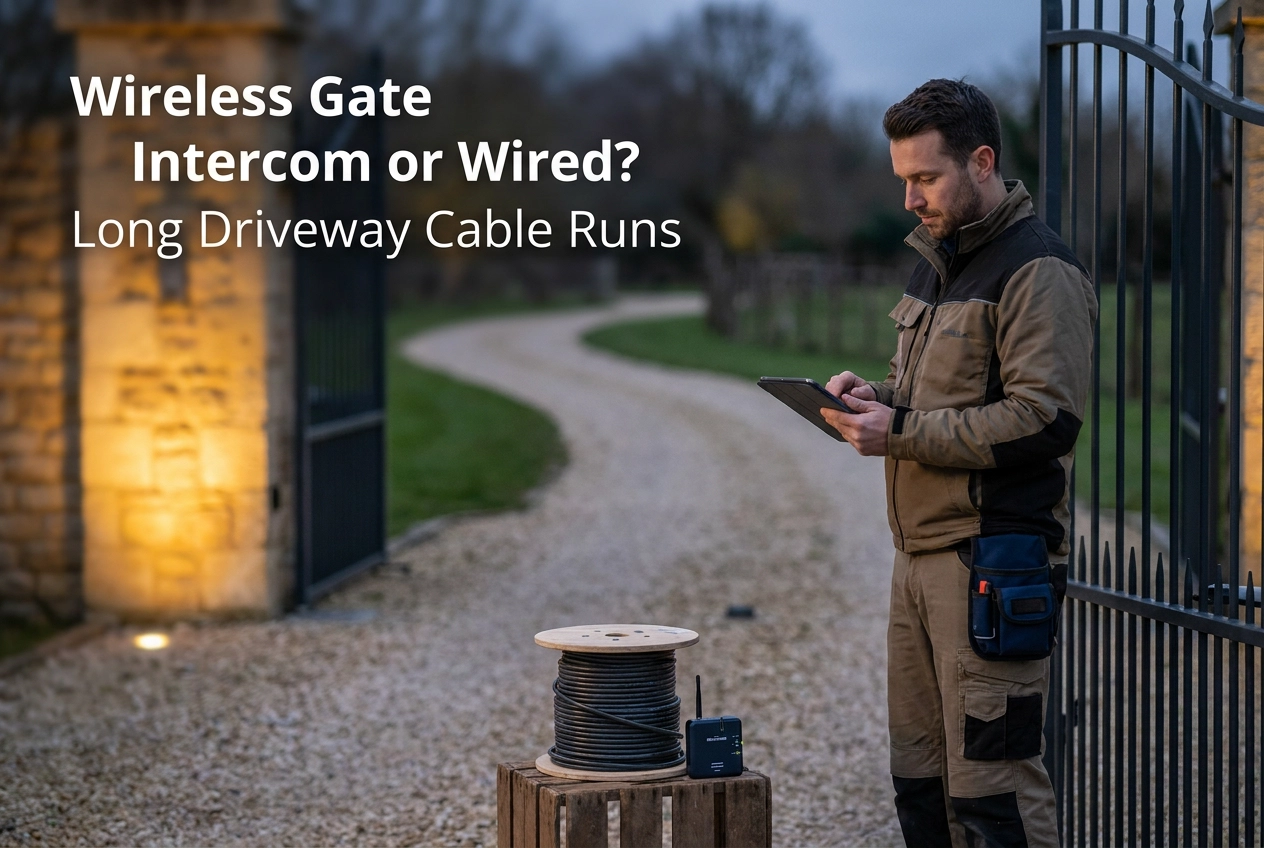
Choosing a gate intercom should not begin with a spec sheet. It should begin with your driveway. Before you compare handsets, apps or audio quality, you need to know whether you can dig a trench, how far the gate sits from the house, and whether listed-building or conservation-area rules restrict new cabling. These site conditions decide whether a wireless intercom for gate use is a practical solution or a compromise, and whether a hard-wired system justifies the excavation. This comparison avoids another product round-up. It explains why a site survey matters more than specifications and walks through the three questions that settle the choice: Can you trench, and what must protect the cable? How far is the gate, and what lies between house and gate? Is the property listed or in a conservation area? You will also see when wireless is the right answer despite battery, range and latency compromises, when wired is the honest answer, a side-by-side summary, how Portara surveys intercom routes across Sussex and Kent, and the final three-question decision rule.
Why a Site Survey Decides, Not the Spec Sheet
This is an installation-feasibility comparison, not another intercom round-up. The question is not which product has better numbers, but whether a cable and a power supply can physically reach your gate. Specification sheets describe what a system does once it is installed. They say nothing about reinstating block paving, crossing a soakaway, or running mains to a pillar 90 metres from the house.
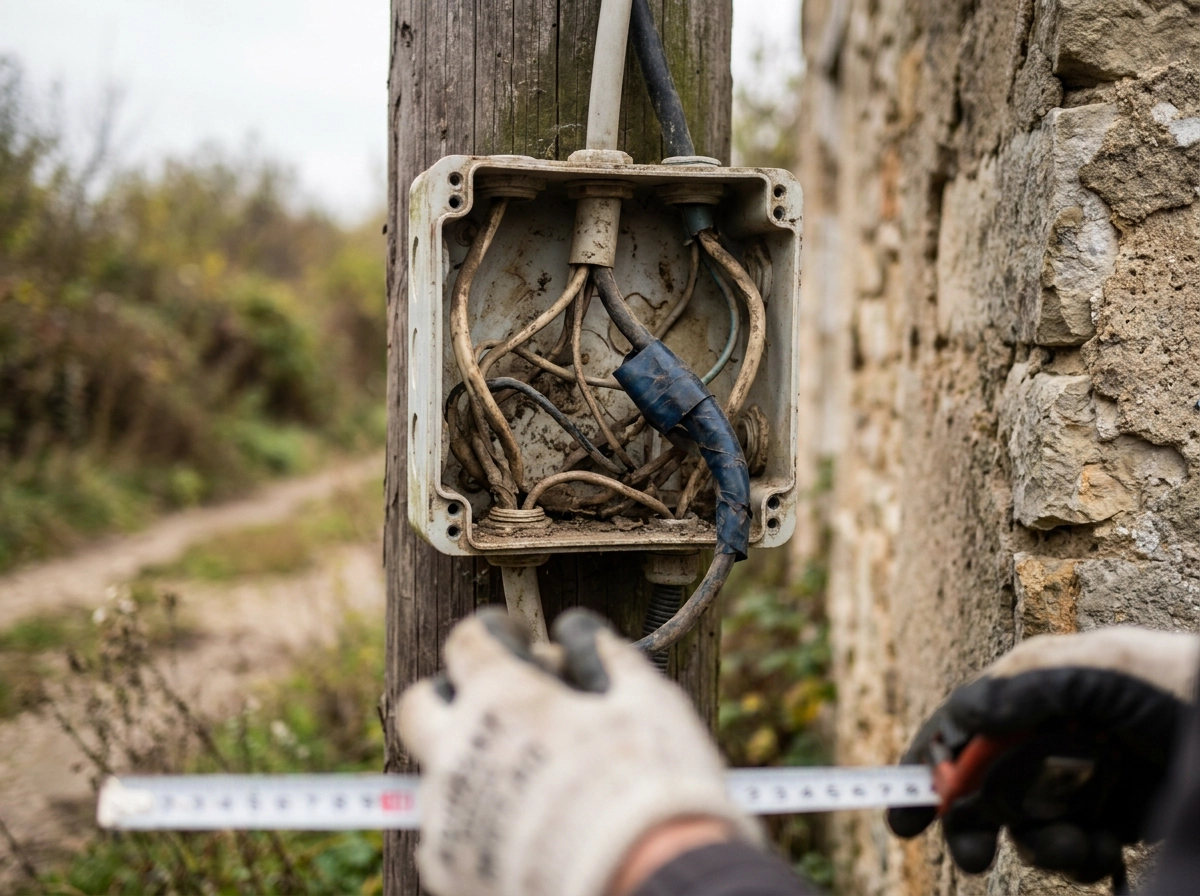
Three questions settle the wireless versus hard-wired decision on almost every long driveway:
Can you trench, and what has to go in the trench?
How far is the run, and what sits between house and gate?
Is the property listed or otherwise constrained?
Answer them and the choice usually makes itself. Where the ground takes a duct and mains reaches the gate line, hard-wired is more predictable. Where trenching is impractical, the driveway is very long, or the property is listed, a wireless gate intercom link earns its place.
Our practical decision framework sets out how to work through the answers.
Question 1: Can You Trench, and What Has to Go in the Trench?
The first survey question is blunt: can a duct reach the gate line, and what will it cross? If it cannot, a wireless gate intercom moves up the list.
Buried cable needs mechanical protection. IET Wiring Matters guidance notes that unarmoured cables such as HO7RN-F or unarmoured XLPE must have sufficient protection when buried, and asks whether any conduit or duct matches what armoured cable provides. That article is written around PV and EV wiring, but the principle applies to an intercom run trenched to a gate. It cites Regulation 14(2) of the Electricity Safety, Quality and Continuity Regulations (ESQCR) 2002 and the Northern Ireland equivalent; read the full, current text before quoting it.
The survey is archaeology as much as engineering. Tarmac, block paving, mature hedging, tree roots, land drains, soakaways, irrigation lines and existing services each change the cost and route. A trench rarely carries one cable: gate power, the intercom feed, video or network, gate control and possibly driveway lighting may share the route, affecting duct size and depth. Check 3: Power, Cabling and Connectivity on Site covers that coordination.
Voltage drop, the loss of voltage along a cable as length and load increase, must be calculated for the actual run. On a long low-voltage feed it can fail the design, not the intercom.
Question 2: How Far Is the Gate, and What Sits Between House and Gate?
Trenching settles the cable question. It does not tell you what the signal must survive en route to the gate, or whether power can reach it at all.
No universal distance makes a wireless gate intercom necessary, so treat any quoted figure with suspicion. Distance is one variable among several, and the threshold is a site-survey judgement, not a specification.
Radio performance depends on what the link passes through. Obstructions such as stone walls, metal structures and outbuildings are known to affect wireless signal quality; the survey should test the actual link at the gate.
In practice, power availability at the gate end is often the more immediate design constraint, if mains has not been run to the gate for automation, any intercom installation must address that first. Where mains already reaches the gate line for automation, the wired case strengthens.
Battery management, range and latency are real categories of compromise, and the survey should quantify each for your property. The number that matters is measured on your driveway, not printed in a brochure.
Latency and call quality are worth testing on site, particularly on video intercoms where a delivery driver will not wait while a connection negotiates. Test the link from the gate, not from the kitchen.
One further constraint can override both: the status of the property itself.
Question 3: Is the Property Listed or in a Conservation Area?
Distance and obstructions are only part of the picture. On older properties, the ground itself may be protected, and that can outweigh any radio or cabling consideration.
Historic England publishes technical guidance on installing new services and on installing equipment, cabling and pipework in heritage contexts. Check its current wording and confirm how it applies to your property type before treating it as advice for your site.
Listed building consent and conservation area matters normally involve the local planning authority. The survey should identify what is likely to need consent, including new posts, brackets, gate-mounted equipment and any new power feed. Our guide to planning permission and gate safety regulations explains the wider consent framework.
In heritage contexts, it is good practice to favour reversible, visually discreet solutions, and your conservation officer or local planning authority is the right authority on what will be acceptable for your specific property. Surface routing that can be removed later, or a wireless link that avoids disturbing historic ground, often sits more comfortably than a deep trench.
Wireless is not automatically permission-free. A new post, a cabinet, a modified gate leaf or an added power supply can all raise consent questions, particularly on a listed structure.
Finally, record what is installed and how. A future owner or the conservation officer can then see what was added and reverse it if required. Where heritage constraints point to a reversible solution, the wireless case strengthens, which leads to the next question.
When a Wireless Gate Intercom Is the Right Answer
Where heritage consent or an untouchable surface has already ruled out a deep trench, wireless stops being a compromise and becomes the practical answer. Where all three conditions apply, wireless is the practical choice.
Where the route would cross paving, planting or a heritage surface, as established under Question 1, avoiding a trench removes a significant share of the civil work.
The trade-offs are the point of the comparison. You should expect to manage a battery routine at the gate end, and link quality will depend on, and should be measured through, the structures between house and gate. Latency on audio and video calls is a factor worth testing on site. The survey should verify performance at the gate itself rather than at the front door.
To see how the intercom fits the wider entry design, read matching entry options to how you live.
When a Hard-Wired Gate Intercom System Is the Honest Answer
Hard-wired earns its place when none of those three conditions applies. Continuous mains power at the gate end removes the need for any battery management at the gate end. A dedicated cable keeps audio and video performance consistent, independent of radio conditions, as discussed under Question 2. And because the duct and power are already there, a properly specified duct can be sized from the outset to accommodate future access control, additional call points or gate lighting, making it worth planning that capacity into the original trench.
What changes is where the budget sits. Trenching, ducting and the mechanical protection buried cable needs are design inputs, not optional extras, so price the ground before comparing intercoms.
If you are weighing an upgrade to an existing entrance rather than a new installation, our guide to Getting the Most from Your Gate Intercom Upgrade explains how much existing infrastructure can be reused.
Wired vs Wireless Gate Intercom: The Three Questions Side by Side
If the hard-wired case above fits your site, the next step is to see how the three questions interact. Weigh them side by side:
Question
Wired
Wireless
Trenching
A feasible route with protected cable favours wired.
An impractical or blocked route favours a wireless gate intercom.
Distance and obstacles
Existing power at the gate and a clear route favour wired.
No power, very long runs and obstructing structures push towards wireless.
Listing and heritage
Consent confirmed first; reversible surface routing may allow wired.
A listed property or sensitive surface favours reversible, surface-routed or wireless options, with consent confirmed first.
A table cannot confirm the fourth column: the actual route, whether mains can reach the gate, and any consent requirement. Those are site survey findings. Treat this grid as a decision aid, not a verdict. Plan the intercom and access control integration around the split the survey reveals. The survey supplies the missing values.
How Portara Surveys Intercom Routes Across Sussex and Kent
A decision table can point you in a direction; only a site visit confirms it. Portara Automation designs, installs, repairs and automates electric gate systems, access control and intercoms for residential, commercial and agricultural properties across East Sussex, West Sussex and Kent.
Because Portara also offers bespoke metal fabrication and CNC plasma cutting, the gate pillar, mounting arrangement and equipment housing can be designed around the cable route or the wireless link rather than the other way round. Equipment is made to fit the entrance, not forced onto it.
That flexibility extends to upgrades. Existing manual gates that still work perfectly well can be automated and connected, which matters where the driveway already does its job but the entrance technology does not.
The survey then settles the three questions in order:
Trenching feasibility and the protected route.
Power availability at the gate line.
Any listed building or conservation constraint.
Equipment is chosen only once those answers are on paper.
Specifics come from the site visit itself. This section deliberately quotes no range, battery or distance figures, because those numbers belong to your driveway, not to a general guide. The next step is the decision rule those answers feed.
Conclusion: The Three-Question Decision Rule
First, can you trench, and can the cable be properly protected? If yes, and mains can reach the gate line, a hard-wired gate intercom system is usually the more predictable choice across its working life.
Second, how far is the gate, and what sits between house and gate? Where there is no power at the gate and the run crosses structures, a wireless gate intercom is the practical answer, and the survey should measure the link at the gate rather than estimate it from the kitchen.
Third, is the property listed or otherwise constrained? If it is, favour reversible, visually discreet options and confirm what needs consent before anything is ordered.
Where the answers disagree, expect a mixed design. Wired where the ground allows, wireless where it does not, is a normal outcome on a long driveway.
Have the survey done first. The decision belongs to the site, not to the spec sheet, and Portara Automation can carry it out across East Sussex, West Sussex and Kent.