
Wooden Gate Automation: Why Steel Specs Don't Transfer
Timber gates can be automated, but hinge loading, seasonal movement and torque mean the drive, fixings and safety devices need their own spec.
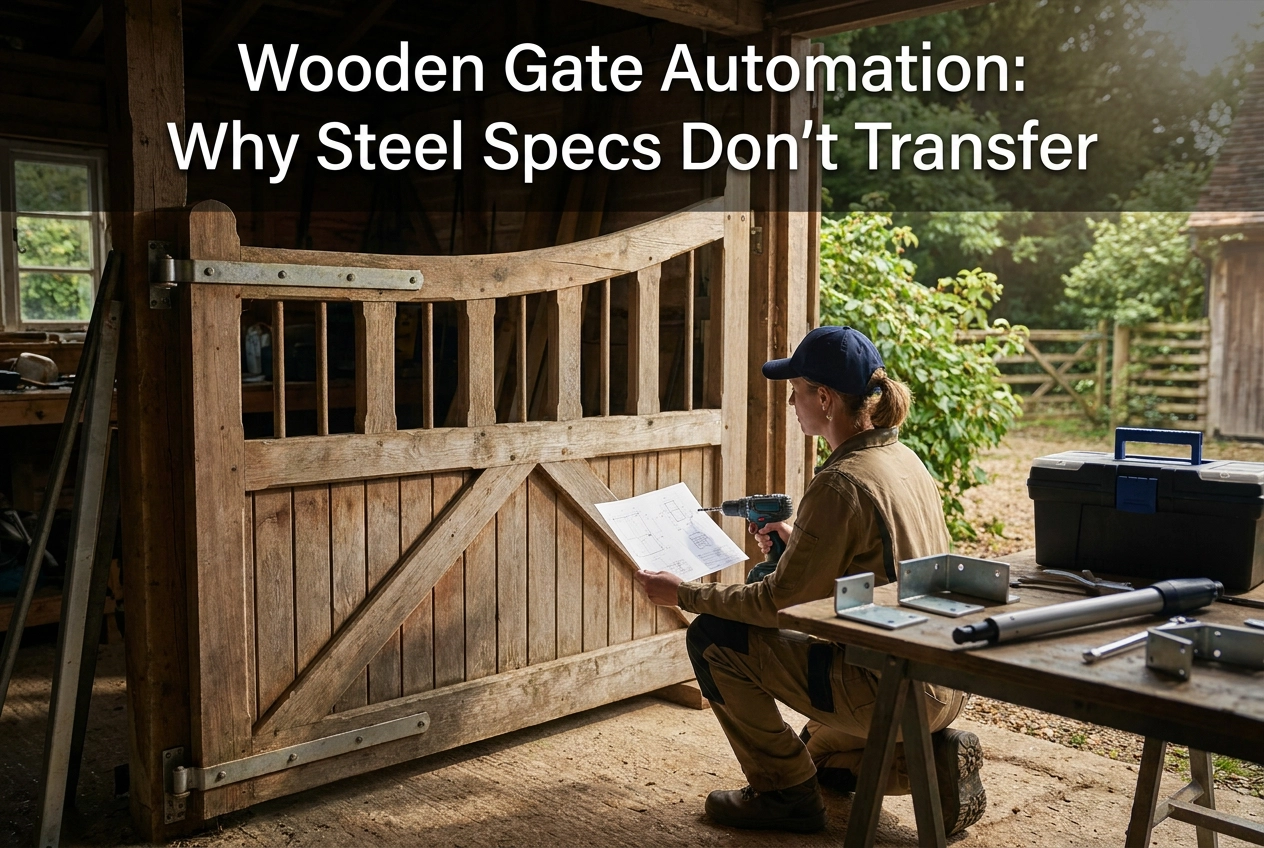
If you own a timber gate and assume automation is a like-for-like swap with a metal-gate install, the first surprise will be the specification. Steel behaves predictably. Timber does not. Wooden gate automation can succeed, but only when the drive, fixings and safety devices are chosen around how the timber actually moves, loads and flexes, not around a standard steel package.
This guide takes a materials-first approach. It concedes where timber is the wrong substrate and explains why hinge loading changes the load path, how seasonal movement makes a leaf grow and shrink, and why operator torque must be matched to a flexible leaf rather than a rigid one. You will also work through what the standards require, what fixings and posts are really holding, how force limits and testing apply to a leaf that flexes, and how to specify safety devices on electric swing gates in timber. Finally, you will see when the honest answer is a new gate, what a timber gate survey should cover, and how to get wooden gate automation right.
Why Wooden Gate Automation Is Not a Like-For-Like Swap
Most owners approach wooden gate automation as a like-for-like swap: same drive, same brackets, same safety package, bolted to timber instead of steel.
The difference is not the operator but the substrate. Steel transmits load straight into the frame; a timber leaf absorbs it, changes size with moisture and holds fixings in a very different way. An existing timber gate was also built to hang and swing by hand, never designed around the reaction forces a motor applies at start-up, at reversal or while holding the leaf.
Timber gates can be automated well, but only when the specification is built around that individual gate. For some, replacement is the honest answer. The rest of this piece covers hinge loading, seasonal movement, operator torque, fixings and posts, force testing, safety device placement and the replace-or-retain judgement. Our guide to automating an existing manual gate sets out the wider retrofit process.
The driver throughout is a risk assessment, not a parts list. HSE guidance stresses that powered gate safety depends on how components combine for a particular installation.
What the Standards Require, Timber or Steel
BS EN 12453 sets safety-in-use requirements for power-operated gates in industrial, commercial and residential premises, including areas within reach of people, so it covers domestic timber swing gates as much as steel ones (UK gate standards).
Force limits, as summarised by the Door Industry Journal, cap at 1400N for gaps wider than 500mm and 400N at 500mm or less, decaying to 150N within 0.75 seconds and 25N within five seconds.
Check the current version before citing it. BSI lists BS EN 12453 as Current, Under Review, while trade coverage refers to a 2017 version and a later amendment exists.
Gate Safe adds the strongest caveat: meeting the standard does not satisfy all mandatory Essential Health and Safety Requirements under the Supply of Machinery (Safety) Regulations 2008. Every powered gate still needs a risk assessment and a post fit for purpose.
HSE safety bulletin FOD 7-2010, issued 2 September 2010, expects installers to measure opening and closing forces with test equipment, reverse on contact, fit photoelectric beams, protect trapping points, provide an emergency release and leave a CE-marked technical file.
Hinge Loading: Where the Load Path Changes
Hinge loading is the leaf's weight plus the dynamic forces the operator introduces, all travelling through the hinges and into the post or pier behind them. That load path differs by material. A steel gate fixes through welded brackets and bolted plates into a known material. A timber gate usually takes fixings only as deep as the post allows, into grain that is softer in one direction than another and moves with moisture.
Many existing timber gates hang on strap or T hinges selected for occasional hand operation. Automation raises cycle counts and adds powered start-up and reversal loads, shortening the service life of hardware never sized for it. Enforcement reflects the risk: the Door Industry Journal records prosecutions involving unprotected hinge area gaps, untested operating force and failures to achieve structural integrity. Hinge zones warrant the same attention as the gate edges.
Assess on site with the leaf in place, checked in cold and warm conditions. No universal timber load figure is published, and gate type and weight drive everything downstream.
Seasonal Movement: A Timber Leaf Grows and Shrinks
Timber does not hold the shape you assess on the day. Wood adsorbs moisture in humid air and loses it when dry, so a leaf and its post swell and shrink across the year (Purdue extension guidance). A gate that swings clear in a dry July can foul the post or scrape the ground after a wet winter.
Movement reshapes the geometry the operator works with. A closed gap that satisfied a safety device at commissioning can widen or tighten, shifting trapping points and misaligning beams.
Movement is rarely even across a leaf, joints, board orientation and finish all influence how a leaf responds, so inspect for twist and sag rather than assuming uniform shrinkage. A leaf that no longer hangs square must be corrected before a drive is added. Binding here is a common fault path; see our guide to diagnosing a gate that opens but will not close.
Watch the gate over more than one season, specify adjustable hinges, and build tolerance into the closed position rather than a hairline fit.
Treat seasonal adjustment as part of ownership, and let the installation allow re-setting rather than a single final set-up.
Operator Torque Against a Timber Leaf
Seasonal movement settled, the next question is torque: the turning force the operator applies at the hinge to start the leaf, keep it moving, hold it and reverse it on contact.
Timber changes the answer. A timber leaf is usually lighter than a steel frame of the same size, but softer and less rigid. Brackets compress, fixings bite unpredictably, and a long leaf flexes under load instead of passing torque into the hinge.
Weight, width and hinge position set the requirement. A drive sized for a rigid steel gate of similar width can be under-specified once the leaf deflects rather than transfers force.
Force decay suffers too. The force measured at the leaf edge can vary across the arc, so meeting the required decay limits takes deliberate set-up and on-site measurement, not a factory default.
Specify from measured leaf data and the operator manufacturer's own limits, not a kit matched on width alone. Choosing the right electric gate opener starts with the same measurements.
Fixings and Posts: What Gate Automation Is Actually Bolted To
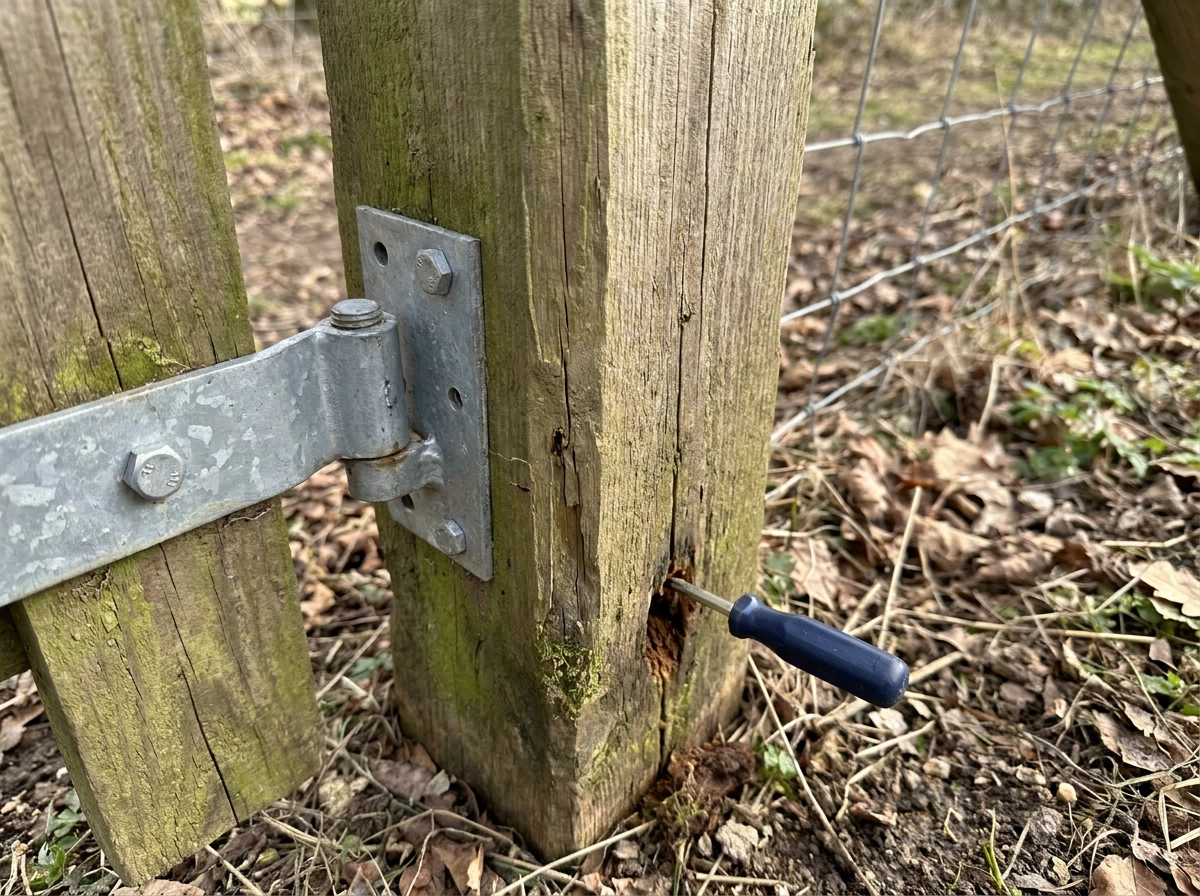
Torque ultimately lands somewhere, and on timber that is a bracket fixed to a post. Every automation bracket is only as strong as the material it fixes into. Species, section size, grain direction, moisture content and remaining sound timber determine whether it holds. Probe the post at ground level, the zone most exposed to moisture, and along the hinge mortises before assuming the bracket will hold.
Fixing into timber requires attention to grain direction and available depth; through-fixings with load-spreading plates are generally more reliable than short screws into soft grain. Consult a structural timber reference or the fixing manufacturer's technical data before specifying. Anchoring into solid structure matters more than screw count. Ground fixings and gate stops carry reaction forces too: a drive that pushes the leaf needs something to push back against, so the post must be stable in both directions. Post Material and Sizing for Automated Gate Loads explains how that support is specified.
Where a post is not fit for purpose, the honest options are a new steel post, reinforcement of the existing gatepost, or a different anchoring arrangement. Gate Safe's requirement that the pier or post be fit for purpose is the standard to test any of these against.
Force Limits and Testing on a Leaf That Flexes
With posts and fixings settled, the question becomes how much force the gate may exert, and how that is proven on site. The force bands set out above, 1400N and 400N by gap size, decaying to 150N then 25N, must be proven on site, not assumed. A datasheet figure or a control board setting is not a recorded measurement; only instrumentation is. See safety device testing and force measurement equipment.
A timber leaf is not a rigid test surface; any deflection in the leaf under load means measurements at different points may not agree, and the gate's behaviour changes across seasons. The test is a snapshot that must be repeated.
Where adjustment alone cannot meet the limits, add force limitation alongside contact and non-contact sensing, then re-test after every adjustment or seasonal change. Untested operating force features in the prosecutions cited by the Door Industry Journal, making a written force test record one of the cheapest safeguards on the job.
Specifying Safety Devices on Electric Swing Gates in Timber
Force testing is only half the package; the placement of protection matters just as much.
Map the hazards on a swing gate: the hinge side gap between leaf and post, the closing edge between the two leaves, and where the leaf approaches a fixed object or wall. Those tighter force limits for gaps of 500mm or less, noted earlier, mean narrow hinge-side clearances on timber gates often need active protection.
Mount photoelectric beams, safety edges and other sensing on structure that does not change size: posts, piers, walls, ground. Never span a leaf that grows, twists and sags. Re-tensionable, realignable mounts suit timber better than rigid brackets, and through bolts with load spreading plates hold more predictably than short screws into grain. For the wider choice of gate type, see Swing Gates vs. Sliding Gates: Which Design Suits Your Driveway?.
Then the non-electronic parts FOD 7-2010 expects: reachable emergency release, marked trapping points, and a technical file with CE marking and force test records.
When the Honest Answer Is a New Gate
With the safety package settled, one question remains: should this gate be automated at all? Both regulators treat replacement as a legitimate risk-assessment outcome, not a failure. Replacement is therefore a judgement against the risk assessment, not a value that crosses a fixed line.
Based on structural assessment, three conditions typically push toward replacement rather than retention: a post that cannot realistically be made fit for purpose, a leaf that has lost rigidity or splits along its joints, and hinges that cannot be upgraded for powered loads. No sentence here implies these are regulatory thresholds; they are practitioner signals.
The cost argument matters: if the drive sits on a leaf needing repeated repair, re-hanging and re-adjustment, a properly rated gate often costs less over its working life than keeping a struggling timber gate moving.
Retention works where posts and piers are sound, the leaf hangs square and swings freely, hinge positions can be strengthened and gaps can be brought within the force bands.
Replacing need not mean steel. A bespoke gate built to suit the operator, whether a timber frame fabricated for automation or custom metal fabrication, keeps timber on the table.
What a Timber Gate Survey Should Cover Before Automation
Where a gate survives that judgement, the survey decides the specification. Measure the leaf first: width, thickness, weight and hinge positions, then check square, twist, hang, ground clearance and closed gap. No drive should be discussed before those figures exist.
Inspect posts and piers properly, including timber near ground level, and trace the load path from every hinge and drive fixing point into whatever holds the post. Record hinge-side and closing gaps in millimetres; these set the force band that applies and the safety devices required.
Ask about usage and exposure: cycles per day, wind loading, and coastal or exposed conditions across East Sussex, West Sussex and Kent, all of which govern how fast the timber and its hardware move and wear.
Cover the control side in the same visit: power availability, control panel location, intercom or access control needs, and how the emergency release will be reached.
Portara Automation designs, manufactures, installs and repairs bespoke electric gate systems and automates existing manual gates across East Sussex, West Sussex and Kent.
Getting Timber Gate Automation Right
Those findings feed one judgement: a timber gate can be automated well, but not as a like-for-like swap with a metal install. The leaf, post and fixings carry load differently, so the drive, brackets and safety devices must be specified around that behaviour.
The standards and risk-assessment framework set out above remain the method.
Before committing, settle four questions: can the posts and piers be made fit for purpose; how does the leaf behave across seasons; can the hinges carry powered cycles; and can the force bands be achieved and measured on site?
Where those tests cannot be met without repeated repair, replacement is often the more durable and cheaper answer, and a bespoke gate built for automation still leaves timber on the table.
Have the gate surveyed by someone who assesses the structure, not just quotes for a drive.
Conclusion
Automating a timber gate is a structural and safety decision, not a simple swap. The leaf, post, hinges and fixings carry load differently from steel, so the drive, brackets and safety devices must be specified around that behaviour. All the technical factors above come down to one practical step. Have the structure assessed first, then automate with confidence.